.png)
• Retail banks successfully acquire millions of new customers every year, yet many customers never actively use the products they sign up for.
• Customers frequently enroll in savings accounts, credit cards, digital banking tools, rewards programs, and financial dashboards but never fully activate them.
• Global banking churn averages 17.6%, showing that many customers disengage shortly after joining a financial institution.
• In India, 35% of bank accounts remain dormant, highlighting the gap between account creation and meaningful financial engagement.
• Digital adoption may reach 85%, but activation falls to 62%, meaning a large portion of customers never start using core banking features.
• Traditional banks experience roughly 18% churn, while neobanks average closer to 10%, indicating how experience quality affects retention.
• Research suggests 70% of banks lose customers during onboarding due to slow or complex processes.
• Improving retail customer experience (CX), onboarding journeys, and product activation strategies is critical for turning signups into real engagement.
Why do customers sign up for banking products but never actually use them?
Your bank may be acquiring more customers than ever.
Customers are signing up for:
At first glance, the numbers look strong. More signups. More enrollments. More digital registrations. But when you look deeper, a different pattern emerges. Many of those customers never return to use the product again. Some open accounts but never transact. Others activate digital banking but rarely log in. Some enroll in financial services but never engage with the features.
Across the retail banking industry, there is a growing gap between product signup and real customer usage.
Banks often measure success through metrics such as:
But these numbers do not always represent real engagement. Recent data shows that while digital adoption may reach 85%, activation drops to around 62%. This means nearly one-quarter of customers never begin meaningful product usage after signup.
The consequences of this adoption gap are significant. Banks end up with large numbers of inactive or dormant customers. In India alone, 35% of bank accounts remain dormant, representing billions in idle balances and lost engagement opportunities.
For retail banks, dormant products create several challenges:
• lower customer engagement
• reduced product usage
• missed cross-selling opportunities
• weaker long-term relationships.
When customers abandon banking products, the problem is rarely just about the product itself. Most of the time, the issue lies in customer experience.
Customers stop using financial products when the experience feels:
One of the biggest failure points is the onboarding journey. Research shows 70% of banks lose customers due to slow or complicated onboarding processes.
As Manish Kumar from NatWest explains:
“Slow UI and poor user experience can quickly destroy customer retention.”
– Manish Kumar, NatWest
This insight reflects a larger shift happening across the retail customer experience landscape. Customers now expect banking services to work with the same simplicity and speed they experience in other digital industries. When that expectation is not met, they simply stop using the product.
The gap between product signup and real engagement represents one of the biggest opportunities in retail banking today.
Banks that improve retail CX journeys can significantly increase:
The challenge is identifying where customers disengage in the journey. Many banks struggle to see these friction points clearly. However, organizations that combine behavioral analytics, customer feedback, and journey insights can uncover the exact moments where engagement breaks down.
Modern experience intelligence approaches, led by Predictive Experience Intelligence (PXI)™ developed by NUMR CXM, enable banking teams to connect behavioral signals with real customer feedback providing a unified view of the journey and making it easier to identify, understand, and act on points of disengagement.
This makes it easier to understand:
Once those moments become visible, turning signups into real product usage becomes far more achievable.
In the next section, we’ll explore why retail banking customers stop using the products they sign up for and what retail CX leaders must fix to close this adoption gap.
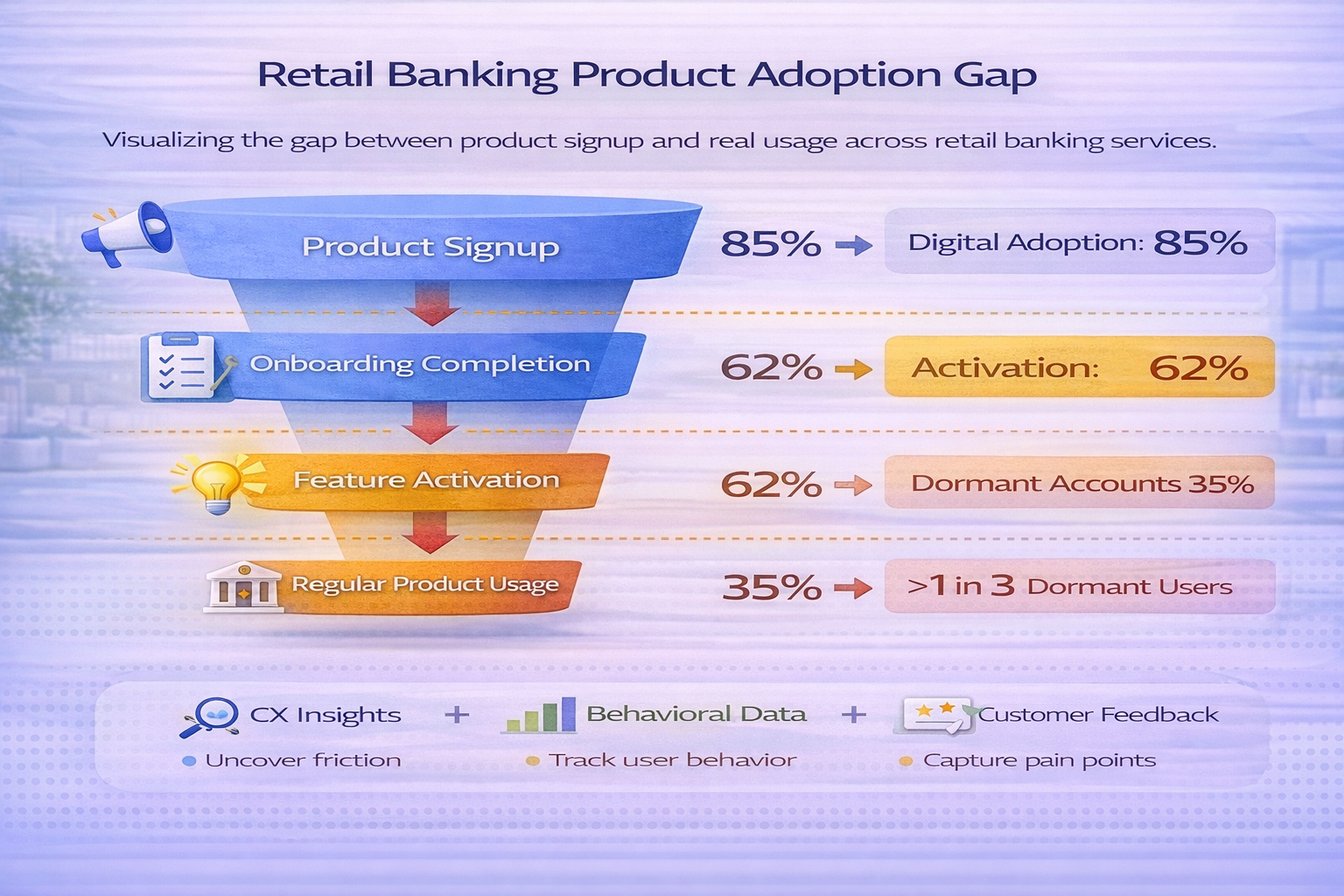
Retail banking customers rarely abandon products without a reason. In most cases, customers initially sign up with genuine intent. They may open an account, enroll in a rewards program, activate digital banking, or sign up for a financial service expecting it to simplify their financial life.
But after signup, something changes. The experience becomes confusing. The value is unclear. Or the process simply takes too much effort. Over time, customers stop engaging. This pattern is now a growing challenge across retail customer experience programs, where acquisition continues to grow but product activation and engagement lag behind.
Below are the most common reasons retail banking customers stop using the products they sign up for.
The first interaction customers have with a banking product often determines whether they will continue using it. When onboarding feels slow, complicated, or unclear, customers quickly lose interest. This is especially common when customers must complete multiple steps before experiencing any value.
Typical onboarding friction points include:
• lengthy verification processes
• complex documentation requirements
• confusing registration workflows
• unclear instructions for first-time users.
Research shows that 70% of banks lose customers because onboarding processes take too long or feel overly complex. When customers encounter friction early, many simply stop using the product. For retail banking leaders, improving onboarding is often one of the fastest ways to improve retail CX and product activation rates.
Customers rarely continue using a product unless they quickly understand why it matters to them. In retail banking, many products are launched with strong marketing messages but weak value communication during the actual user journey.
Customers may sign up for:
But if the value of these products is not clear within the first interaction, engagement quickly drops. This is a common issue in consumer experience in retail financial services, where customers face too many options without clear guidance on what to use first. Retail banks that highlight quick wins and immediate benefits during onboarding typically see stronger engagement.
Banks often assume that adding more features increases product value. But in reality, too many features can overwhelm customers.
Retail banking platforms frequently include:
For many customers, this complexity creates confusion instead of engagement. When customers are unsure which feature to use first, they often use none of them. This is a common challenge in retail CX design, where feature expansion happens faster than experience simplification.
Banks that simplify product journeys and guide customers toward key features tend to improve engagement significantly.
Trust is one of the most important factors in financial services. If the experience feels slow, unreliable, or confusing, customers may hesitate to continue using the product.
Common digital experience issues include:
• slow system performance
• confusing navigation
• unclear product instructions
• inconsistent digital experiences across channels.
These issues directly affect customer experience in the retail industry, particularly in highly regulated sectors like banking. When customers lose confidence in the digital experience, they often disengage before fully adopting the product.
Retail banking marketing often promises convenience and simplicity. But the actual product experience sometimes tells a different story.
Customers may expect:
Instead, they may encounter:
When expectations and experiences do not match, customers lose trust. Over time, this disconnect contributes to the growing retail customer experience gap seen across the industry.
For retail banking leaders, the real challenge is not just identifying these issues. It is knowing exactly where they happen in the customer journey. Many banks rely on high-level metrics such as product enrollments or digital registrations.
But those numbers rarely reveal why customers stop engaging. Organizations that combine behavioral analytics with retail customer experience surveys and journey insights can uncover the precise friction points causing disengagement.
Modern experience intelligence approaches such as the PXI ™ - a state-of-the-art proprietary tech developed by Numr can allow banking teams to connect customer insights and real behavioral data with business implications in banking.
This helps answer critical questions like:
Once those insights become visible, banks can begin fixing the real causes of product abandonment.
In the next section, we’ll explore how this problem appears across retail banking products and why some services struggle more than others to drive customer engagement.
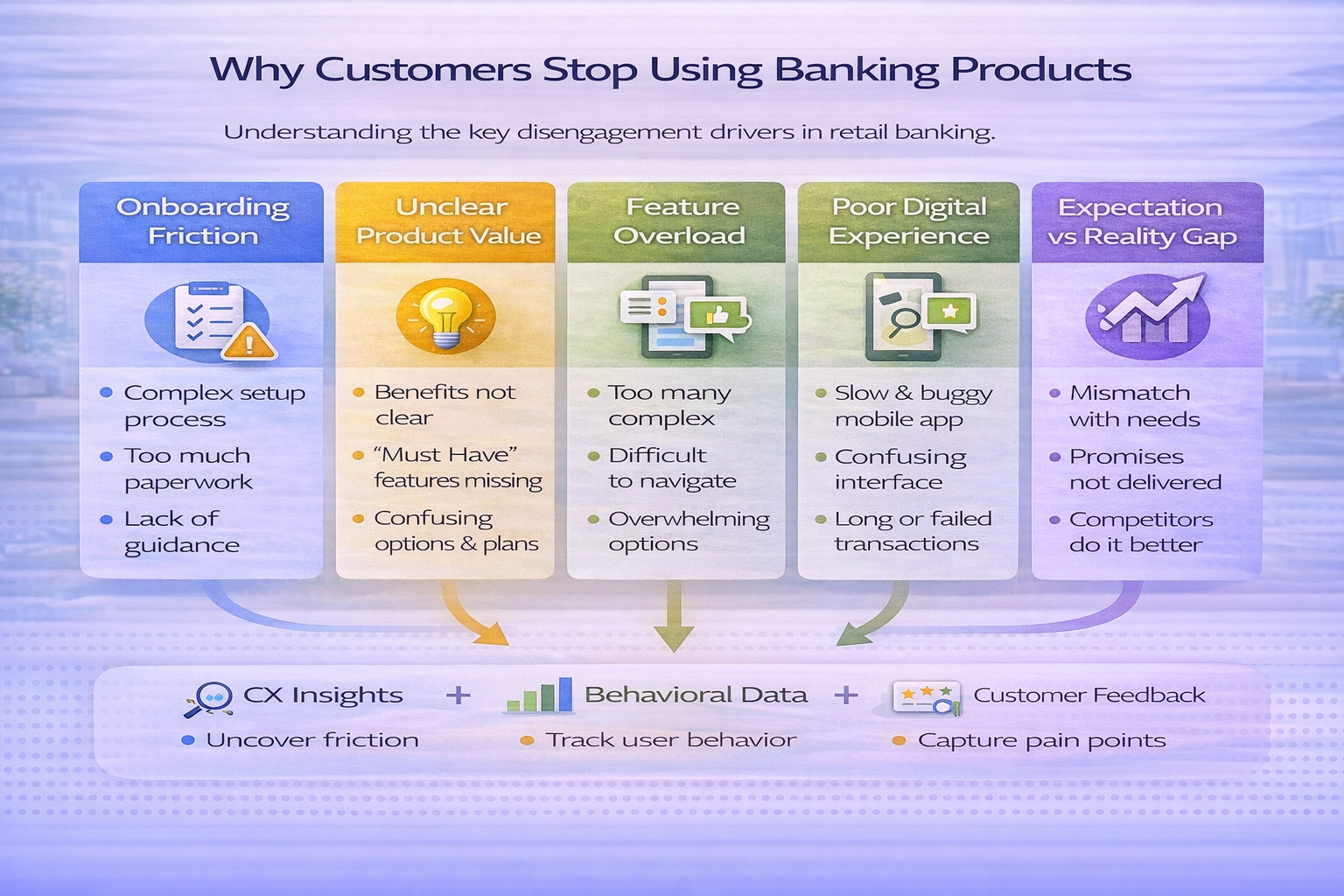
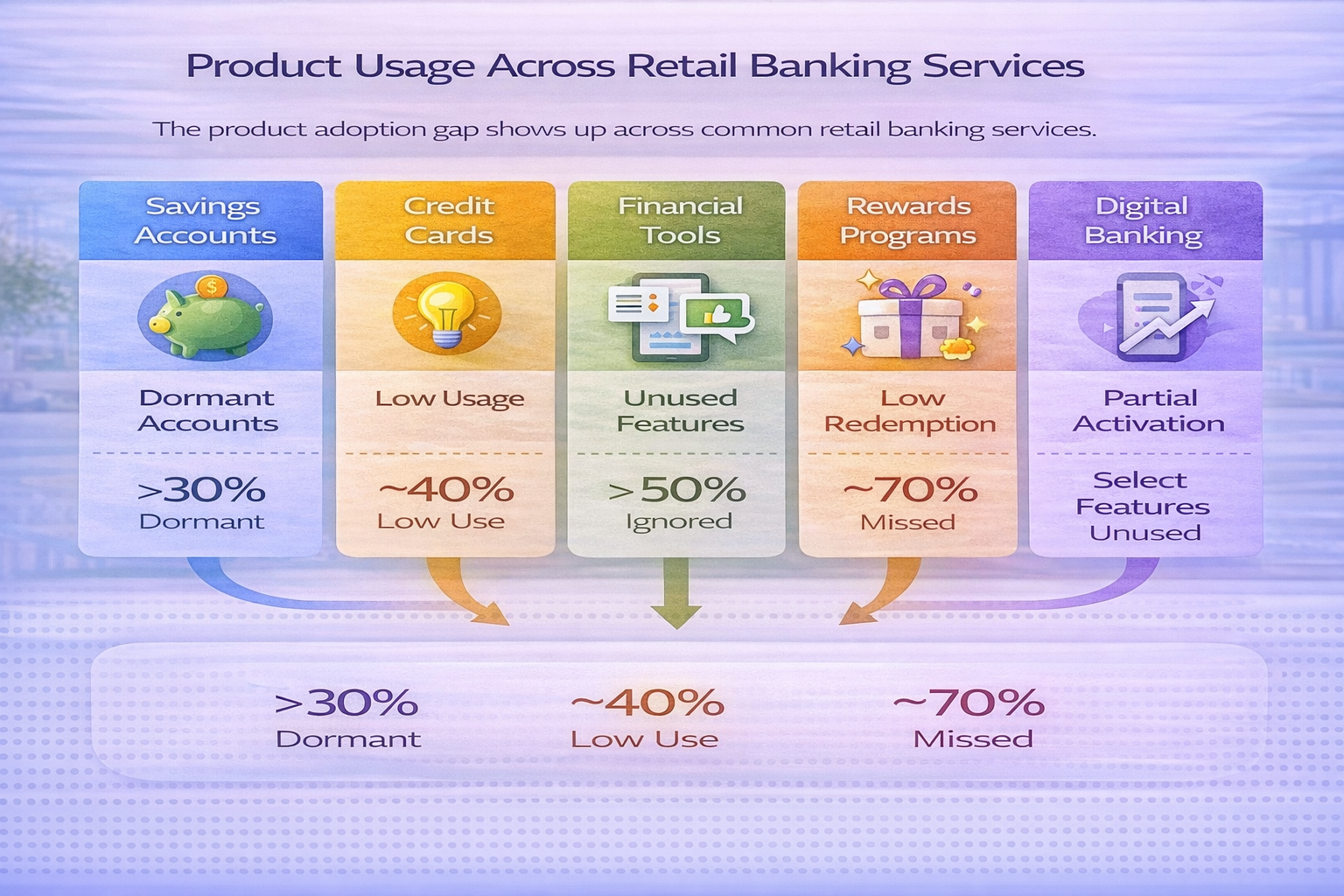
The problem of customers signing up but never using products is not limited to one banking service.
It appears across multiple retail banking offerings, from basic financial accounts to advanced digital services. Customers may initially enroll because the product promises convenience, rewards, or financial benefits.
But when the experience fails to deliver immediate value, engagement quickly fades. For retail banking leaders responsible for retail customer experience, this pattern represents a major challenge. Understanding where the adoption gap occurs is the first step toward improving retail CX and long-term customer engagement.
Opening a bank account is often the first interaction customers have with a bank. However, many of these accounts never become active.
Customers may complete the signup process but rarely perform transactions afterward. In many markets, this leads to large numbers of dormant accounts. Recent data indicates that 35% of bank accounts in India remain inactive, highlighting the scale of the engagement challenge.
Dormant accounts represent more than unused balances. They signal that the bank has failed to create an ongoing retail experience that encourages customers to interact regularly with the institution. For retail banking leaders, this means the initial acquisition succeeded, but customer engagement never truly began.
Credit cards are one of the most aggressively marketed products in retail banking.
Customers frequently sign up due to:
But many customers never become consistent users. Some activate the card but rarely transact. Others stop using it after the introductory offer ends.
This often happens because customers do not clearly understand:
When product value is unclear, usage declines. This reflects a broader challenge in customer experience in retail industry financial services, where marketing drives acquisition but experience fails to sustain engagement.
Retail banks increasingly offer digital tools designed to help customers manage their finances more effectively.
These may include:
Many customers sign up for these services during onboarding. However, after enrollment, they rarely return to use them. The problem is rarely the technology itself.
Instead, customers often lack clear guidance on:
Without clear product education, these features remain hidden within the broader retail banking digital experience.
Loyalty programs are designed to strengthen long-term relationships with customers.
Banks offer reward programs that provide:
Customers often enroll in these programs during account opening or credit card signup. But participation frequently drops after enrollment.
Customers may struggle to understand:
When reward systems feel complicated, customers lose motivation to participate. This issue appears frequently in retail customer experience surveys, where customers report confusion about loyalty benefits.
Many retail banks invest heavily in digital platforms designed to improve convenience.
Customers often register for:
Yet activation does not always translate into ongoing engagement. Recent data shows that while digital banking adoption can reach 85%, only about 62% of customers activate core banking features. This means a significant share of customers sign up but never move beyond basic registration. For retail banks, this represents a major gap between digital adoption and real product usage.
When customers stop using banking products, the impact goes far beyond one inactive feature. It affects the entire retail customer experience ecosystem.
Unused products lead to:
• lower engagement across banking channels
• fewer cross-selling opportunities
• weaker long-term customer relationships
• reduced customer lifetime value.
In other words, the challenge is not just product adoption, it is customer relationship activation.
As customer success strategist Lincoln Murphy explains:
“You can focus on adoption, retention, expansion, or advocacy or you can focus on the customer’s desired outcome and get all of those things.”
– Lincoln Murphy, Customer Success Strategy Expert
This insight is especially relevant for retail banking. Customers do not sign up for products simply to own them. They sign up because they expect those products to help them solve financial problems, manage money more easily, or improve their financial outcomes.
When the experience fails to deliver those outcomes quickly, customers disengage. For retail banking leaders responsible for retail CX and digital transformation, the challenge is identifying where that disconnect happens in the customer journey. Traditional analytics often show only high-level metrics like signups or registrations.
But they rarely reveal:
This is why many banks are now turning to advanced experience intelligence systems to connect behavioral signals with real customer feedback.
Predictive Experience Intelligence (PXI)™, developed by NUMR CXM, enables banks to unify these signals into a single, actionable view helping teams understand customer behavior in context and take timely actions to improve experience and engagement.
By combining customer behavior data, journey analytics, and retail customer experience surveys, banks can uncover:
Once those insights become visible, improving adoption becomes much easier.
When customers stop using banking products, the problem rarely starts with the product itself. More often, it starts with the experience surrounding the product. Retail banks may launch strong products with valuable features, but if the customer journey is confusing, slow, or disconnected, customers quickly lose motivation to engage.
This is why improving retail customer experience (retail CX) has become one of the most important priorities for banking leaders. Customers today compare their banking experiences with the best digital experiences they encounter in other industries.
If a retail bank cannot deliver a simple and intuitive journey, customers often disengage before fully adopting the product.
Many banking products involve multiple steps before customers can experience real value.
Customers may have to:
While these steps may be necessary for regulatory reasons, the overall experience can become overwhelming. When the journey feels too complicated, customers often stop halfway.
For retail banks, this creates a significant gap between product enrollment and real usage. Simplifying the journey is one of the most effective ways to improve customer experience in retail banking services.
After customers enroll in a banking product, they often receive little guidance on what to do next.
For example, customers might sign up for:
But once enrollment is complete, the experience becomes silent. Customers are left to figure out the product on their own. Without clear guidance, many customers never discover the features designed to help them.
This is a common issue in consumer experience retail environments, where digital services grow faster than customer education. Banks that provide guided journeys and contextual recommendations often see stronger engagement with their products.
Another major challenge in retail banking is fragmentation.
Customers interact with banks through multiple channels:
When these channels are not connected, the experience becomes inconsistent. Customers may encounter different processes, different information, or different levels of support depending on the channel they use. This inconsistency weakens trust and discourages engagement.
For retail banking leaders, improving customer experience in retail industry financial services requires creating a seamless experience across channels.
Speed plays a critical role in digital engagement. Customers expect banking services to respond quickly and work reliably. When systems are slow, customers quickly lose confidence.
Common performance issues include:
These experiences reduce trust and make customers less likely to return.
As CX strategist Blake Morgan explains:
“Customer experience is the new competitive battleground.”
– Blake Morgan, Customer Experience Futurist
This insight highlights a key shift in the retail CX landscape. Customers no longer judge banks only by interest rates or product features. They judge them by the quality of the experience.
One of the biggest reasons banks struggle with product adoption is that they simply do not know where customers disengage.
Traditional metrics show:
But these numbers rarely explain why customers stop using the product. Retail banks need deeper insight into the customer journey. This is where modern experience intelligence approaches become essential.
By combining behavioral analytics with retail customer experience surveys, banks can identify the exact moments where customers lose interest. Solutions based on PXI system developed by Numr allow banking teams to connect product usage data with real customer feedback.
This helps leaders understand:
With these insights, banks can begin fixing the experience gaps that cause product abandonment.
Many banks believe they understand product performance because they track signups and product enrollments. But those numbers only tell a small part of the story. Customers may sign up for a banking product without ever truly adopting it.
This is why retail banking leaders need to track engagement metrics that reveal real product usage, not just acquisition. Without these insights, banks may assume a product is successful while a large portion of customers remain inactive.
Understanding these metrics is essential for improving retail customer experience and long-term engagement.
Activation rate measures the percentage of customers who perform their first meaningful action after signing up for a product.
For example, activation might mean:
Activation shows whether customers move beyond registration and begin using the product.
In many cases, adoption may appear strong, but activation reveals a hidden gap. Recent research shows that digital banking adoption may reach 85%, yet activation falls to around 62%. This difference highlights the activation gap that many retail banks struggle to close.
Another important metric is how often customers return to use a product. Even when customers activate a service once, they may not return regularly. Engagement frequency helps banks understand whether a product has become part of the customer’s routine.
For example, banks may track:
Products that customers return to frequently often create stronger long-term relationships. Tracking these patterns is critical for improving consumer experience in retail banking environments.
Many banking products contain multiple features designed to improve financial management. However, customers often use only a small portion of these features. Feature adoption measures how many customers actually use the product’s key capabilities.
For example:
Low feature adoption often indicates that customers either do not understand the value of the feature or cannot easily discover it within the experience. Improving feature discovery is an important part of modern retail CX strategy.
Retention metrics show whether customers continue using a product over time. Dormancy signals reveal when engagement begins to decline.
These signals may include:
In retail banking, dormancy is a major issue. As noted earlier, 35% of bank accounts in India remain inactive, demonstrating how common this problem has become. Identifying early dormancy signals allows banks to intervene before customers fully disengage.
Behavioral data alone does not always explain why customers stop using products. To understand the real reasons behind disengagement, banks also need direct customer feedback.
Retail banks increasingly use:
These insights reveal the emotional and practical factors behind customer behavior.
As customer experience expert Jeanne Bliss explains:
“Customer experience is the sum of all interactions a customer has with your organization.”
– Jeanne Bliss, Customer Experience Pioneer
This perspective highlights an important truth. Product adoption is not just about features it is about the entire customer journey surrounding the product.
Tracking metrics individually is helpful, but real insight comes from connecting these signals together. Retail banks that combine behavioral analytics with customer feedback can see the full picture of product adoption.
Modern experience intelligence approaches powered by Predictive Experience Intelligence (PXI)™, a proprietary system developed by NUMR CXM enable banking teams to unify activation data, engagement patterns, and customer feedback into a single, end-to-end view of the customer journey.
This allows leaders to identify:
With this level of insight, banks can move beyond measuring signups and start improving real customer usage, driving stronger retail experience outcomes and long-term engagement.
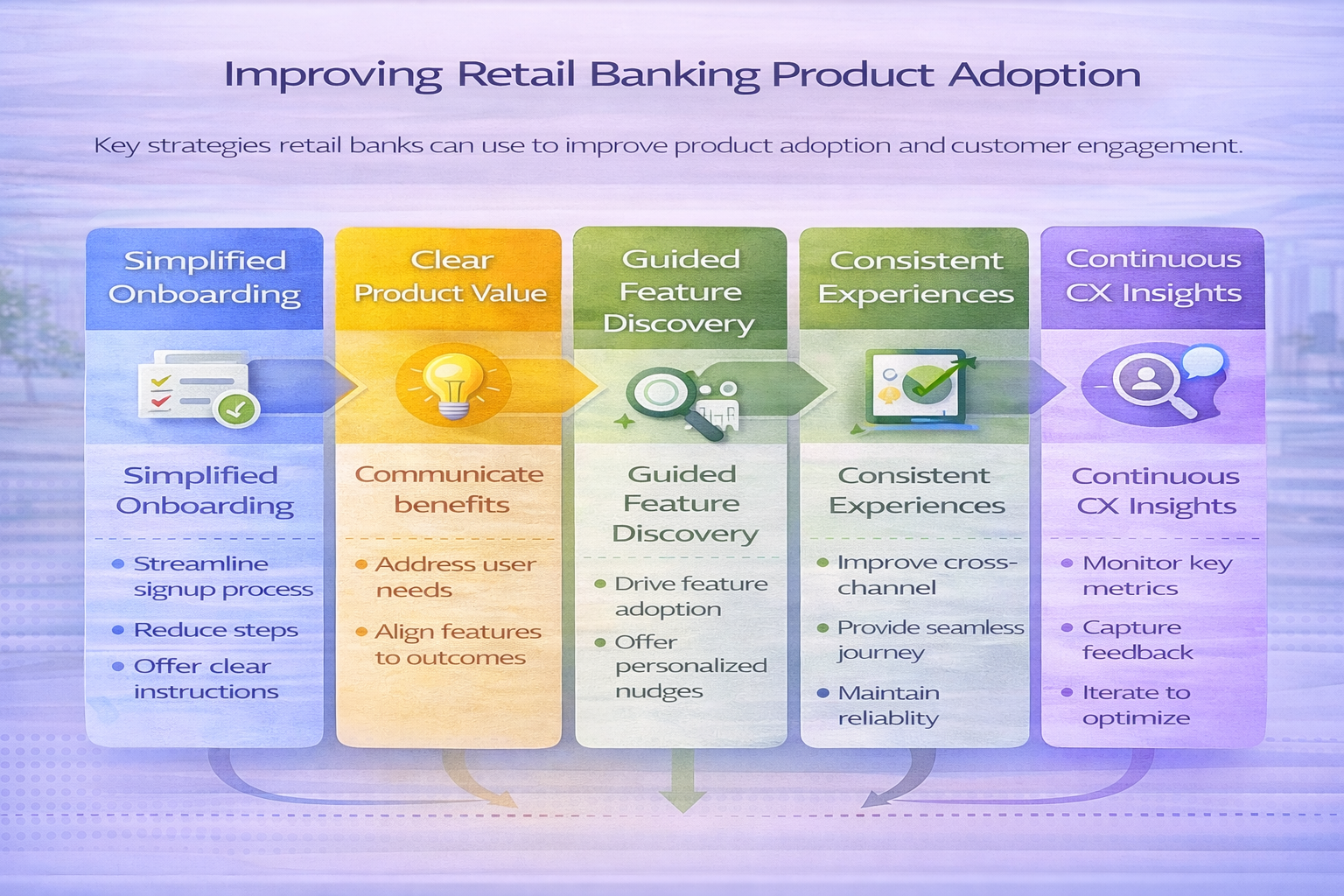
Once retail banks understand why customers stop using products, the next step is improving the experience. The goal is not simply to increase signups. The goal is to turn those signups into real customer engagement and long-term product usage.
Banks that improve retail customer experience journeys can significantly increase activation rates, product engagement, and customer loyalty. Below are some of the most effective ways retail banking leaders can improve product adoption.
The first experience customers have with a product often determines whether they will continue using it.
If onboarding feels complicated or time-consuming, customers quickly lose interest.
Retail banks can improve onboarding by:
When customers experience value quickly, they are far more likely to return. Improving onboarding is one of the most powerful ways to strengthen retail CX and early product activation.
Customers rarely continue using a product unless they clearly understand how it helps them. Retail banking products often include powerful capabilities, but customers may never discover them.
Banks can improve engagement by highlighting:
For example, customers are more likely to use budgeting tools when they understand how those tools help them manage spending or reach savings goals. Communicating value clearly is essential for improving consumer experience in retail financial services.
Many banking products contain dozens of features. Without guidance, customers often feel overwhelmed. Instead of showing everything at once, banks should guide customers toward the features that matter most for their financial needs.
Examples include:
This approach helps customers experience quick wins, which encourages continued engagement.
Improving feature discovery is a key part of modern retail CX design.
Retail banking customers interact with their bank through multiple touchpoints.
These include:
When these experiences feel disconnected, customers become confused. Consistency across channels improves trust and makes products easier to use. Banks that unify their digital and physical experiences often see stronger engagement with their services.
This is why many organizations are investing heavily in customer experience in retail industry transformation programs.
One of the most powerful ways to improve product adoption is to continuously learn from customer behavior.
Retail banks can gain valuable insight by analyzing:
As customer experience strategist Shep Hyken explains:
“Customer experience is no longer a department, it's a philosophy that should drive every interaction.”
– Shep Hyken, Customer Experience Expert
This mindset is especially important in retail banking. When banks continuously monitor how customers interact with products, they can identify the moments where engagement breaks down.
Modern experience intelligence approaches and customer insight platforms—led by Predictive Experience Intelligence (PXI)™, a proprietary technology developed by NUMR CXM help connect customer behavioral data with real business and financial outcomes.
This allows banking teams to understand:
With these insights, banks can evolve their retail customer experience strategies and design products that customers actively adopt and continue to use.
One of the biggest challenges retail banking leaders face is visibility. Banks often know that customers are not using certain products.
They can see the metrics:
But those numbers rarely reveal why customers disengage. When a customer stops using a product, traditional analytics usually show only the outcome.
They do not explain:
For organizations trying to improve retail customer experience, this lack of insight creates a major blind spot.
Retail banks commonly track operational metrics such as:
While these metrics are useful, they only describe what happened, not why it happened. For example, a bank may notice that many customers enroll in a financial product but rarely return to use it.
However, the metrics alone cannot explain:
Without this deeper insight, banks often struggle to improve customer experience in retail financial services.
To understand product abandonment, banks must analyze customer experience signals across the entire journey.
These signals include:
When these signals are analyzed together, they reveal where customers lose motivation to continue using a product.
For example, banks may discover that customers disengage:
These insights are critical for improving retail CX strategies and product design.
Behavioral data tells banks what customers are doing. Customer feedback reveals why they are doing it. When both types of data are combined, banks gain a much clearer understanding of the customer journey.
For example:
Behavioral data may show that customers rarely use a financial planning tool.
Customer feedback may reveal that customers do not understand how the tool benefits them. Together, these insights help banks identify the real experience gap. This approach is becoming increasingly important as retail banks try to improve consumer experience retail financial services.
Retail banking environments are becoming more complex.
Customers interact with banks through many channels:
Understanding this entire ecosystem requires more than traditional analytics. Banks increasingly rely on experience intelligence approaches that connect product usage data with customer sentiment and journey insights.
These systems allow banking teams to identify:
Approaches based on advanced experience intelligence frameworks are helping organizations translate customer signals into actionable CX improvements.
Predictive Experience Intelligence (PXI)™, developed exclusively by NUMR CXM, enables banks to move beyond guesswork by turning behavioral signals into clear, actionable insights across the entire customer journey.
Instead of guessing why customers abandon products, banks can see the full picture of the customer journey, identify where breakdowns occur, and take timely action to improve outcomes.
Once banks understand where customers disengage, they can begin improving the experience.
Retail banks that continuously analyze customer insights often see improvements in:
This is why improving retail customer experience and retail CX strategies has become a major competitive priority across the financial services industry. Banks that truly understand their customers can design experiences that make financial products easier to use and more valuable.
And when the experience improves, product adoption naturally follows.
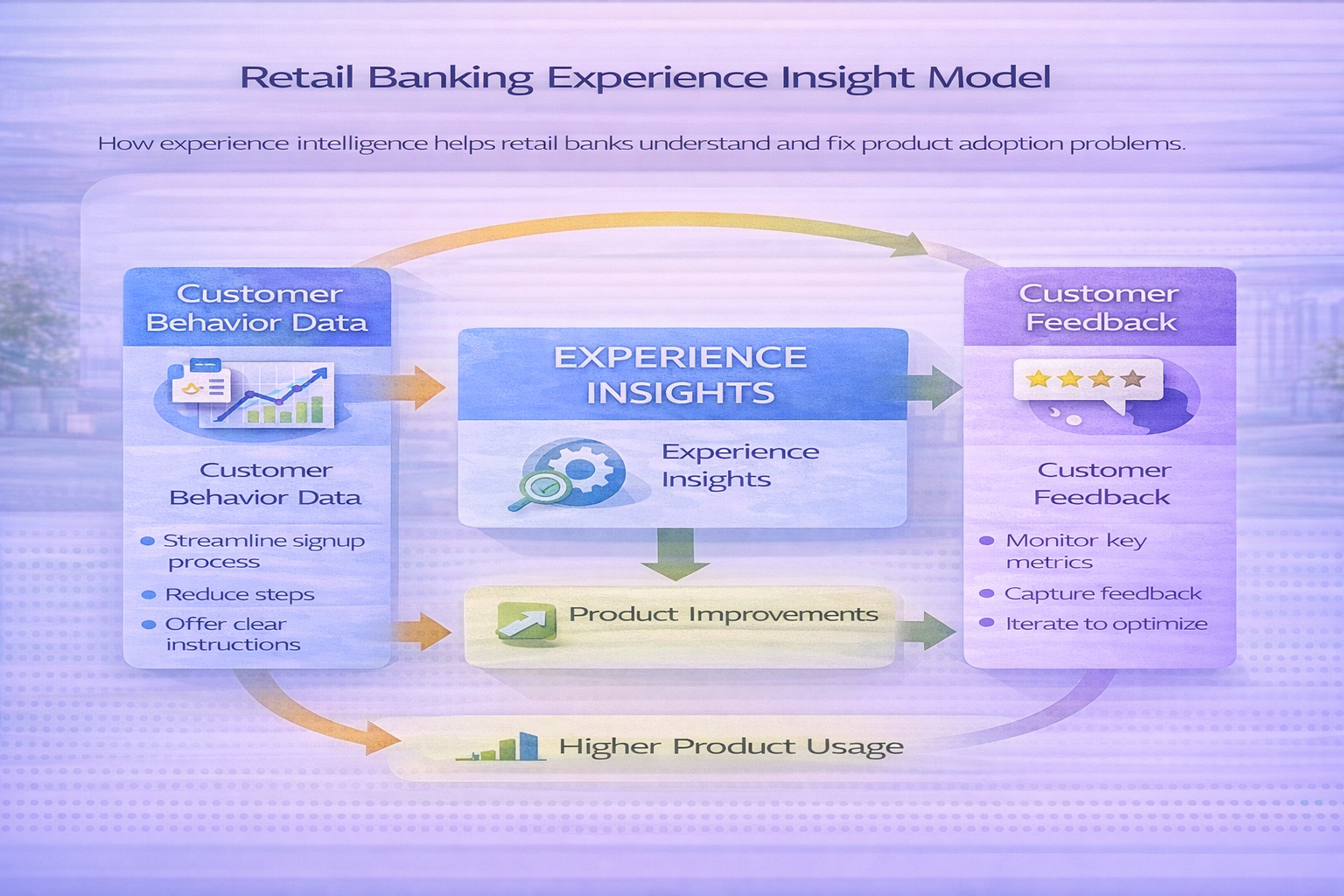
For many years, retail banks focused primarily on customer acquisition.
Success was measured through metrics such as:
But as banking competition has intensified, these metrics are no longer enough. Today, the real challenge is customer engagement. Retail banks must ensure that customers do more than simply sign up for products; they must actively use them as part of their financial lives. This shift is transforming how banking leaders think about retail customer experience and digital strategy.
Unused products represent missed opportunities.
When customers actively use banking products, banks benefit from:
But when customers sign up and never return, the bank receives very little long-term benefit.
This is why improving product usage has become a key priority across customer experience in retail industry financial services.
Retail banks that increase product engagement often see stronger long-term growth.
Retail banking customers now compare their financial experiences with the best digital services in other industries.
They expect banking interactions to be:
Banks that fail to meet these expectations risk losing engagement quickly.
As customer experience expert Don Peppers explains:
“Customers don’t compare you to your competitors anymore. They compare you to the best experience they’ve had anywhere.”
– Don Peppers, CX Thought Leader
This insight reflects a major shift in retail CX strategy. Banks are no longer competing only with other financial institutions. They are competing with the best digital experiences customers encounter every day.
Acquiring customers is only the beginning of the relationship.
The real value comes from ongoing engagement.
Retail banks that prioritize engagement often focus on:
This approach helps banks transform product enrollment into real usage.
Improving product adoption requires understanding the entire customer journey.
Retail banks must identify:
Traditional analytics tools often fail to provide this level of insight. That is why many organizations are adopting experience intelligence frameworks that combine behavioral analytics, customer feedback, and journey analysis.
Predictive Experience Intelligence (PXI)™, developed exclusively by NUMR CXM, enables retail banks to connect product usage data with real customer experiences in a unified, intelligence-led view.
This provides a clearer understanding of:
With these insights, retail banks can shift from reactive analysis to proactive experience optimization designing journeys that drive continuous product engagement rather than one-time signups.
The future of retail banking will be shaped by organizations that understand their customers best.
Banks that continuously analyze experience insights can:
In a competitive financial landscape, the ability to improve retail customer experience and retail CX journeys will determine which banks succeed in turning signups into long-term engagement.
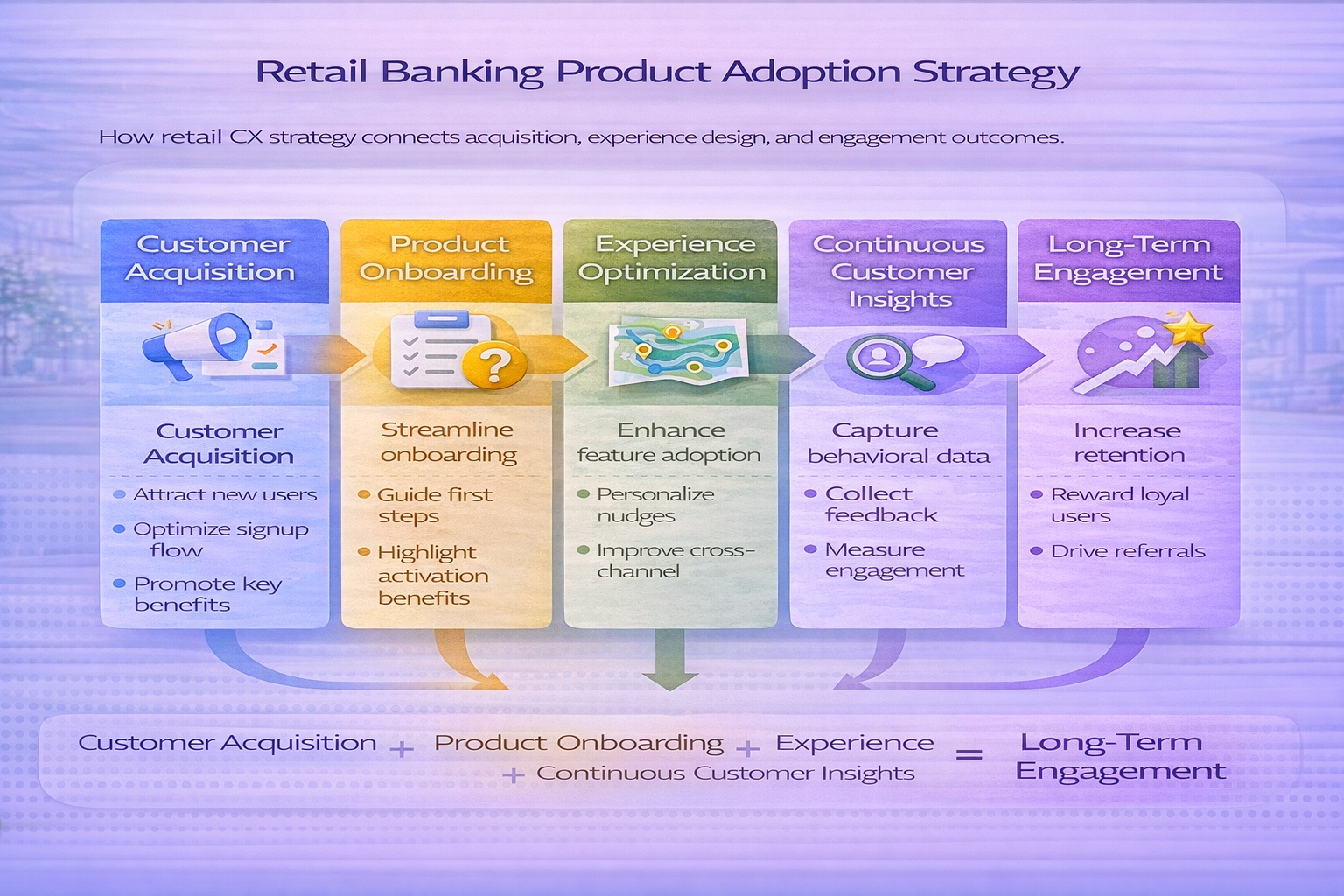
Retail banks already succeed at attracting customers. Marketing campaigns, digital onboarding, and product promotions bring millions of customers into the ecosystem every year.
But the real challenge begins after the signup. Many customers enroll in banking products but never integrate them into their daily financial behavior.
This gap between product signup and product usage is where the real opportunity lies.
Retail banks that close this gap can significantly improve:
To improve product adoption, banks must understand the entire retail customer journey.
Customers interact with banking services through multiple touchpoints:
At each step of the journey, small moments of friction can reduce engagement.
For example:
Individually, these problems may seem small. But together, they create a customer experience that discourages long-term product usage. Retail banks that analyze these interactions carefully can identify exactly where customers disengage.
Many banks already collect large amounts of operational data.
They track:
However, these metrics rarely reveal why customers stop using a product. Understanding the real problem requires connecting behavioral data with customer experience insights.
This means combining:
When these signals are analyzed together, banks can begin identifying the true causes of product abandonment.
Retail banking environments generate enormous amounts of customer interaction data. Without the right tools, much of that information remains disconnected. Experience intelligence approaches are designed to bring these signals together.
By analyzing behavioral data alongside customer feedback, banks can uncover:
This deeper understanding allows banks to move beyond assumptions and focus on evidence-based retail CX improvements.
Many retail banks are now adopting Predictive Experience Intelligence (PXI)™, an advanced CX-focused system developed by NUMR CXM, to understand product adoption more effectively by combining behavioral signals, journey analytics, and real-time customer insights into a unified view of engagement.
These systems connect multiple layers of insight, including:
Solutions like NUMR CXM’s CX and Predictive Experience Intelligence (PXI)™ platforms allow banking teams to see how customers actually experience their products across the entire journey.
Instead of guessing why customers disengage, banks can clearly identify:
By leveraging Predictive Experience Intelligence (PXI)™, an advanced CX-focused system developed by NUMR CXM, teams can move beyond static insights to continuously monitor behavioral signals, detect risks early, and take proactive action.
This transforms retail customer experience strategy from reactive analysis to proactive, outcome-driven optimization.
The ultimate goal for retail banks is not simply to increase enrollments. The goal is to turn banking products into regular customer habits. When products become part of everyday financial behavior, engagement grows naturally.
Customers begin using services consistently for:
Retail banks that achieve this level of engagement build stronger, more resilient relationships with their customers—relationships that ultimately drive long-term growth and competitive advantage. Banks that combine experience intelligence, retail CX strategy, and continuous customer insight powered by Predictive Experience Intelligence (PXI)™, an advanced CX-focused system developed by NUMR CXM are better positioned to close the adoption gap and transform initial signups into lasting, meaningful engagement.
Retail banking has successfully solved the acquisition problem. Customers are signing up for new accounts, financial tools, credit products, and digital services at record levels.
But many of those products never become part of the customer’s daily financial behavior. This gap between product signup and product usage is one of the most important challenges facing retail banks today.
For retail banking leaders responsible for retail customer experience and digital transformation, closing this gap requires a shift in strategy. Success is no longer measured only by how many customers sign up. It is measured by how many customers actively use the products they enroll in.
Retail banks that focus on product adoption often see stronger long-term results.
When customers actively use banking products, institutions benefit from:
This is why improving retail customer experience and retail CX strategy has become a top priority across the financial services industry. Banks that prioritize engagement outperform those that focus only on acquisition.
Customers rarely abandon products because they lack features. More often, they abandon them because the experience surrounding the product feels difficult or unclear.
Retail banks that improve experiences across the entire journey often see improvements in:
This is why leading financial institutions increasingly treat customer experience in retail industry environments as a strategic capability, not just an operational function.
Improving product adoption requires a deeper understanding of customer behavior.
Banks must identify:
Traditional analytics alone cannot always provide these answers. Retail banks increasingly rely on experience intelligence frameworks that combine behavioral data with customer feedback.
Approaches such as Predictive Experience Intelligence (PXI)™, an advanced CX-focused system developed by NUMR CXM, enable banks to connect journey analytics, product usage signals, and retail customer experience insights into a unified, real-time view of customer behavior.
This allows teams to identify exactly where engagement breaks down, understand the underlying causes, and take proactive actions to improve those experiences and drive stronger product adoption.
Retail banking is becoming increasingly competitive. Customers now expect financial services to be as seamless and intuitive as the best digital experiences they encounter in other industries.
Banks that continuously analyze customer experience signals and retail CX insights are better positioned to:
Those improvements ultimately determine whether customers simply sign up for a product or continue using it long term. Retail banks that invest in experience intelligence and customer insight frameworks including Predictive Experience Intelligence (PXI)™, an advanced CX-focused system developed by NUMR CXM are better equipped to transform initial signups into sustained, meaningful engagement.
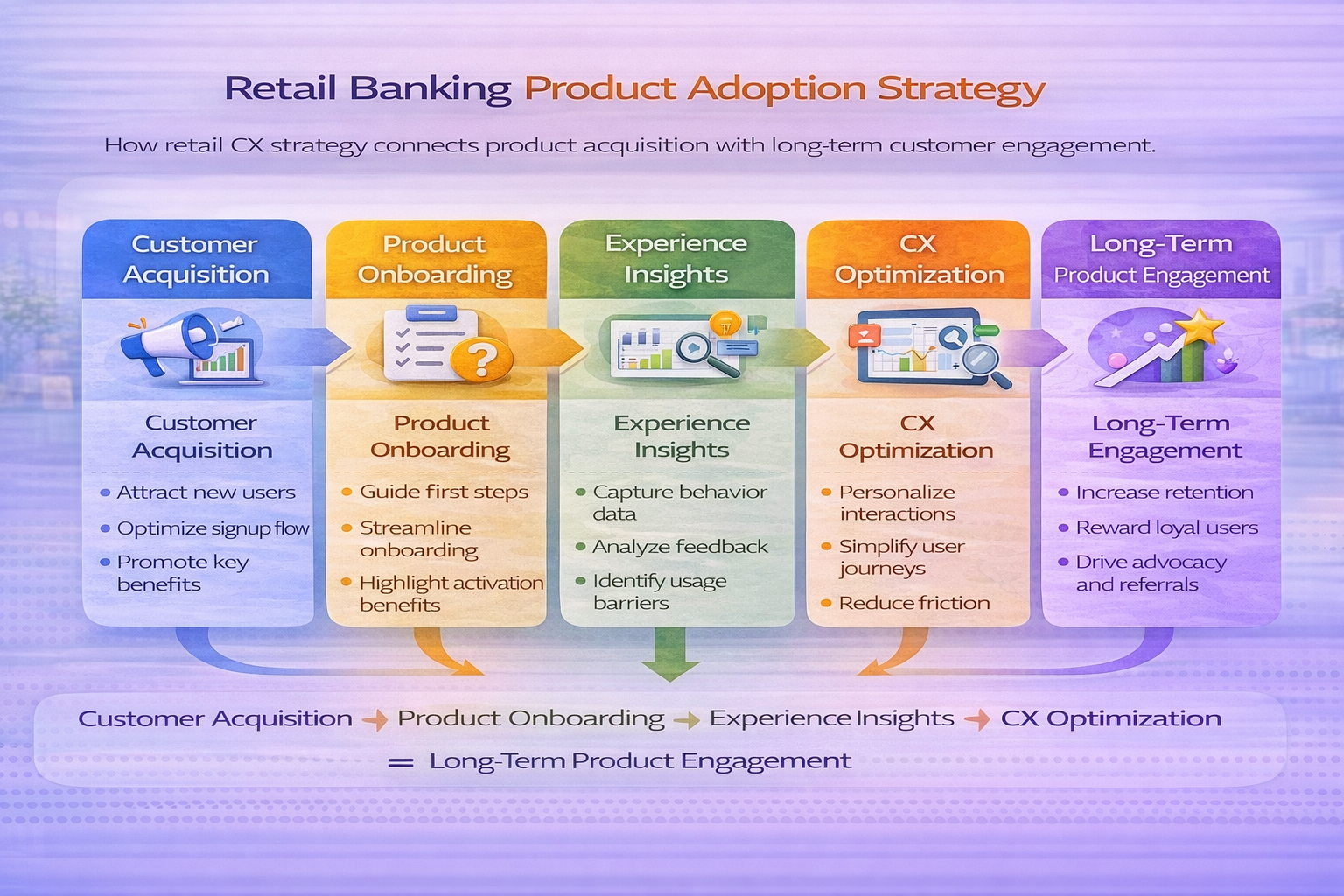
Retail banks are acquiring customers at an unprecedented pace. New accounts, digital registrations, and product enrollments continue to grow across the industry.
But growth alone is not enough. The real challenge is ensuring that customers actually use the products they sign up for. When customers stop engaging with financial products, banks lose opportunities to build deeper relationships, increase product adoption, and create long-term value.
The key to solving this challenge is understanding where the customer journey breaks down. Banks that analyze experience signals across onboarding, product discovery, and daily usage can identify the exact moments where engagement begins to decline.
Once those friction points become visible, improving adoption becomes far easier.
Retail banking journeys generate enormous amounts of customer data. But data alone rarely explains why customers abandon products. What banks truly need is experience and insight.
By combining:
banks can gain a deeper understanding of how customers interact with their products.
This approach helps reveal:
Leading banks are increasingly adopting Predictive Experience Intelligence (PXI)™, an advanced CX-focused system developed by NUMR CXM, to connect product analytics with real-time customer experience signals.
Platforms built around this approach, such as those developed by NUMR CXM, enable banking teams to analyze customer behavior across the entire journey, identify friction points early, and take proactive actions to improve product adoption and overall experience.
These insights help identify:
With the right insights, retail banks can begin designing experiences that encourage customers to return, engage, and build long-term relationships with their financial products.
If your organization is trying to understand why customers sign up for products but rarely use them, exploring experience insights across the customer journey can provide valuable answers.
Understanding these signals can help retail banking teams:
You can explore how Predictive Experience Intelligence (PXI)™, an advanced CX-focused system developed by NUMR CXM, enables financial institutions to uncover product adoption gaps, identify underlying behavioral risks, and proactively improve customer engagement through real-time, data-driven actions.
If you want help, schedule a CX strategy discussion.
Many customers sign up for banking products because of marketing campaigns, promotions, or initial convenience. However, they often stop using the product when the onboarding process feels complicated, the value is unclear, or the digital experience creates friction. When the customer journey does not quickly demonstrate value, engagement drops and products remain unused.
The product adoption gap refers to the difference between customers who sign up for a banking product and those who actively use it. Banks may see strong enrollment numbers, but many customers never perform meaningful actions such as transactions, feature activation, or ongoing engagement. Closing this gap is a major focus for modern retail CX strategies.
Dormant accounts typically occur when customers open accounts but never integrate them into their daily financial activities. This often happens due to poor onboarding experiences, unclear product benefits, or lack of engagement after signup. Without ongoing interaction, accounts remain inactive even though they were successfully opened.
Customers usually stop using banking products because of:
These issues are usually tied to weaknesses in retail customer experience design rather than the product itself.
Customer experience plays a critical role in determining whether customers continue using financial products. When banking journeys are intuitive, fast, and helpful, customers are more likely to engage regularly. Poor experiences, however, create frustration and discourage long-term usage.
Retail banks often measure product adoption using metrics such as:
These metrics provide deeper insight into whether customers are truly integrating products into their financial routines.
Activation rate measures the percentage of customers who perform their first meaningful action after signing up for a product. Examples include making a transaction, linking accounts, setting up automated savings, or using a financial tool. Activation is often the first indicator of real product engagement.
Onboarding introduces customers to the product and sets the tone for the entire relationship. If onboarding is complicated or slow, customers may abandon the product before discovering its value. Simplifying onboarding is one of the most effective ways to improve retail CX and product engagement.
Banks can improve engagement by:
These strategies help customers understand how the product improves their financial lives.
Many customers ignore features because they are difficult to discover or poorly explained. When products contain too many features without clear guidance, customers may feel overwhelmed and avoid exploring them. Improving feature discovery is a key component of modern retail CX design.
Retail customer experience surveys help banks understand how customers perceive their products and services. These insights reveal friction points in the customer journey and provide valuable feedback that cannot be captured through behavioral analytics alone.
Behavioral analytics shows how customers interact with banking products. It reveals patterns such as feature usage, transaction frequency, and drop-off points in the journey. When combined with customer feedback, these insights help banks identify the causes of product abandonment.
Experience intelligence refers to the process of combining behavioral data, journey analytics, and customer feedback to understand how customers interact with banking products. This approach helps banks identify engagement barriers and improve retail CX strategies.
Predictive Experience Intelligence (PXI)™ is an advanced CX-focused system developed by NUMR CXM that uses behavioral signals and AI to predict risks within customer journeys and prevents worse business and financial outcomes such as churn or drop-offs by triggering actions before problems occur.
Banks can identify journey friction by analyzing:
These insights help reveal where customers lose motivation to continue using the product.
Customers increasingly expect financial services to deliver the same level of convenience as leading digital platforms. Banks that provide seamless, intuitive experiences gain a significant advantage because customers are more likely to remain engaged with their products.
Improving retail CX simplifies the customer journey and helps customers quickly understand product value. When experiences become easier and more intuitive, customers are more likely to activate features, engage regularly, and continue using banking services.
Retail banks often use technologies such as:
These tools help organizations analyze customer behavior and improve product experiences.
Reducing dormant accounts requires improving early customer engagement. Banks can encourage activity by simplifying onboarding, guiding customers through initial product use, and continuously analyzing customer experience signals to identify engagement barriers.
CX insight platforms unify behavioral data, customer feedback, and journey analytics to deliver a complete, real-time view of the customer experience. However, traditional platforms often remain reactive, identifying issues only after they impact outcomes.
Solutions powered by Predictive Experience Intelligence (PXI)™, an advanced CX-focused system developed by NUMR CXM, take this further by continuously analyzing behavioral signals to detect early signs of friction in product journeys. PXI identifies adoption risks, uncovers the underlying reasons behind low engagement, and enables banks to take proactive actions before customers drop off.
This allows retail banks to not only uncover product adoption gaps but actively intervene in critical moments guiding customers, optimizing journeys, and driving sustained product usage and long-term engagement.


.png)
.png)

.png)
.png)