.png)
TL;DR
• Most enterprises believe they are doing customer experience because they run NPS, track CSAT, and review dashboards but this only captures a narrow and incomplete view of the customer journey.
• The majority of CX programs still operate on a legacy model focused on measuring past experiences rather than influencing future outcomes.
• In 2026, CX is no longer a reporting function; it directly impacts churn, revenue retention, cost-to-serve, and customer lifetime value.
• Traditional CX platforms (including VoC tools like Zykrr) remain survey-first, dashboard-driven, and dependent on manual execution.
• This creates a major execution gap: teams collect insights but fail to act fast enough to prevent customer drop-offs or revenue loss.
• Around 30–40% of CX teams take no action after receiving insights, while 66% of companies believe CX improved but only 17% of customers agree.
• Predictive CX solves this by using behavioral signals, AI, and real-time journey data to detect friction early and trigger action before issues escalate.
• The shift is clear: CX is moving from a measurement system to a decision system that directly drives business outcomes.
Are You Measuring CX, Or Controlling It?
Let’s be honest for a second. You probably already have a CX system in place. You’re running NPS. You’re tracking CSAT. You’re reviewing dashboards regularly. On paper, everything looks like it’s working.
But here’s the real question: Are you actually controlling customer experience or just measuring it after it breaks?
Because this is where most enterprises get stuck. It’s not that you lack data. It’s not that your tools are completely wrong. It’s that everything happens too late. By the time your dashboard shows a drop, the customer has already faced friction. By the time a survey response comes in, the experience has already failed. By the time your team takes action, the opportunity to fix it has already passed.
And in many cases the revenue impact is already locked in. This is what reactive CX looks like in reality. It creates visibility but not control. And that’s why so many organizations feel like they are “doing CX” but still struggling to improve outcomes.
This gap is not small, it's structural. Industry data shows that around 30–40% of CX teams take no action even after receiving insights, while 66% of companies believe they improved CX but only 17% of customers agree. That’s not just a performance issue. That’s a system failure. Because if your CX system can’t help you act at the right time, it doesn’t matter how accurate your insights are. They’re already too late. And this is where the shift begins. Not from one tool to another. But from one way of thinking to another. From measuring experience to controlling outcomes in real time. This is what defines predictive CX.
It doesn’t wait for customers to tell you something is wrong. It detects signals as they happen. It identifies risk before churn occurs. It enables action while the customer is still in the journey.
So instead of asking: “What happened?”
You start asking: “What is about to happen and how do we fix it now?”
That’s the difference. And in 2026, that difference is what separates teams that report CX from teams that actually drive business outcomes with it.
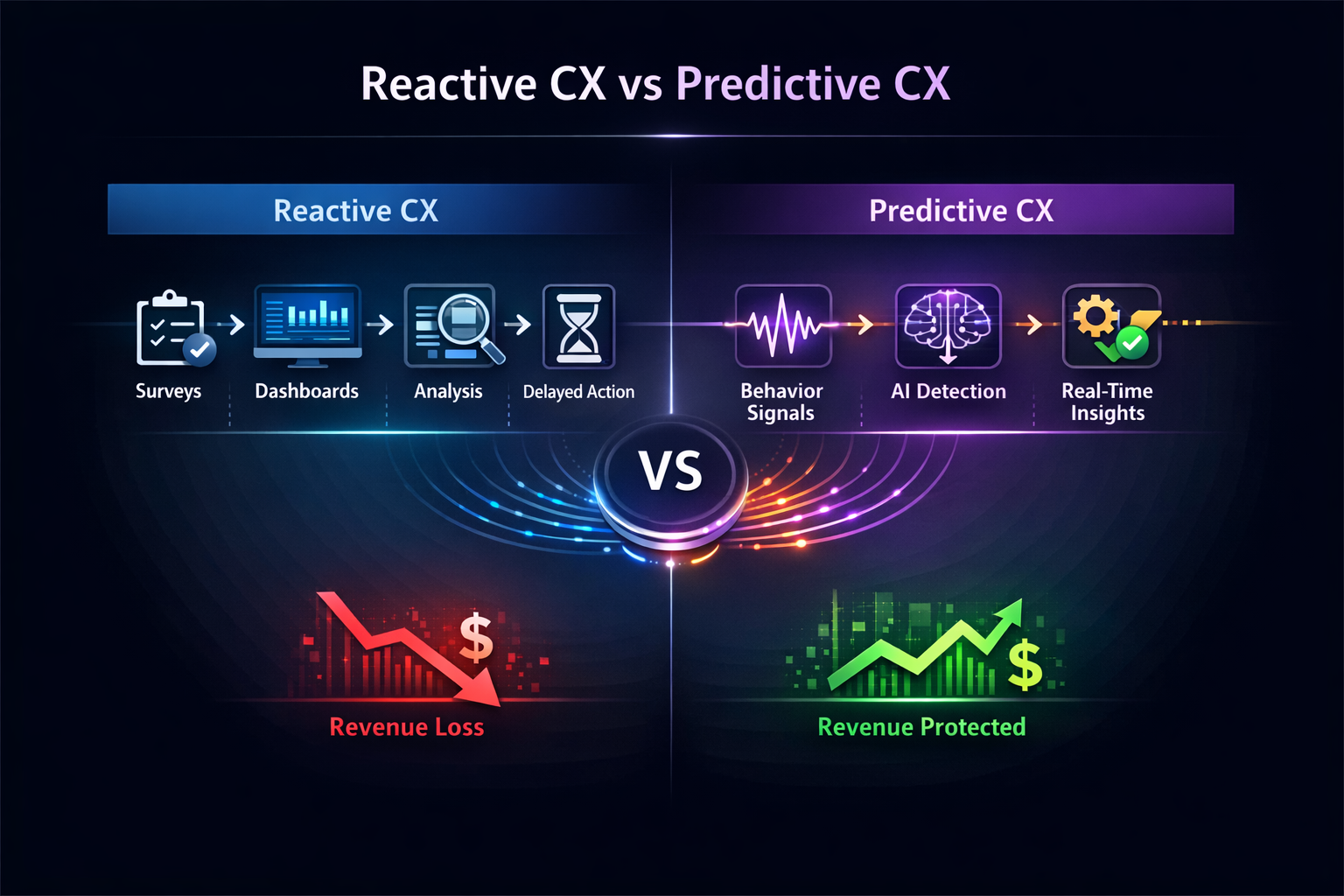
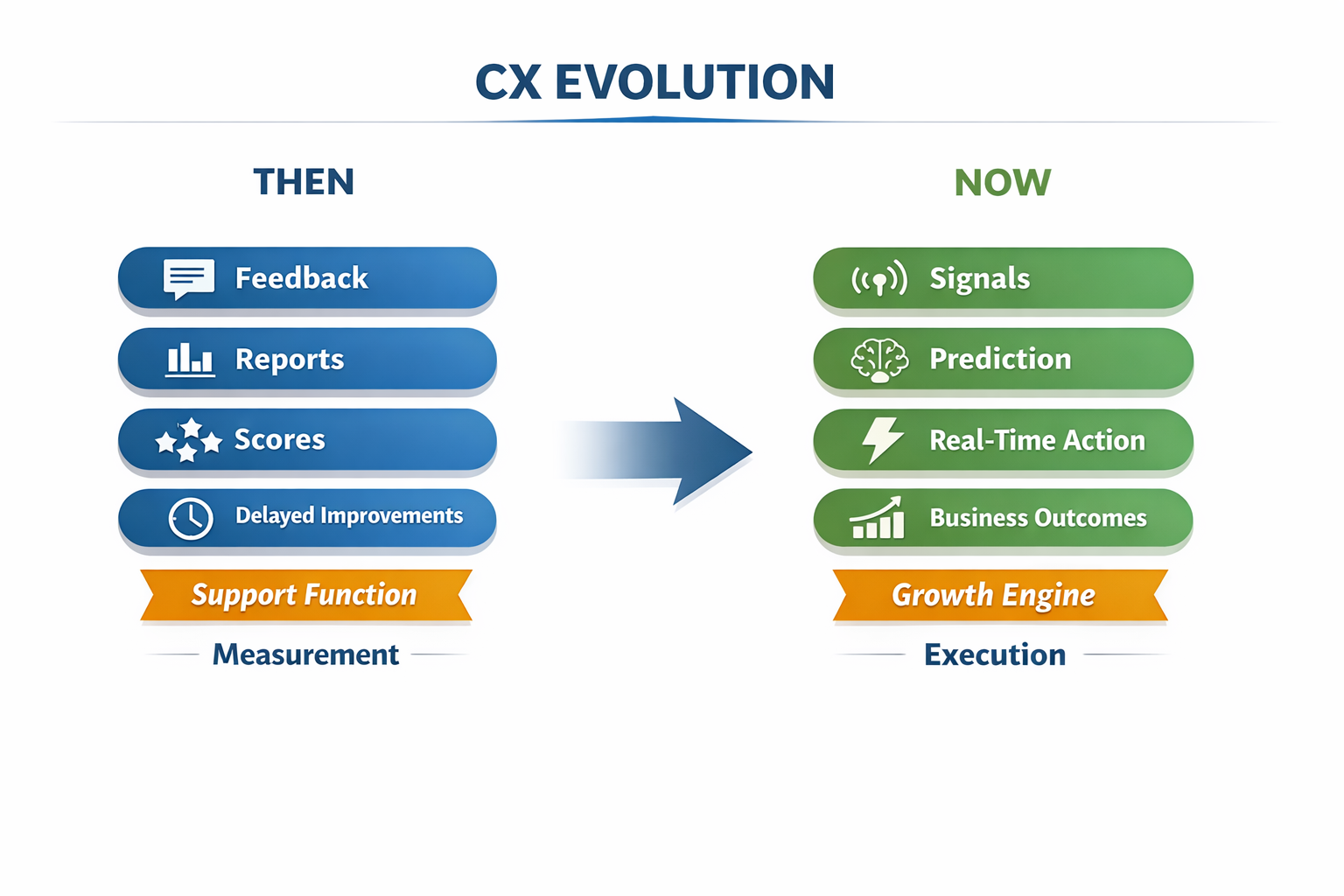
A few years ago, CX sat on the edge of the business. Important, but not critical. It shaped perception, but didn’t always drive performance. That’s changed. Today, CX is no longer a support function or reporting layer, it’s a direct driver of growth.
You can see this in how enterprises prioritize it. Nearly 75% of businesses now treat CX as a primary differentiator, ahead of price and product. At the same time, 86% of customers are willing to pay more for better experiences.
So CX is no longer just about satisfaction, it’s about revenue. When experience improves, customers stay longer, engage more, and spend more. When it breaks, they leave faster than ever. That’s why CX has moved into the boardroom.
Leaders aren’t asking, “How are our scores trending?”
They’re asking, “How is CX impacting churn, conversion, and lifetime value?”
At the same time, AI has raised expectations. Around 73% of consumers say AI is improving their experience, through personalization, recommendations, and real-time interactions.
Customers now expect:
What once felt innovative is now baseline.
This is where the gap becomes critical. Traditional CX systems were built to collect feedback, measure sentiment, and report performance. But modern CX must detect risk early, predict outcomes, trigger real-time action, and directly influence business metrics.
That’s a fundamentally different role.
In 2026, reactive CX broke down because it was built for measurement, not impact. Today, CX is expected to drive churn reduction, revenue protection, conversion growth, and cost efficiency.
And that requires a system that doesn’t just analyze the past, but actively shapes what happens next.
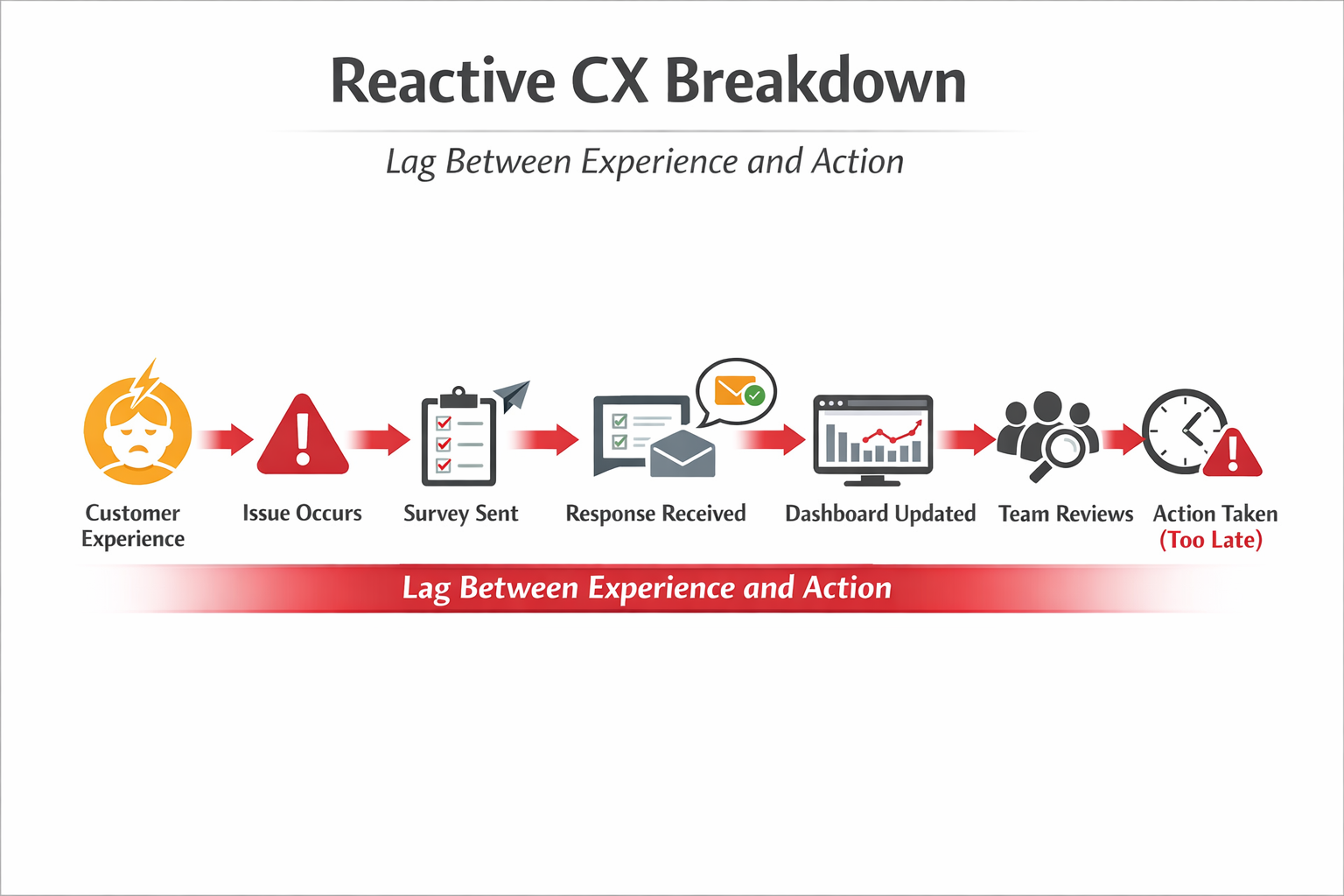
If you look at how most CX programs are designed today, they follow a familiar pattern: collect feedback, analyze responses, review dashboards, then decide what to improve. On the surface, it feels structured and measurable.
But the real question is: Does this system prevent problems or just explain them after they happen?
That’s the issue with reactive CX. It’s not wrong. It’s too late.
Reactive CX relies heavily on surveys like NPS and CSAT, but feedback is only a small slice of reality. Most customers never respond, and those who do often provide limited input. Critical signals confusion, hesitation, frustration go unnoticed. As a result, decisions are based on incomplete data, creating a distorted view of the customer journey. This is why 66% of companies believe CX has improved, while only 17% of customers agree.
Even when issues are identified, it happens after the experience has already failed. A drop-off, complaint, or low score triggers action but the moment that mattered is gone. And with 52% of customers willing to switch after a single bad experience, delay becomes costly.
Reactive CX can describe what happened, but struggles to explain why. It depends on manual interpretation and execution, slowing decisions and often leading to inaction. That’s why 30–40% of CX teams take no action after insights.
It’s not broken, just limited. It was built for a slower world. Today, CX moves in real time and reactive systems can’t keep up.
Now that you’ve seen where reactive CX breaks, the question is: what replaces it? This shift isn’t about better tools. It’s about a fundamentally different way of running customer experience.
Predictive CX is often misunderstood. Many platforms claim to be “predictive” because they use AI or analyze trends. But real predictive CX aligned with PXI doesn’t start with feedback or wait for outcomes. It starts with behavior in motion.
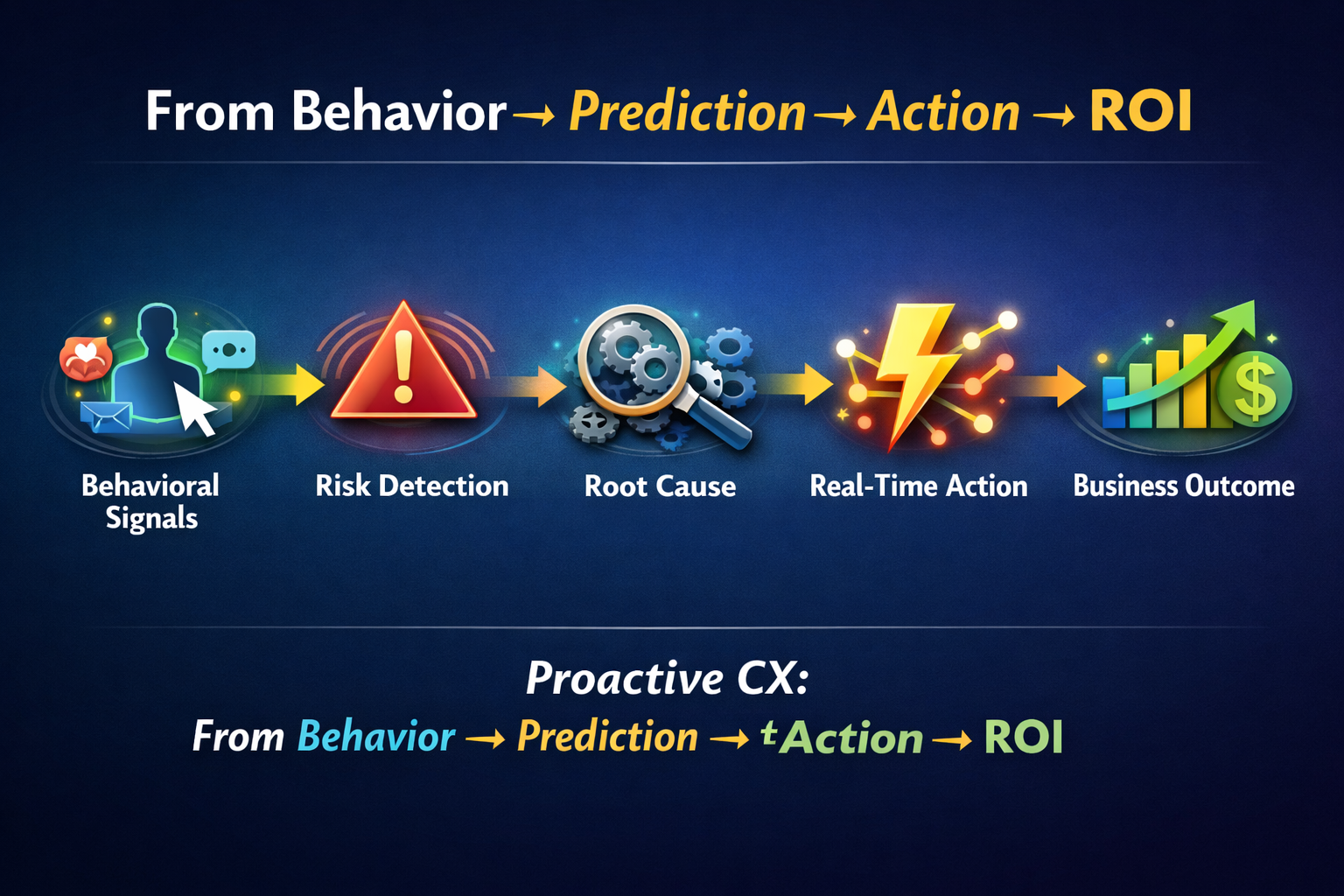
Every action becomes a signal: hesitation, retries, drop-offs, delays, unexpected exits. These aren’t just interactions, they’re early indicators of risk. So instead of asking “What happened?”, you ask “What is about to happen, and how do we act now?”
This is the core shift. Reactive CX gives insights. Predictive CX drives decisions in real time. A PXI-style system continuously detects signals, evaluates risk, identifies likely causes, and triggers responses while the customer is still in the journey.
Traditional CX relies on what customers say. Predictive CX relies on what they do. Behavior is continuous, unbiased, and appears before outcomes. A retry signals friction. A stalled journey signals risk. These signals come before churn or complaints, enabling foresight instead of hindsight.
Predictive CX doesn’t just detect it. Through alerts, automation, and contextual interventions, issues are resolved instantly. The impact is measurable: faster resolution, lower costs, reduced support demand.
This isn’t about better reporting. It’s about better outcomes preventing churn, improving conversion, and protecting revenue in real time.
At this point, the difference between reactive and predictive CX may sound obvious. But in reality, most enterprises are still operating in a hybrid state, partly reactive, partly trying to become predictive, without fully understanding what actually needs to change.
Because this is not a feature comparison. It’s a structural shift in how CX operates inside your business.
Reactive CX is built on what customers say. It depends on surveys like NPS and CSAT, where only a small percentage of customers respond and even fewer provide actionable insight.
That means you are making decisions based on:
Predictive CX flips this completely. It is built on what customers do.
Every interaction becomes data:
This creates a much more accurate and continuous view of the customer journey. Instead of sampling opinions, you’re observing reality.
Reactive CX is always late. By design.
It depends on:
Which means: By the time you see the problem, the experience is already broken.
Predictive CX operates in real time. It continuously monitors customer journeys and detects friction as it happens.
So instead of: “We discovered a drop-off last week”
You move to: “We detected friction and acted immediately”
This is the difference between reporting failure and preventing it.
Reactive CX answers: What happened?
It tells you:
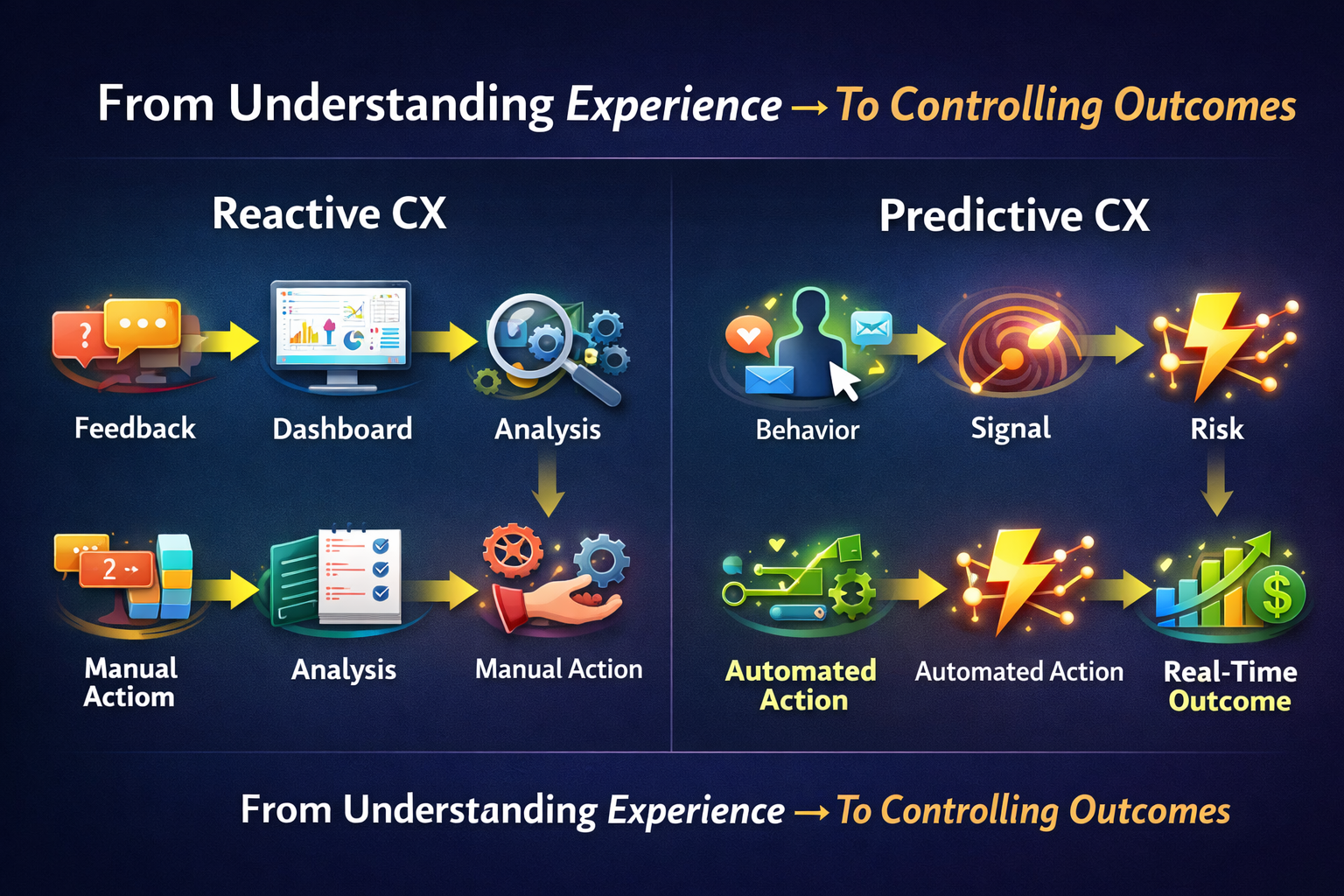
But it stops there. Predictive CX goes further.
It answers: What will happen next?
Using behavioral patterns and AI models, it identifies:
This allows you to act before outcomes occur.
As one expert insight puts it:
“If a metric only tells you what already happened, its history early signals beat perfect hindsight.”
And that’s exactly what predictive CX delivers.
Reactive CX depends heavily on people. Insights sit in dashboards. Teams review them. Actions are discussed.
And often: Nothing happens in time.
This is one of the biggest reasons why 30–40% of CX teams take no action on insights. Not because the insights are wrong but because the system does not enable execution.
Predictive CX removes this dependency. It embeds automation into the process itself.
It can:
So CX is no longer dependent on someone checking a dashboard. It becomes a self-operating system.
Reactive CX struggles with one critical question: What is the ROI of CX?
It tracks:
But connecting these to revenue, churn, or cost is often indirect and unclear. Predictive CX is built differently.
It directly links:
So you can measure:
This is why CX is no longer just a reporting layer. It becomes a performance driver.
If you step back, the difference becomes very clear:
Reactive CX is a system of understanding.
Predictive CX is a system of control.
One tells you what went wrong.
The other ensures it doesn’t.
And in a world where:
Waiting is no longer a viable strategy.
At this stage, the shift is clear. Reactive CX explains the past. Predictive CX anticipates the future.
But the real question for you is: How do you actually operationalise this inside your business?
Because strategy alone doesn’t change outcomes. You need a system that can continuously detect, decide, and act without waiting. This is exactly where Predictive Experience Intelligence (PXI) comes in.
Predictive Experience Intelligence (PXI)™ is an advanced CX-focused system developed by NUMR CXM that uses behavioral signals and AI to predict risks within customer journeys and prevents worse business and financial outcomes such as churn or drop-offs by triggering actions before problems occur.
This definition is important.
Because PXI is not:
It is an execution system. It transforms CX from something you measure into something you run.
Most CX systems stop at insight. PXI goes further.
It continuously analyzes live customer behavior across journeys:
And instead of waiting for feedback, it identifies early signals of friction.
For example:
A user starts a journey but exits midway.
A customer retries the same step multiple times.
A high-intent lead delays completing onboarding.
These are not random actions. They are signals of risk in motion. PXI captures these signals instantly and evaluates what is likely to happen next.
What makes PXI powerful is not just detection. It’s the closed-loop system behind it.
PXI operates through a continuous workflow:
Signal → Risk → Reason → Alert → Action → ROI
Here’s what that means in practice for you:
This is where CX stops being passive. It becomes self-operating and outcome-driven.
Let’s bring this into a real-world scenario.
A customer walks into a bank branch and opens the mobile app to start an account process but exits midway.
In a traditional system:
Nothing happens.
No feedback is collected.
The opportunity is lost.
In a PXI-driven system:
Result: The customer returns and completes onboarding.
That’s not just a better experience. That’s revenue saved in real time.
The biggest shift PXI brings is this:
CX is no longer a reporting layer. It becomes a decision system.
Instead of:
You move to:
As Sid Banerjee, Chief Strategy Officer at Medallia, highlights:
“In 2026, we’re going to see a shift in how organizations collect, analyze, and act on customer experience data using AI.”
PXI represents exactly that shift from data collection to real-time action. Predictive Experience Intelligence (PXI)™, an advanced CX-focused system developed by NUMR CXM, actually made this visionary statement into reality.
If you step back, PXI is not just an improvement in CX. It’s a redefinition of its role.
Traditional CX:
PXI-driven CX:
This is why more enterprises are moving toward PXI-style systems.
Because in a world where:
You can’t afford to react.
If your current CX stack still relies on surveys, dashboards, and manual execution, then your system is always behind the customer. PXI changes that. It puts you ahead of the outcome.
You’re no longer asking: “What went wrong?”
You’re deciding: “What needs to happen next right now?”
And that is the real shift from reactive CX to predictive CX in 2026.
At this point, the shift from reactive to predictive CX is not theoretical anymore; it's already happening inside enterprises. But here’s something important you need to understand.
Companies are not moving away from platforms like Zykrr because they are “bad tools.” They are moving because they’ve outgrown what these tools are designed to do.
Platforms like Zykrr were built to solve a very specific problem:
Capture customer feedback
Organize it
Analyze it
Help teams act on it
And to be fair, they do this reasonably well.
They help you answer questions like:
But the challenge is this: These are still post-event questions.
Even Zykrr itself highlights how CX programs often start with surveys, dashboards, and feedback systems before trying to connect them to outcomes like retention or revenue.
Which means: The system still depends on what customers tell you after the experience.
As CX matures, the expectations change. Leaders are no longer being asked: “Did we collect feedback?”
They are being asked:
And this is where the gap becomes obvious.
Because feedback platforms:
So even if you have dashboards full of insights you still don’t know what’s happening right now.
This is not about missing features. It’s about architecture.
Feedback-first platforms are built around: Signal (survey) → Analysis → Dashboard → Action
But modern CX requires: Behavior → Signal → Risk → Action (in real time)
That difference changes everything.
Because in high-volume customer journeys:
So if your system depends on feedback it will always be late.
This is why enterprises are moving toward predictive CX models powered by PXI.
Because PXI doesn’t rely on:
It relies on:
So instead of: “Let’s analyze what went wrong last week”
You move to: “Let’s prevent what is about to go wrong right now”
And that is the difference between improving CX vs controlling outcomes
If you’re currently evaluating Zykrr or similar platforms, the real question is not:
“Which tool has better dashboards?”
It’s: “Which system actually helps us act before we lose customers?”
Because many alternatives in the market including tools like SurveyMonkey, Qualtrics, or other feedback platforms still operate within the same feedback-first model. They may differ in UI, analytics, or integrations.
But structurally: They are still reactive.
If you want a deeper breakdown of how modern CX platforms compare and which ones actually move beyond reactive models check this detailed analysis of Top 7 Zykrr alternatives
This will help you understand:
Zykrr and similar platforms represent an important phase in CX evolution.
But in 2026 that phase is no longer enough.
Because CX is no longer about:
It’s about:
And that’s why enterprises are not just switching tools. They are switching models.
If you look at how customer experience is evolving across industries, one thing becomes very clear: Enterprises are not upgrading CX because they want to. They are doing it because they have to.
The shift toward predictive CX is not driven by trends or hype. It is driven by a combination of rising expectations, increasing complexity, and direct business pressure.
Earlier, CX was treated as a support function. You improved experience to reduce complaints or increase satisfaction scores. But today, the equation has changed.
CX now directly impacts:
This is why nearly 75% of businesses now prioritize CX over price and product, and 86% of customers are willing to pay more for better experiences. So when CX improves revenue improves. And when CX fails, revenue drops immediately.
Customer expectations have shifted faster than most systems.
Today, your customers expect:
And more importantly they expect issues to be resolved before they even complain.
This is being driven by AI-led experiences across industries. In fact, 73% of consumers say AI improves their experience, which means predictive, proactive interactions are quickly becoming the standard.
So if your CX system still waits for feedback it already feels outdated to your customer.
The biggest reason enterprises are moving away from reactive CX is simple: The cost of delay is too high.
When you detect problems late:
And in many cases the customer is already gone. Data shows that 52% of customers will switch to a competitor after just one bad experience.
Which means:
reacting after the fact is not recovery
it’s damage control
This is why reactive CX is no longer just inefficient. It is financially risky.
Most organizations are not struggling with data anymore.
But there is still a major gap. Data exists. Action does not. This is why many CX programs feel stuck.
You can see:
But you still can’t act in real time.
Predictive CX closes this gap by turning: data → signals → decisions → actions
AI is no longer an innovation layer. It is becoming the foundation of CX.
Today:
And predictive capabilities are no longer optional. They are expected.
This includes:
So the question is no longer: “Should we use AI in CX?”
It is: “Are we using it fast enough to stay competitive?”
One of the most important trends in 2026 is that not all companies are benefiting from AI and CX investments equally. While many are adopting tools only about 5% of enterprises are achieving strong AI ROI.
This creates a clear divide:
Leaders:
Others:
And this gap is increasing. Because predictive CX is not just about having the right tools. It’s about having the right system to act on them.
If you bring all of this together, the direction is obvious.
Enterprises are moving away from:
And toward:
As one expert insight highlights: “Predictive and proactive CX will become expected AI is making customer data actionable.”
That line captures the shift perfectly.
If your CX system is still built around:
Then you are always reacting.
But if you move toward predictive CX:
You act before customers leave
You resolve issues before escalation
You protect revenue before loss
And that is why enterprises are not slowly exploring this shift. They are actively moving toward it.
If you strip everything down to its core, the shift we’ve been discussing is not about CX tools. It’s about how you run your business decisions around customers.
Because for years, most enterprises have approached CX in the same way:
And while this approach feels structured, it has one fundamental flaw it operates after the experience is already over.
Many organizations today believe they have strong CX programs. They run NPS. They track CSAT. They have dashboards and reporting layers. And on paper, everything looks solid.
But when you look at outcomes:
This creates a dangerous illusion. You feel in control because you have data. But in reality: You are still reacting to outcomes you can no longer change.
Measurement tells you what happened.
But it does not:
And in fast-moving customer environments, timing is everything.
By the time a dashboard shows a drop:
This is why modern CX leaders are moving away from a measurement-first mindset. Because measurement without action is delayed.
The next evolution of CX is not about better analytics. It’s about intervention at the right moment. This is where predictive CX and more specifically PXI changes the game.
Instead of: “Let’s analyze what went wrong”
You move to: “Let’s intervene before it goes wrong”
This is a completely different operating model.
One that focuses on:
Not after it ends.
When you adopt a predictive, PXI-driven approach, CX stops being a program. It becomes a continuous decision system.
One that is always:
And most importantly learning and improving continuously
This is what transforms CX from a passive function into an active system inside your business.
If your current CX strategy is still built around:
Then your system is structured for understanding. But not for control. And in today’s environment understanding is not enough.
Because:
So the real advantage comes from how quickly you can detect and act
If you had to summarize everything into one simple distinction:
Reactive CX = Explains outcomes
Predictive CX (PXI) = Controls outcomes
One tells you what happened. The other ensures it doesn’t happen again.
The shift from reactive to predictive CX is not optional anymore.
It is already defining:
And the difference is not in how much data they have. It’s in what they do with it and when they do it.
By now, you understand the shift. Reactive CX explains what happened. Predictive CX anticipates what will happen.
But there’s still one critical gap most enterprises face: How do you actually make this work in real business environments?
Because strategy is easy to discuss. Execution is where most CX systems fail.
Many platforms today position themselves as:
But when you look closely, they still follow the same old pattern:
So even with advanced analytics the system still depends on manual execution.
Which means:
action is delayed
opportunities are missed
outcomes are not controlled
This is why most enterprises struggle to move from insight to impact.
Numr CXM is not a traditional CX platform with predictive features added on top. It is built entirely on Predictive Experience Intelligence (PXI). And this is the key difference.
Predictive Experience Intelligence (PXI)™ is an advanced CX-focused system developed by NUMR CXM that uses behavioral signals and AI to predict risks within customer journeys and prevents worse business and financial outcomes such as churn or drop-offs by triggering actions before problems occur.
This is not a layer. It is the foundation of the system.
Instead of focusing on surveys or dashboards, Numr continuously runs a real-time intelligence loop across your entire customer journey:
Signal → Risk → Reason → Alert → Action → ROI
Here’s what that means for you in practice:
So instead of waiting for problems to appear the system prevents them while the journey is still active.
Let’s simplify this with a real-world example.
A high-intent customer starts onboarding but drops off midway.
In a traditional system:
In Numr’s PXI-driven system:
Result: The customer completes onboarding instead of leaving.
That is not just better than CX. That is revenue protection in real time.
Most CX platforms help you understand problems. Numr helps you prevent them. That difference changes everything.
Because now CX is no longer:
It becomes a decision engine embedded inside your operations.
One that continuously:
This is where Numr solves the biggest gap in CX today.
Most enterprises already have:
But they lack: real-time execution
Numr bridges this gap.
It ensures that:
insights don’t sit in dashboards
actions don’t wait for meetings
outcomes are influenced immediately
If you’re still relying on traditional CX platforms, your system is built to understand the past. If you move to a PXI-driven system like Numr:
You start controlling the future.
You don’t wait for customers to complain.
You don’t wait for dashboards to update.
You act while the experience is still happening.
And that is the real difference between modern CX in theory vs modern CX in practice
.
If your current CX strategy still depends on surveys, dashboards, and delayed actions, then you’re not alone but you are already behind where CX is heading.
The real opportunity is not collecting more feedback. It’s acting on the right signals at the right time.
With a PXI-driven approach like Numr, you can:
So instead of asking “what went wrong?” After the fact you start deciding “what should happen next?” while the journey is still active.
If you want to see how this works in your business context:
Book a demo and understand how PXI can turn your CX into a real-time decision system.
Predictive customer experience uses AI, behavioral data, and real-time signals to anticipate customer needs and risks. Instead of reacting after issues occur, it enables organizations to act before problems impact the customer or the business.
Reactive CX is a traditional approach where companies collect feedback through surveys like NPS and CSAT, analyze past interactions, and take action after the experience has already happened.
The key difference is timing and execution. Reactive CX looks at past events and responds after problems occur, while predictive CX detects risks in real time and enables proactive action before customer experience breaks down.
Reactive CX relies on delayed feedback, low response rates, and manual workflows. In fast-moving customer journeys, this leads to late actions, missed opportunities, and direct revenue loss.
Predictive CX identifies early behavioral signals such as inactivity, drop-offs, or repeated failures. These signals indicate risk, allowing businesses to intervene before customers decide to leave.
Behavioral signals are real-time customer actions such as clicks, navigation patterns, retries, delays, and drop-offs. These signals provide insight into customer intent and friction points before outcomes occur.
NPS and CSAT measure customer sentiment after the experience. They do not capture real-time behavior, predict future outcomes, or enable immediate action, which limits their effectiveness in modern CX strategies.
Customer experience automation refers to systems that automatically trigger actions such as alerts, workflows, or interventions based on real-time data and predictive insights, reducing reliance on manual processes.
AI enables real-time analysis of large-scale customer data, predicts outcomes like churn or conversion, automates decision-making, and personalizes interactions across customer journeys.
Churn prediction uses machine learning and behavioral data to identify customers who are likely to stop using a product or service, allowing companies to take preventive action.
Predictive Experience Intelligence (PXI)™ is an advanced CX-focused system developed by NUMR CXM that uses behavioral signals and AI to predict risks within customer journeys and prevents worse business and financial outcomes such as churn or drop-offs by triggering actions before problems occur.
Dashboards provide historical insights but require manual interpretation and action. Modern CX systems move beyond dashboards by enabling automated, real-time decision-making and intervention.
Predictive CX directly impacts revenue by reducing churn, improving conversions, optimizing journeys, and lowering operational costs through proactive intervention.
Industries with high customer volume and complex journeys such as banking, insurance, retail, telecom, and automotive benefit the most from predictive CX.
It is the ability to track customer interactions across multiple touchpoints as they happen, allowing organizations to detect friction and take immediate action.
By identifying risks early and enabling proactive engagement, predictive CX ensures issues are resolved before customers disengage or switch to competitors.
Machine learning identifies patterns in customer behavior, predicts outcomes, and continuously improves decision-making by learning from new data over time.
Customer experience directly influences retention, lifetime value, and purchase decisions, making it a measurable driver of business performance rather than just a support function.
Churn reduction strategies involve identifying at-risk customers, understanding friction points, and taking proactive actions to retain them before they leave.
Enterprises should adopt predictive CX. It enables real-time action, proactive decision-making, and measurable business outcomes, making it essential for modern CX strategy.


.png)
.png)

.png)
.png)