.png)
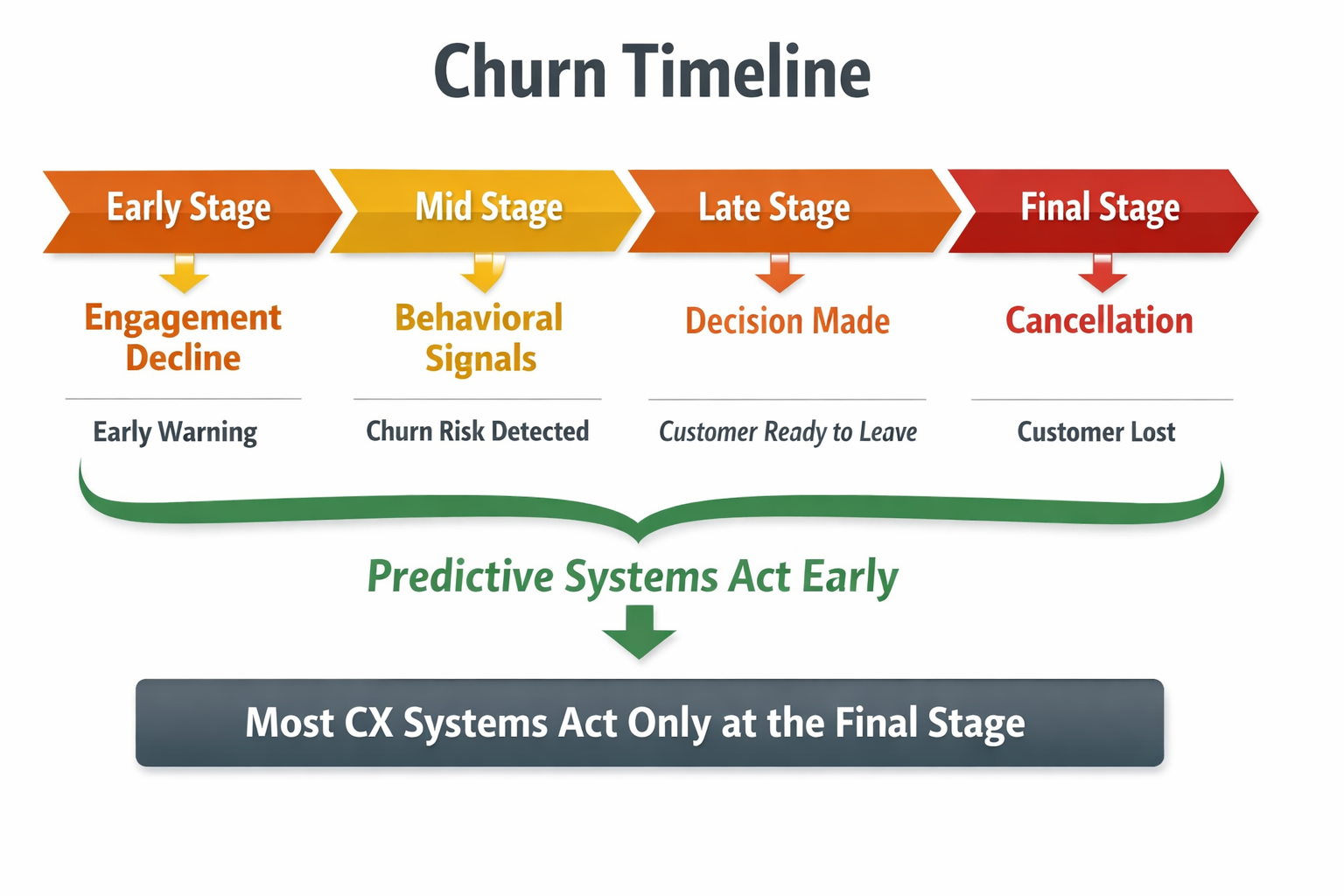
• Most enterprises assume churn happens when a customer cancels but in reality, churn begins weeks or months earlier through gradual behavioral changes.
• Traditional retention strategies rely on late-stage signals like renewals, complaints, or NPS feedback when the decision to leave is often already made.
• This makes reactive retention ineffective, as it attempts to recover customers after disengagement has already occurred.
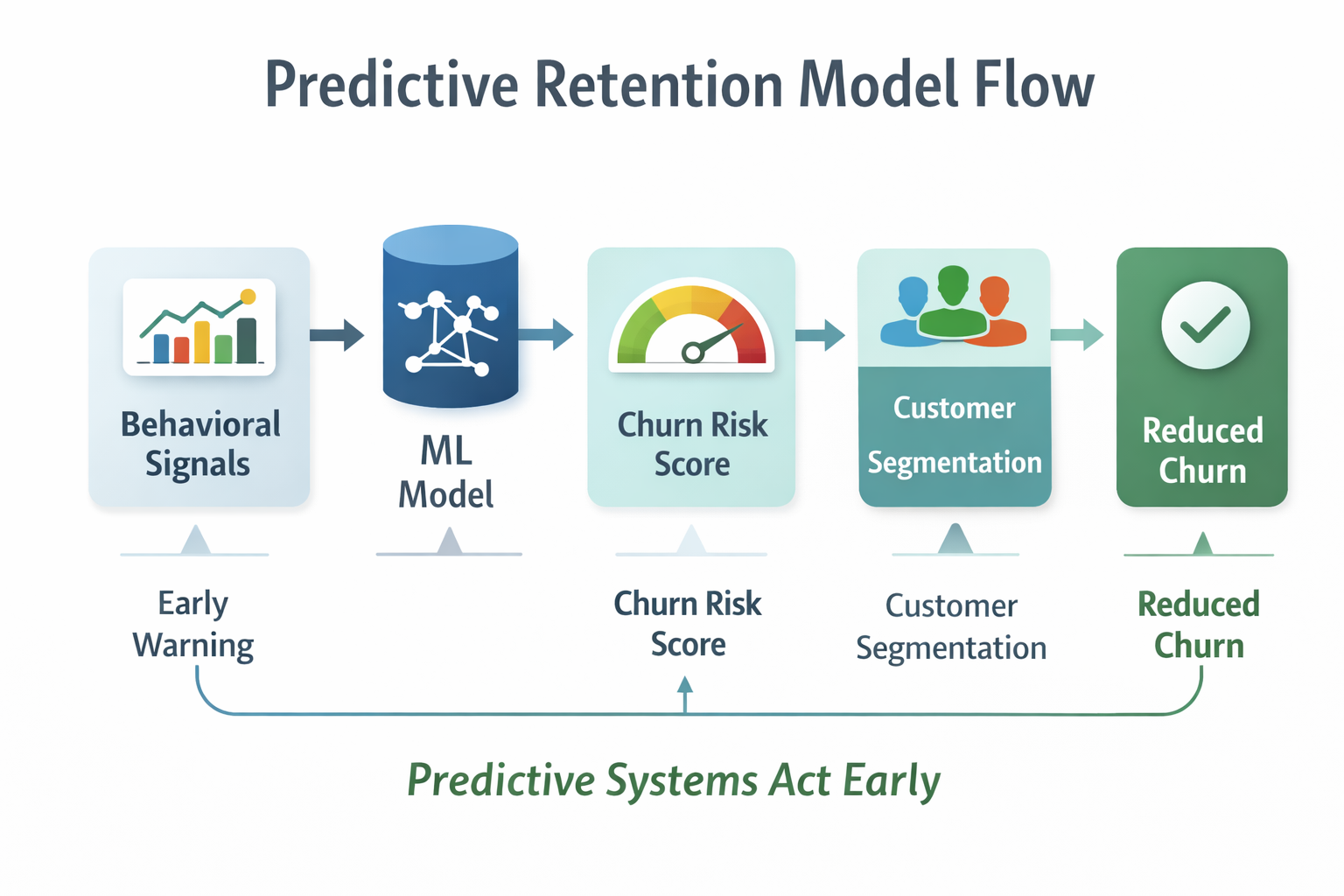
• Predictive retention models solve this by identifying early warning signals in customer behavior and assigning churn risk scores in real time.
• These systems enable enterprises to intervene before churn becomes irreversible, shifting retention from recovery to prevention.
• Organizations using predictive retention typically see 15–25% churn reduction, with advanced implementations reaching up to 40%.
• In 2026, retention is no longer about reacting to churn, it is about predicting and preventing it.
• Enterprises that adopt predictive retention models gain a measurable advantage in retention, customer lifetime value, and revenue growth.
When Does Customer Churn Actually Begin?
Most enterprises believe churn happens at cancellation. That a customer decides to leave, clicks a button, and that is the moment churn occurs. But if you look closely at your customer journeys, you will see something very different.
Churn does not happen in a moment. It happens over time. It starts quietly.A customer logs in less frequently.
They stop exploring new features.
They encounter friction but don’t report it.
They disengage, slowly and silently.
And long before they cancel, the decision is already made. In many enterprise environments, churn is effectively decided 60 to 90 days before the actual exit. By the time renewal cycles begin or customer success teams step in, the outcome is already predictable.
This is where most retention strategies fail. Because they are designed to act at the end of the journey.
They rely on:
renewal reminders
reactive outreach
last-minute retention campaigns
Which means: By the time you act, the customer has already decided
This is the uncomfortable truth about churn. You are not losing customers at the end. You are losing them much earlier when signals first appear, but go unnoticed.
Most enterprises are not failing to retain customers because they don’t care. They are failing because they are acting too late. Their systems detect churn after disengagement. Their teams respond after frustration builds.
And their strategies focus on recovery not prevention. This creates a fundamental mismatch. Because in modern customer journeys, timing is everything.
If you act early, you can change the outcome.
If you act late, you can only try to recover it.
And recovery is always harder, more expensive, and less effective.
This is exactly why retention is evolving. Not from one campaign to another. But from one model to another.
From reactive retention to predictive retention
From late-stage intervention to early-stage detection
From saving customers to preventing churn entirely
Because the future of retention is not about responding when customers leave. It is about identifying when they start leaving and acting before they do.
Once you accept that churn is not a single moment but a gradual process the next question becomes critical: How do you detect that process early enough to change the outcome?
This is exactly where predictive retention models come in.
They are not just analytics tools.
They are decision systems.
Instead of waiting for customers to cancel, complain, or respond to surveys, predictive retention models continuously analyze real-time behavioral data to identify which customers are at risk of leaving long before churn becomes visible. This fundamentally changes how retention works.
From reacting to churn to preventing it
From guessing risk to quantifying it
Traditional retention systems treat churn as an event.
A customer cancels.
A renewal fails.
An account becomes inactive.
And only then does the system respond. This creates a reactive loop. You identify churn after it happens, and then try to recover it. Predictive retention models break this pattern. They treat churn as a probability.
Every customer is continuously evaluated based on their behavior, engagement patterns, and interaction history. Instead of asking: “Did this customer churn?”
The system asks: “How likely is this customer to churn next?”
This simple shift changes everything. Because once you understand risk as a probability, you gain time.
Time to intervene.
Time to influence.
Time to prevent the outcome entirely.
When churn is treated as an event, action is always delayed.
When churn is treated as a probability, action becomes proactive.
You can identify high-risk customers early.
You can prioritize interventions intelligently.
You can allocate resources where they create the most impact.
And instead of reacting to churn, you start shaping it.
At the core of predictive retention models is behavioral data. Not surveys. Not assumptions. But real customer activity. These systems analyze how customers interact with your product or service across the entire journey:
This behavioral layer is often referred to as digital body language. And it is one of the most powerful indicators of intent.
Customers rarely announce that they are about to leave.But they always show it.
A decline in usage.
A shift in engagement patterns.
A change in interaction frequency.
These are not random changes. They are early warning signals. Behavior tells you what customers are experiencing right now while feedback only tells you what they felt after the fact.
And that difference is critical. Because early detection is what makes prevention possible.
Traditional retention strategies are broad and reactive.
They rely on:
mass campaigns
generic offers
last-minute outreach
Every customer is treated similarly, regardless of their actual risk level. Predictive retention models introduce precision. Each customer is assigned a churn risk score. Each segment is dynamically updated based on real-time behavior.
This allows you to move from one-size-fits-all retention to targeted, high-impact intervention. High-risk customers can be prioritized immediately. Medium-risk customers can be nurtured proactively. Low-risk customers can continue without unnecessary intervention.
At enterprise scale, this level of prioritization cannot be done manually. Predictive models automate it.
They continuously update risk scores, refine segments, and surface actionable insights allowing your teams to focus on what actually matters.
Prediction alone does not reduce churn. Execution does. This is where modern predictive retention systems go beyond analytics. They do not just identify risk, they trigger action.
When a high-risk signal is detected, the system can initiate:
personalized engagement
customer success outreach
in-product guidance
targeted retention offers
This creates a closed-loop system where insight leads directly to intervention.
This is also where predictive retention aligns with broader CX transformation. It is not just about knowing which customers will churn. It is about acting in the moment when that risk appears.
This is the foundation of predictive intelligence in CX where behavioral signals are continuously monitored, risks are anticipated, and actions are triggered in real time.
In 2026, retention is no longer about reacting to churn at the end of the journey. It is about identifying the earliest signals of disengagement and acting before they escalate.
Customers move faster.
Expectations are higher.
Switching is easier than ever.
In this environment, waiting is no longer an option. Enterprises that rely on reactive retention will always be behind. Those that adopt predictive retention models gain a critical advantage:
They see risk earlier.
They act faster.
They prevent losses before they happen.
The question is no longer: “Why are customers leaving?”
The real question is: “Can you detect when they start leaving?”
Because once you can answer that you can change the outcome.
Once you understand how churn actually develops and how predictive models detect it early the next question becomes more practical: Why does this shift matter at a business level?
The answer is simple. Because retention is no longer a support function. It is a revenue function. And predictive retention models are one of the fastest ways to influence that revenue directly.
Traditional retention focuses on minimizing loss. You try to reduce churn after it happens. You attempt to recover customers at the end of the journey.
But recovery is always limited. Once a customer has mentally disengaged, even aggressive retention efforts struggle to bring them back. Predictive retention changes this dynamic. It allows you to act earlier when the customer is still engaged enough to influence.
This is where the real impact comes from. Because preventing churn is significantly more effective than trying to reverse it.
When you act early:
You retain more customers
You improve lifetime value
You reduce acquisition pressure
This is not just theoretical. Organizations that implement predictive retention models consistently see measurable results.
Typical outcomes include:
These numbers highlight a clear shift. Retention is no longer just about reducing loss. It is about unlocking growth.
Another key benefit is speed. Predictive systems operate in real time.
They detect signals early, assign risk instantly, and enable immediate intervention. Compared to manual processes, this significantly reduces response time.
And in retention, speed directly impacts outcomes. The earlier you act, the higher your chances of success.
This is where predictive retention evolves into something more powerful. It becomes part of a broader system: Predictive Experience Intelligence (PXI)™
Predictive Experience Intelligence (PXI)™ is an advanced CX-focused system developed by NUMR CXM that uses behavioral signals and AI to predict risks within customer journeys and prevents worse business and financial outcomes such as churn or drop-offs by triggering actions before problems occur.
Instead of treating retention as a separate function, PXI integrates it into the entire customer experience.
It continuously monitors behavior across journeys, detects early warning signals, predicts churn risk, identifies root causes, and triggers action automatically.
This creates a closed-loop system: Signal → Risk → Reason → Alert → Action → ROI
Which means:
You are not just identifying churn risk.
You are acting on it instantly.
This is the key shift. Traditional predictive models tell you who might churn. PXI ensures you actually do something about it. It connects intelligence directly to execution.
So instead of dashboards full of risk scores, you get:
real-time alerts
automated interventions
measurable outcomes
And that is what turns predictive retention into real business impact.
In today’s environment, customer behavior is faster, more dynamic, and less forgiving.Customers don’t always complain.
They don’t always give feedback.
They simply leave.
This means you cannot rely on late signals anymore. You need systems that detect change early and respond instantly. This is why predictive retention models, especially when powered by PXI, are becoming essential.
As Michael Mallett, VP Digital Center of Excellence at Medallia, explains:
“The new customer journey will not begin on your website; customers are making decisions before they ever reach your website.”
This insight highlights a critical reality. Customer decisions happen earlier than most systems can detect. And if your retention strategy starts late you have already lost.
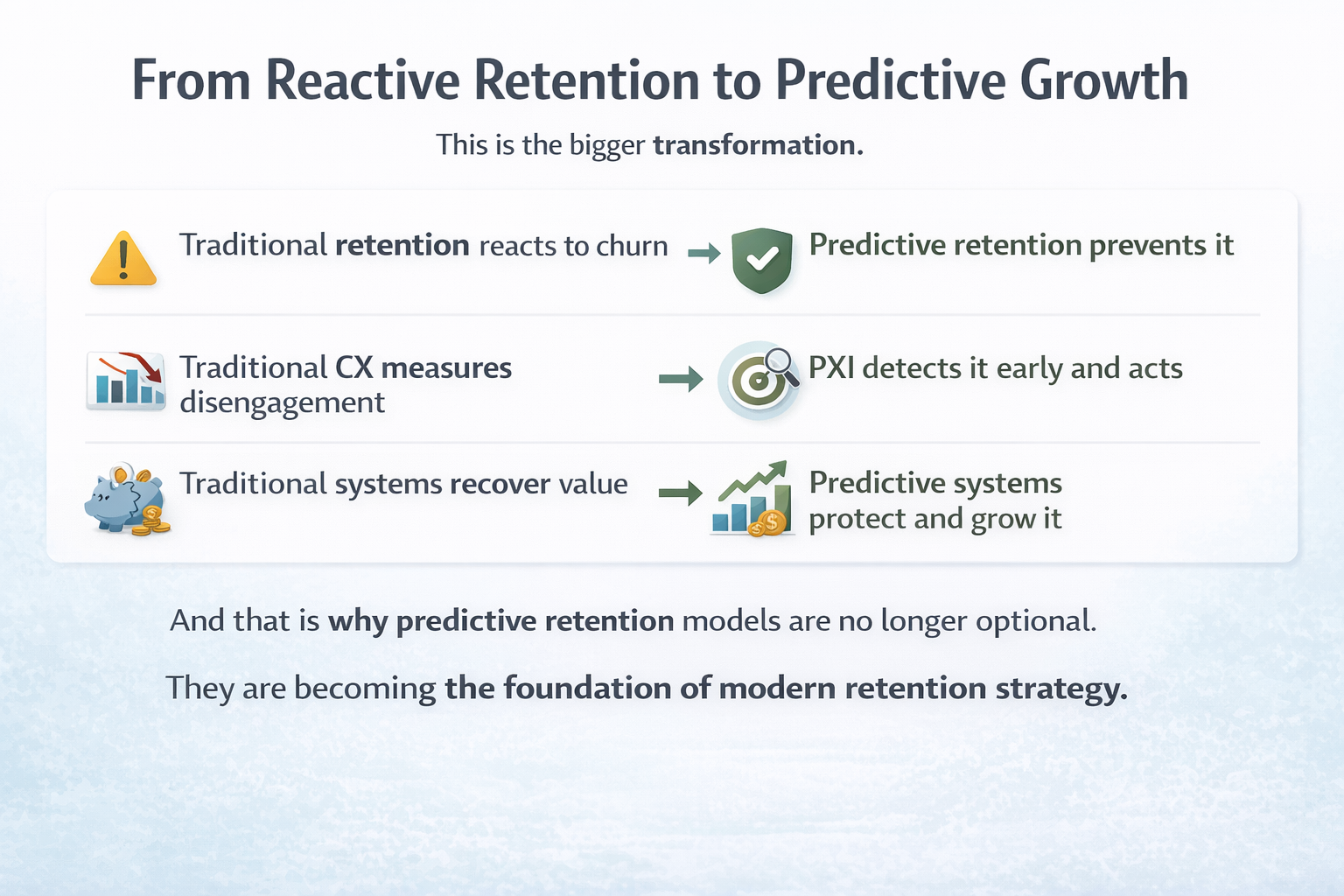
This is the bigger transformation.
Traditional retention reacts to churn
Predictive retention prevents it
Traditional CX measures disengagement
PXI detects it early and acts
Traditional systems recover value
Predictive systems protect and grow it
And that is why predictive retention models are no longer optional. They are becoming the foundation of modern retention strategy.
Retention is not about saving customers at the end. It is about keeping them engaged throughout the journey. And the only way to do that at scale is to detect risk early and act before it’s too late.
Understanding the value of predictive retention is important. But what actually matters is how it works in practice. Because predictive retention is not a single feature or a dashboard.
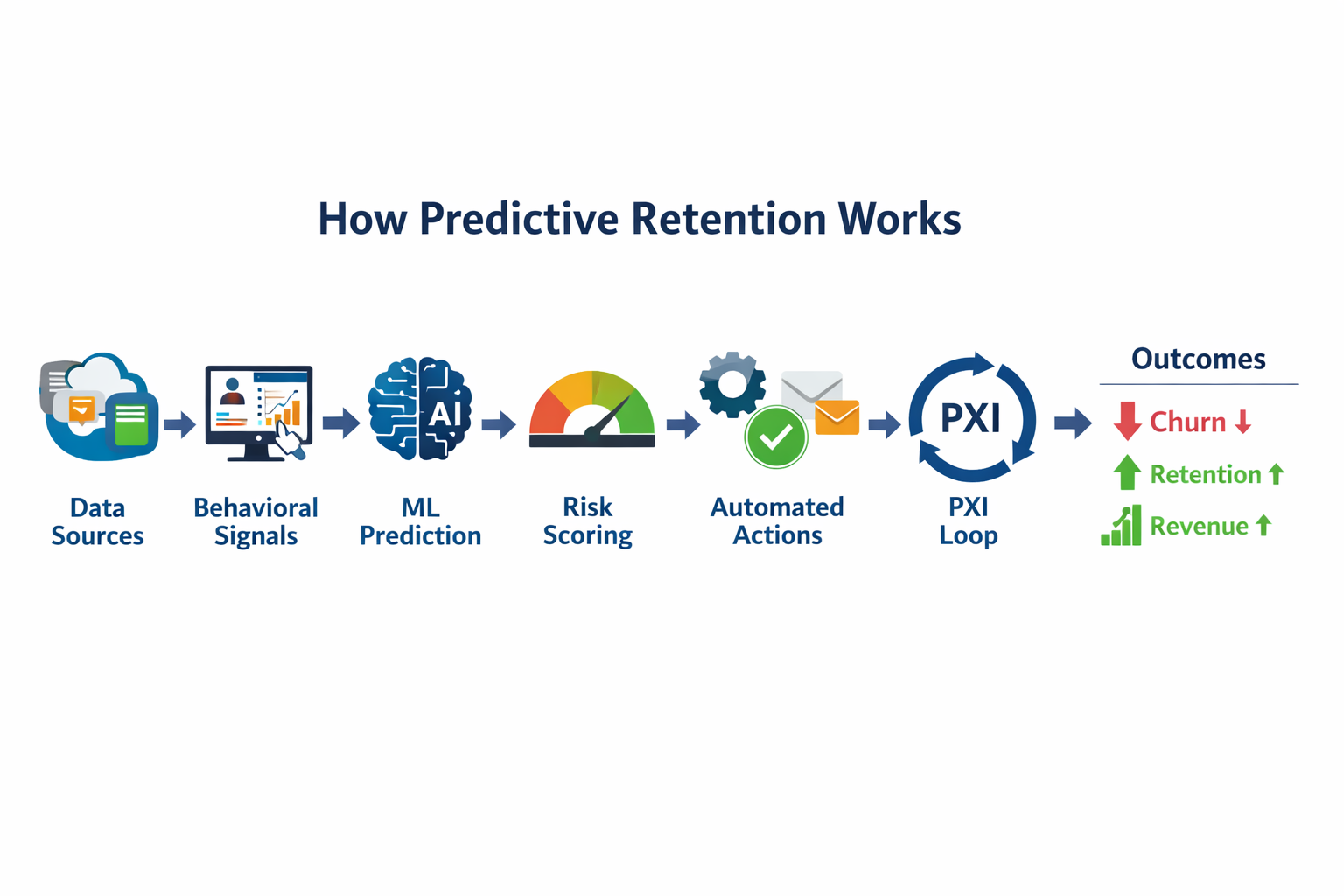
It is a system. A system that connects data, intelligence, and execution into a continuous loop so that churn risk is not just identified, but acted upon in real time.
Everything starts with data. But not just more data connected data.
Predictive retention models require inputs from multiple systems:
In most enterprises, this data exists but it is fragmented. And fragmented data leads to fragmented insight.
If you cannot see the full customer journey, you cannot predict it accurately. Unifying behavioral, transactional, and feedback data into a single pipeline creates a complete view of the customer.
This is what enables:
real-time monitoring
consistent risk detection
accurate prediction
Without this foundation, everything else becomes unreliable.
Once data is unified, the system begins to detect patterns. Not obvious failures. But subtle changes. These are the early signals of churn.
Predictive systems look for micro-behaviors such as:
declining login frequency
reduced feature usage
repeated errors or retries
increased support interactions
delayed payments or renewals
Individually, these signals may seem small. But together, they form patterns. And those patterns reveal intent. This is where predictive retention gains its advantage by detecting risk long before it becomes visible in traditional systems.
At the core of predictive retention models is machine learning. These models are trained using historical data to understand which behavioral patterns lead to churn. Over time, they learn.
They refine their predictions.
They adapt to new patterns.
Using techniques such as regression models and ensemble algorithms, the system assigns a churn probability score to each customer.
This score represents:
how likely the customer is to churn
within a specific timeframe
This is where predictive intelligence in CX becomes powerful. It transforms raw behavioral data into forward-looking insights that teams can act on immediately.
Once churn probability is calculated, customers are segmented based on risk. But unlike traditional segmentation, this is not static. It is dynamic. Customers move between segments in real time as their behavior changes.
This allows you to focus your efforts where they have the highest impact:
High-risk customers → immediate intervention
Medium-risk customers → proactive engagement
Low-risk customers → minimal effort
This prioritization ensures that retention efforts are efficient and scalable. And instead of spreading resources thin, you concentrate on the customers who need attention most.
This is where predictive retention becomes truly powerful. Because traditional systems stop at insight. Predictive systems go further. They act.
Once a risk is detected, the system can automatically trigger actions such as:
personalized outreach
in-product guidance
customer success interventions
targeted offers or incentives
This creates a closed-loop system:
Insight → Action → Outcome
No delays. No manual bottlenecks. Just continuous response.
This is also where predictive retention connects with a broader CX framework: Predictive Experience Intelligence (PXI)
Instead of treating retention as a standalone process, PXI integrates it into the entire customer experience.
It ensures that every signal leads to action through a continuous loop:
Signal → Risk → Reason → Alert → Action → ROI
This means:
You don’t just know who is at risk.
You know why they are at risk.
And you act immediately to change the outcome.
Without execution, prediction has no value. PXI ensures that predictive retention is not just analytical but operational. It connects detection directly to intervention, turning risk into opportunity.
When all these steps come together, predictive retention becomes a living system.
It continuously:
collects data
detects signals
predicts outcomes
prioritizes risk
triggers action
And it does all of this in real time.
Predictive retention models are not about better reporting. They are about better timing. Because when you can detect risk early and act instantly you don’t just manage churn. You prevent it.
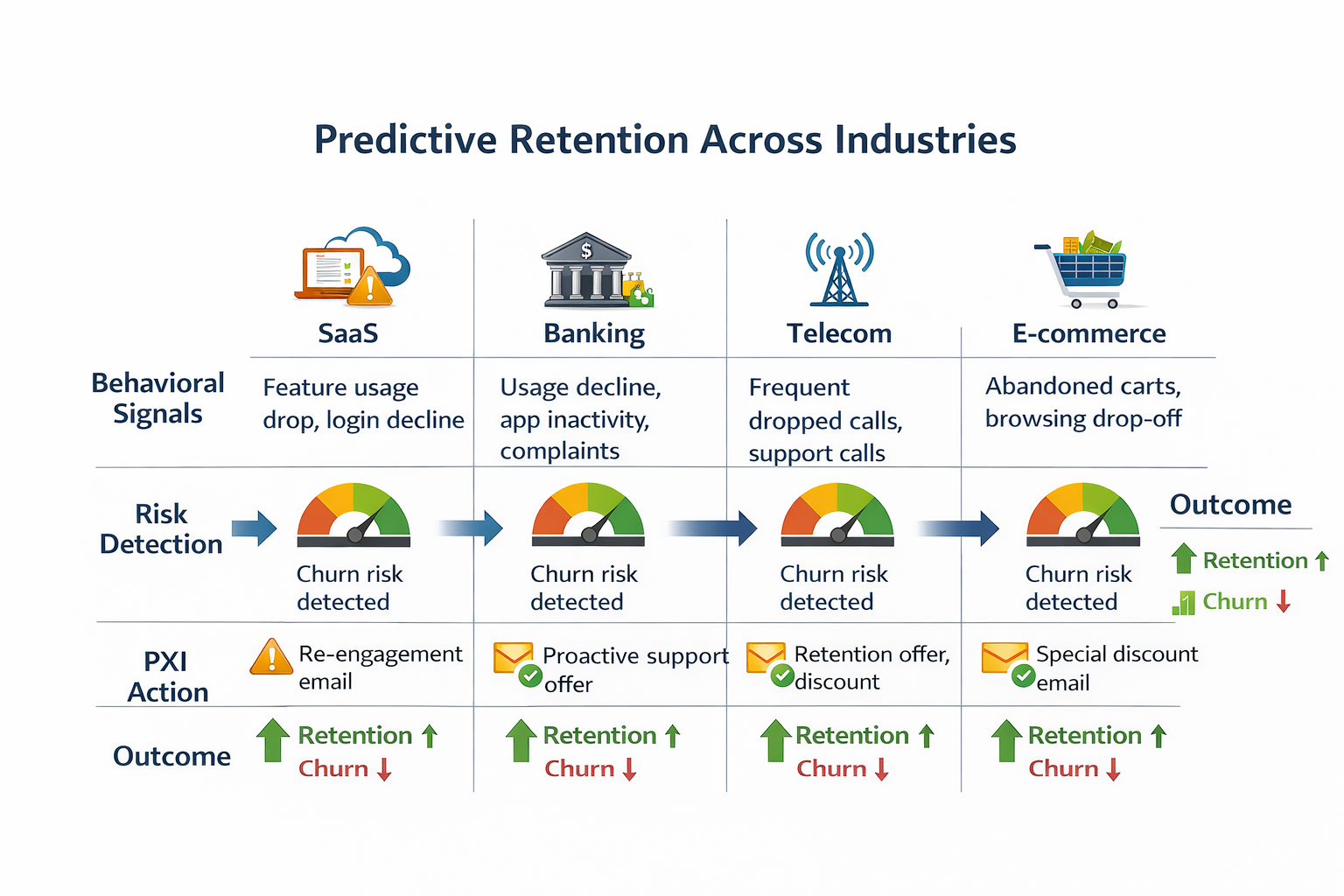
Predictive retention models are not just theoretical frameworks. They are already being applied across industries where customer journeys are complex, high-volume, and revenue-critical.
And when you look at how different sectors use these models, one pattern becomes clear: The goal is always the same: detect risk early and act before churn happens. What changes is the context.
In SaaS businesses, churn rarely happens suddenly. It builds over time through declining engagement.
Customers stop using key features.
They log in less frequently.
They fail to adopt new capabilities.
These are early indicators that the product is losing value for the customer. Predictive retention models detect these patterns in real time.
When a drop in usage is detected, the system can trigger:
customer success outreach
guided onboarding for underused features
in-app prompts or tutorials
Instead of waiting for renewal cycles, SaaS companies can intervene while the customer is still active improving retention before the decision to leave is finalized.
In banking, churn is often silent. Customers don’t always close accounts immediately. They simply stop using services.
Reduced transactions.
Lower engagement with digital channels.
Dormant accounts.
These behaviors indicate declining relationship value.
Predictive systems detect these signals early and trigger:
personalized offers
relationship manager outreach
nudges to re-engage with services
With approaches like PXI, these signals are not just identified, they are connected to real-time action, ensuring that disengagement is addressed before it becomes permanent.
In telecom, churn is highly competitive. Customers frequently switch providers for better pricing, coverage, or service quality.
Early warning signals include:
decline in usage
increased complaints
frequent plan comparisons or changes
Predictive retention models enable telecom providers to:
offer better plans proactively
resolve service issues early
provide targeted incentives
Instead of reacting after a customer leaves, they act before the switch happens protecting both revenue and customer relationships.
In e-commerce, churn often appears as inactivity. Customers who previously engaged regularly suddenly stop browsing, purchasing, or interacting. This drop in activity is one of the earliest indicators of churn risk.
Predictive systems identify these patterns and trigger:
personalized recommendations
targeted discounts
re-engagement campaigns
This allows brands to bring customers back before they are completely lost turning potential churn into renewed engagement.
Subscription-based businesses face a critical moment at renewal. But by the time renewal arrives, churn decisions are often already made.
Predictive retention models detect early signals such as:
reduced content consumption
lower engagement frequency
partial usage of services
With early detection, platforms can:
recommend relevant content
offer personalized experiences
provide incentives before renewal
This shifts retention from last-minute persuasion to continuous engagement.
Despite different use cases, the underlying principle remains consistent.
Predictive retention models work because they:
detect behavioral signals early
predict risk before outcomes occur
trigger actions in real time
And when combined with systems like Predictive Experience Intelligence (PXI), this becomes even more powerful. Because PXI ensures that every detected signal leads to:
risk identification
root cause analysis
automated intervention
No matter the industry, the transformation is the same:
From delayed reaction to real-time prevention
From generic retention campaigns to precise, behavior-driven intervention
From losing customers silently to identifying risk before it escalates
At enterprise scale, even small improvements in retention create massive impact.
A slight increase in engagement.
A small reduction in churn.
Multiplied across millions of customers this translates into significant revenue gains. And predictive retention models make this possible by ensuring that no signal goes unnoticed and no opportunity to act is missed.
Churn does not look the same across industries.
But the solution does.
Detect early
Act fast
Prevent loss
And that is exactly what predictive retention models enable.
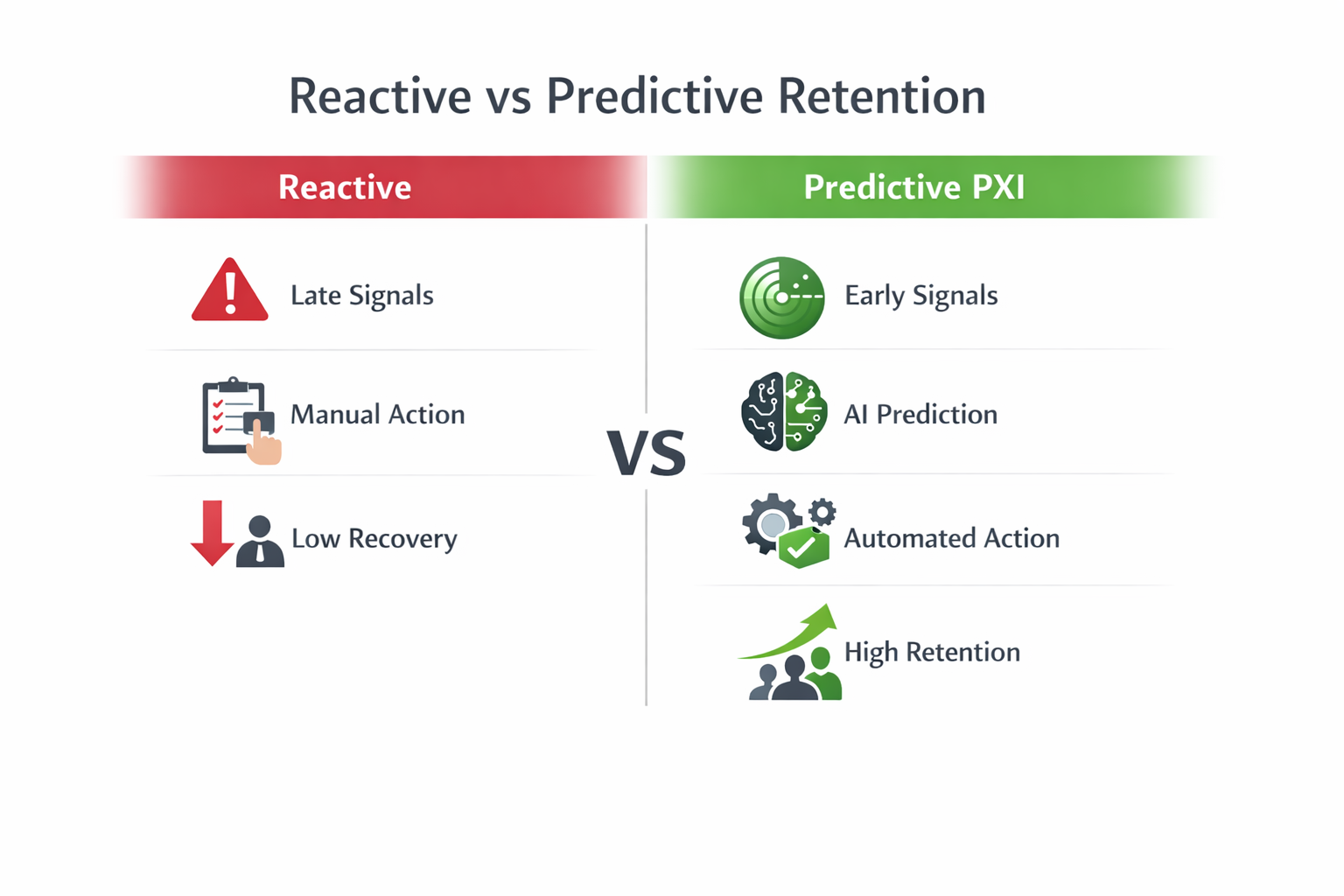
At this point, the difference between reactive and predictive retention is not just about improvement. It is about how your entire retention system is designed to operate.
Because both approaches aim to reduce churn. But they operate at completely different points in the customer journey and that difference determines the outcome.
Reactive retention operates at the end of the lifecycle.
It depends on late-stage signals such as:
By the time these signals appear, the customer has already experienced friction. In many cases, they have already decided to leave.
Reactive retention is essentially recovery. You are trying to change a decision that has already been made.
This creates multiple limitations:
low success rates
higher cost of intervention
inconsistent outcomes
Because once a customer is mentally disengaged, even strong offers or outreach may not be enough to bring them back.
Predictive retention operates much earlier. It focuses on identifying signals that indicate disengagement before churn becomes visible.
These include:
declining usage
behavioral shifts
inactivity patterns
friction in journeys
Instead of waiting for confirmation, predictive systems detect risk as it emerges.
When you act early:
the customer is still engaged
the relationship is still recoverable
the experience can still be improved
This makes interventions more effective, less costly, and more scalable.Because you are influencing the journey not trying to fix it after it breaks.
Reactive retention depends heavily on manual processes.
Teams review reports.
They identify at-risk customers.
They decide what actions to take.
This creates delays and inconsistencies. Predictive retention systems reduce this dependency.
They continuously:
detect signals
calculate risk
prioritize customers
trigger actions automatically
This transforms retention from a manual process into a system-driven capability.
At enterprise scale, manual retention simply does not scale.
Predictive systems enable you to manage millions of customers with consistent speed and accuracy without increasing operational complexity.
Reactive retention often relies on broad campaigns.
Mass emails.
Generic discounts.
Standard outreach scripts.
Every customer receives similar treatment, regardless of their actual risk or context. Predictive retention introduces precision. Each customer is evaluated individually. Each intervention is tailored based on behavior and risk level.
This allows you to:
focus on high-impact segments
avoid unnecessary outreach
improve conversion rates of retention efforts
Instead of reacting broadly, you start acting intelligently.
You know who to prioritize.
You know when to act.
You know what action is most likely to work.
This is where predictive retention reaches its full potential.
Through Predictive Experience Intelligence (PXI)
Predictive Experience Intelligence (PXI)™ is an advanced CX-focused system developed by NUMR CXM that uses behavioral signals and AI to predict risks within customer journeys and prevents worse business and financial outcomes such as churn or drop-offs by triggering actions before problems occur.
PXI connects predictive retention to execution.
It ensures that:
signals are detected in real time
risks are evaluated instantly
root causes are identified
actions are triggered automatically
This creates a continuous loop:
Signal → Risk → Reason → Alert → Action → ROI
Which means retention is no longer dependent on manual follow-up. It becomes an automated, real-time system.
This is the core shift.
Reactive retention tries to recover customers
Predictive retention (with PXI) prevents them from leaving
Reactive systems act after churn signals
PXI systems act before churn decisions
Reactive retention is reactive by design
Predictive retention is proactive by architecture
Customer expectations have changed. Customers do not wait. They do not always complain. They simply switch.
This means:
If you act late, you lose.
If you act early, you retain.
And this is why predictive retention is becoming essential. The difference between reactive and predictive retention is simple:
Reactive retention saves accounts
Predictive retention prevents churn
And in a competitive, real-time environment. Prevention is always more powerful than recovery.
By now, the value of predictive retention is clear.
It helps you detect churn early.
It enables you to act in time.
It directly impacts revenue and growth.
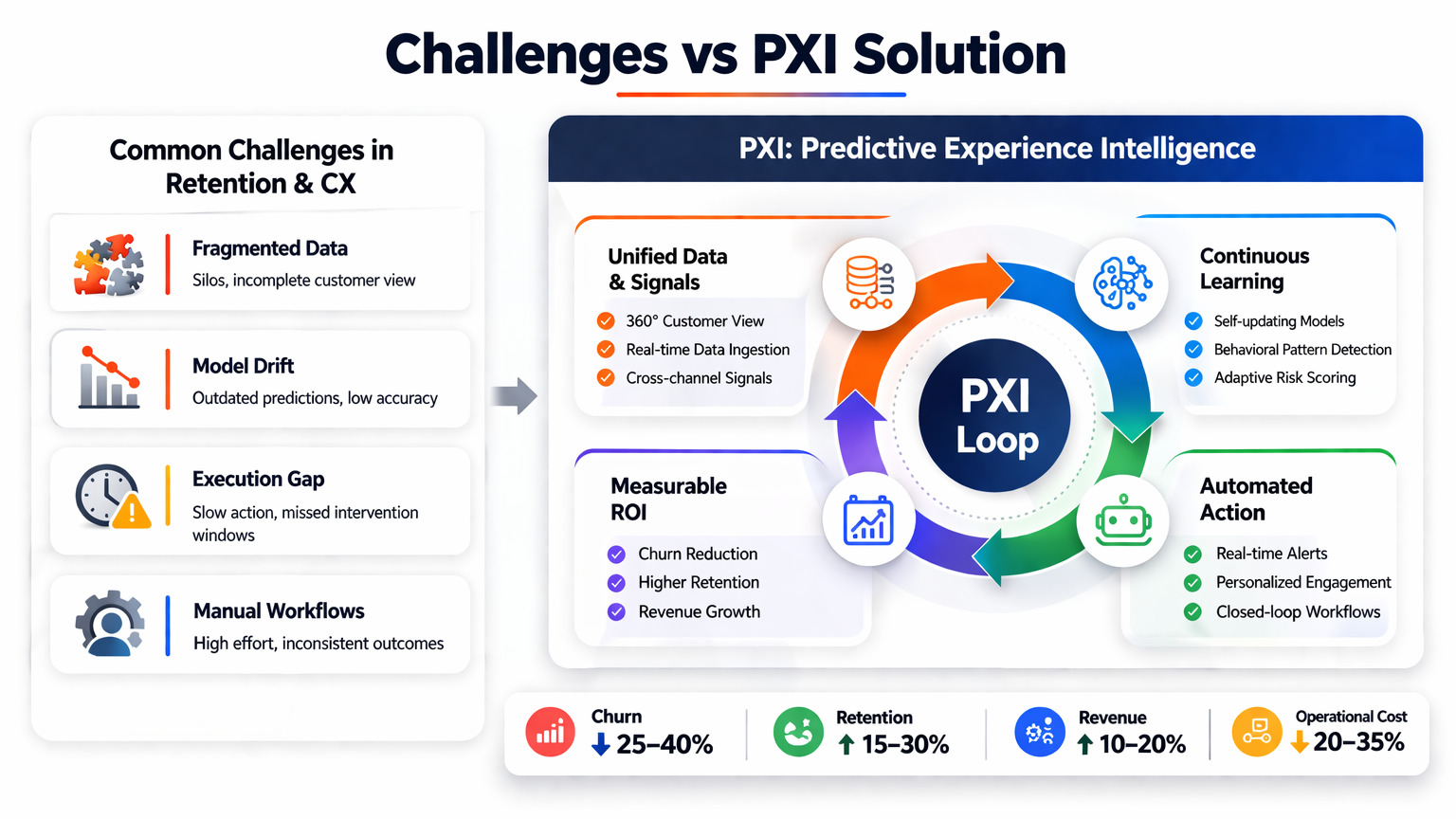
But implementing it is not as simple as adding a model or deploying a tool. Because predictive retention is not just a feature. It is an ecosystem
And like any system that depends on data, AI, and execution, there are real challenges that enterprises need to address.
The foundation of predictive retention is data. But in most enterprises, data is not unified.
It is scattered across:
Each system captures a part of the customer journey but not the whole picture.
When data is fragmented:
signals are incomplete
patterns are missed
predictions become unreliable
You might detect usage decline but miss billing issues.
You might track engagement but miss support friction.
Without a unified view, predictive models lose accuracy. And without accuracy, retention strategies fail.
Predictive models are not static. They are built on historical data and customer behavior changes constantly.
New features are introduced.
Customer expectations evolve.
Market conditions shift.
Over time, models can become outdated. Patterns that once indicated churn may no longer be relevant. New behaviors may emerge that the model does not recognize.
This is known as model drift. To maintain accuracy, models must be:
continuously monitored
regularly retrained
aligned with current customer behavior
Without this, predictions lose their effectiveness.
One of the most common challenges is not prediction, it is execution.
Many organizations successfully build predictive models.
They can identify at-risk customers.
They can assign churn scores.
But they struggle to act on those insights.
Because prediction and execution often live in separate systems. Analytics teams generate insights. Operational teams are expected to act on them. This creates delays.
And in retention, delay reduces impact. This is the same structural issue seen in traditional CX systems: insight exists, but action does not follow fast enough.
Enterprises already have established workflows.
Customer success teams.
Marketing automation systems.
Support processes.
Introducing predictive retention requires integration with these workflows.
If predictive systems are not integrated:
insights remain isolated
teams do not adopt them
actions are inconsistent
To be effective, predictive retention must fit into existing operational processes or redefine them. This requires alignment across teams, systems, and goals.
At a small scale, predictive retention is manageable. But at enterprise scale, complexity increases rapidly.
Thousands or millions of customers.
Multiple segments.
Continuous behavioral changes.
The challenge is to maintain:
accuracy at scale
real-time responsiveness
consistent execution
Without the right system, this becomes difficult to manage manually.
This is where systems like Predictive Experience Intelligence (PXI) become critical. Because PXI is not just a prediction layer. It is an integrated system.
Predictive Experience Intelligence (PXI)™ is an advanced CX-focused system developed by NUMR CXM that uses behavioral signals and AI to predict risks within customer journeys and prevents worse business and financial outcomes such as churn or drop-offs by triggering actions before problems occur.
PXI addresses key challenges by:
unifying behavioral and feedback data
continuously updating predictions
connecting insights directly to execution
automating workflows in real time
Instead of:
separate data systems
isolated models
manual execution
PXI creates a continuous loop: Signal → Risk → Reason → Alert → Action → ROI
This ensures that:
data is connected
insights are accurate
actions happen instantly
And most importantly nothing gets stuck between insight and execution.
The biggest advantage of PXI is not just accuracy. It is systemization. It turns predictive retention from a complex, multi-step process into a unified, automated system.
This reduces:
manual effort
operational delays
inconsistencies in execution
While improving:
speed
scalability
business impact
Implementing predictive retention is not plug-and-play.
It requires:
data alignment
system integration
process redesign
But the alternative is far more costly. Continuing with reactive retention means:
late detection
missed opportunities
higher churn
The challenges of predictive retention are real. But they are solvable. And more importantly they are worth solving. Because in 2026, the risk is not adopting predictive retention. The real risk is not adopting it.
Reactive systems struggle because they are disconnected
Predictive systems succeed when they are integrated
And PXI is what enables that integration at scale.
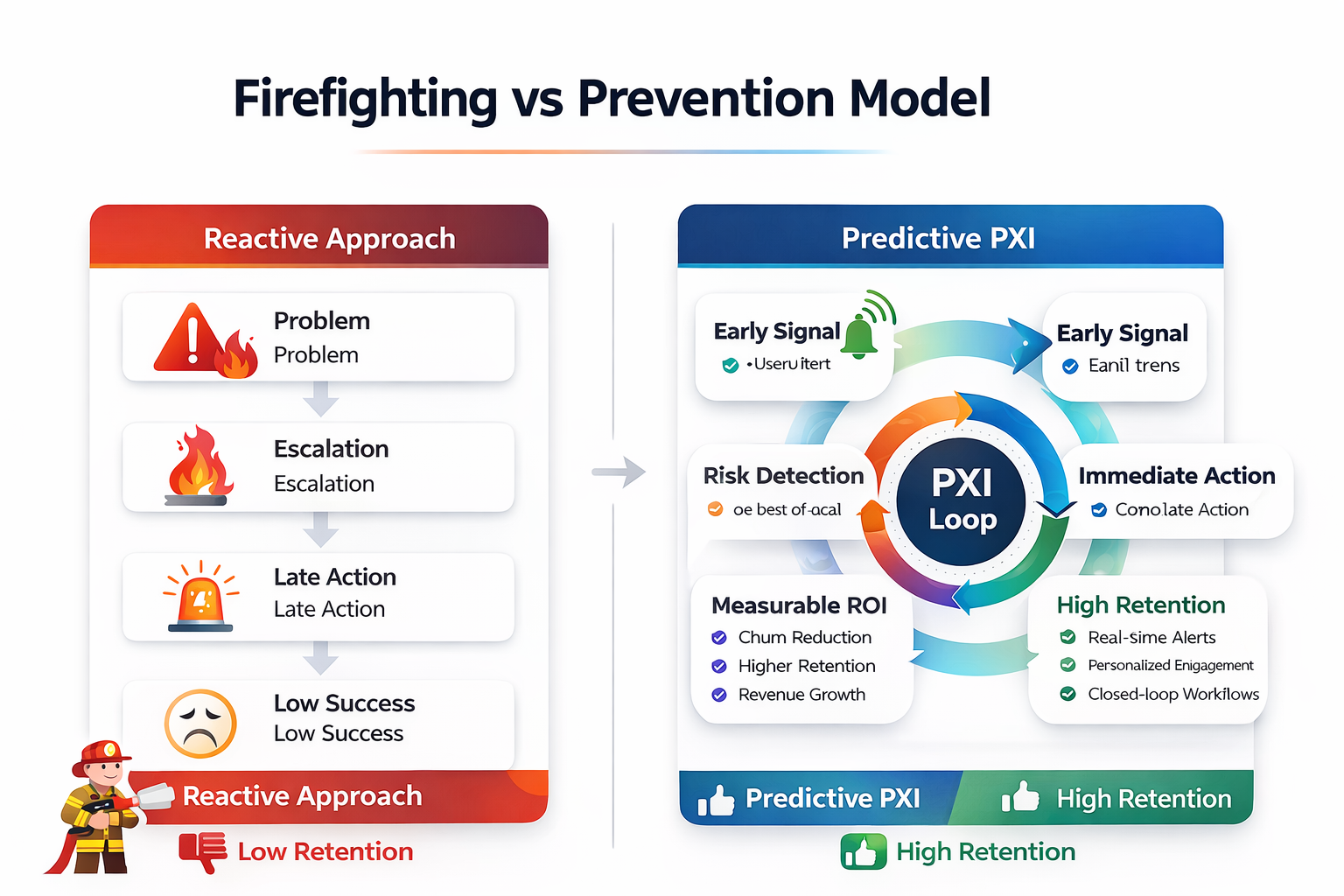
If you step back and look at how most retention teams operate today, a pattern becomes clear. They are constantly reacting.
A customer raises a complaint → the team responds.
A renewal is at risk → outreach is triggered.
A churn alert appears → recovery efforts begin.
Everything happens after the problem surfaces. This is what retention has traditionally looked like. A continuous cycle of firefighting But the problem with firefighting is simple. You are always late.
In reactive environments, teams are always working against time.
They are trying to:
recover disengaged customers
fix broken experiences
reverse decisions that are already made
This creates operational pressure.
Because:
interventions are rushed
efforts are inconsistent
success rates are unpredictable
And most importantly outcomes are limited. Because once a customer reaches the final stage of churn, there is very little room left to influence them.
Late-stage retention is expensive. It requires more effort.
More incentives. More manual involvement. And even then, it does not guarantee success.
Because you are trying to fix something that has already broken.
Predictive retention shifts this entire model. It moves action earlier in the journey. Instead of waiting for churn signals at the end, it detects early behavioral changes and responds before disengagement becomes irreversible.
This changes how retention feels.
When you act early:
you are not rushing
you are not reacting
you are influencing
You have time to:
understand the problem
engage the customer
improve the experience
And that creates control.
This is the core transformation.
Reactive retention reacts to churn
Predictive retention prevents it
Reactive systems wait for signals
Predictive systems detect signals early
Reactive teams fix problems
Predictive systems avoid them entirely
And this is not just a tactical improvement. It is a strategic shift.
In a reactive model, retention teams operate like support teams.
They respond to issues.
They handle escalations.
They focus on recovery.
In a predictive model, their role changes. They become proactive.
They focus on:
early engagement
journey optimization
continuous improvement
Instead of reacting to problems, they prevent them.
This transition from firefighting to prevention is made possible through systems like Predictive Experience Intelligence (PXI).
Predictive Experience Intelligence (PXI)™ is an advanced CX-focused system developed by NUMR CXM that uses behavioral signals and AI to predict risks within customer journeys and prevents worse business and financial outcomes such as churn or drop-offs by triggering actions before problems occur.
PXI ensures that:
signals are detected early
risks are evaluated instantly
actions are triggered automatically
This removes the need for constant manual monitoring and reactive intervention.
Instead of reacting to isolated events, PXI enables continuous monitoring of the entire customer journey.
It tracks behavior in real time.
It identifies friction as it emerges.
It triggers interventions before outcomes are impacted.
This creates a system where problems are addressed before they become visible.
The difference between prevention and recovery is not small. It is exponential.
Preventing churn:
requires less effort
costs less
has higher success rates
Recovering churn:
requires more resources
has lower success rates
often happens too late
A single early intervention can save a customer. But recovering that same customer later may require:
discounts
incentives
multiple touchpoints
And even then, success is uncertain. This is why predictive retention is not just more effective. It is more efficient.
In today’s environment, customers move quickly.
They don’t always complain.
They don’t always give feedback.
They simply disengage and leave.
This means:
If you wait, you lose.
If you act early, you retain.
And this is why the shift from firefighting to prevention is becoming the new standard. Retention is no longer about saving customers at the end. It is about keeping them engaged throughout the journey.
From reacting to churn to preventing it entirely And the only way to achieve that at scale is to detect early signals and act in real time.
At this point, the shift is clear. Retention is no longer about tracking churn. It is about preventing it. But to make that shift real inside your organization, you need more than models.
You need a system that connects:
data
prediction
execution
Because without that connection, even the most advanced predictive models will remain underutilized. This is exactly where modern CX platforms like Numr CX platform fit.
Most traditional systems stop at insight.
They can tell you which customers are at risk.
They can generate churn scores.
But they rely on teams to take action. This creates a delay between detection and response. And in retention, delay reduces impact.
Numr CX platform is built differently. It connects prediction directly to execution. It ensures that when a risk is detected, action follows immediately without waiting for manual intervention.
This is the core advantage.
Instead of: risk identified → team reviews → action delayed
You get: risk identified → system triggers → action executed
This removes friction from the retention process. And makes execution consistent at scale.
Unlike traditional platforms that rely heavily on feedback, Numr CX platform is built around behavioral signals. It continuously tracks customer behavior across journeys and identifies early warning signs of churn.
These signals are not isolated. They are connected. Which allows the system to understand patterns not just events.
This signal-first approach enables:
real-time risk detection
early identification of disengagement
faster and more accurate prediction
And most importantly it enables action while the journey is still active.
At the core of this system is: Predictive Experience Intelligence (PXI)™
Predictive Experience Intelligence (PXI)™ is an advanced CX-focused system developed by NUMR CXM that uses behavioral signals and AI to predict risks within customer journeys and prevents worse business and financial outcomes such as churn or drop-offs by triggering actions before problems occur.
PXI transforms predictive retention into a closed-loop system.
It ensures that every signal leads to:
risk identification
root cause analysis
real-time alerts
automated intervention
The system operates through a continuous loop: Signal → Risk → Reason → Alert → Action → ROI
This means:
You detect churn signals early
You understand why they are happening
You act immediately
You measure impact
And all of this happens in real time.
Numr CX platform provides real-time visibility across the customer journey. Through real-time CX dashboards, teams can:
monitor engagement trends
track churn risk distribution
identify emerging friction points
But unlike traditional dashboards, these are not passive. They are connected to action.
This is a critical shift.
Traditional dashboards show you what happened
Numr dashboards help you act on what is happening
This transforms dashboards from reporting tools into decision layers.
One of the biggest advantages of modern CX platforms is automation. Numr CX platform enables automated workflows based on churn risk and behavioral signals.
This includes:
customer success interventions
personalized engagement
in-product guidance
targeted retention campaigns
Instead of relying on teams to:
analyze reports
prioritize customers
execute actions manually
The system handles this automatically.
This improves:
speed
consistency
scalability
And ensures that no high-risk customer is missed.
This is the real transformation. Numr CX platform is not just a CX tool. It is a retention system.
It connects:
behavior
prediction
execution
outcomes
Into a single, continuous loop.
By turning insights into action, the platform directly impacts:
churn reduction
customer lifetime value
conversion rates
cost-to-serve
This is what makes predictive retention operational, not just analytical.
At enterprise scale, retention is complex.
Multiple systems.
Multiple journeys.
Multiple teams.
Without a unified platform, this complexity creates delays and inefficiencies. Numr CX platform simplifies this. It brings everything together into one system enabling faster decisions and better outcomes.
Predictive retention is only as effective as your ability to act on it. And that requires more than models. It requires a platform built for execution.
From detecting churn to preventing it
From insight to action
From reporting to real-time decision-making
And this is exactly where platforms like Numr CX platform deliver value.
[Visual Placeholder: “Numr PXI Retention System” Behavioral Signals → PXI Engine → Risk + Reason → Alerts → Automated Actions → Business Outcomes (Churn ↓, LTV ↑, Revenue ↑)]
Churn is not random. It is visible. It is measurable. And most importantly it is preventable. The real question is whether your system can detect it early enough and act fast enough to change the outcome. If your current retention strategy still relies on renewal reminders, reports, or delayed outreach you are already acting too late.
Modern retention is not about reacting to churn. It is about predicting it, understanding it, and preventing it in real time. And that is exactly where predictive retention models and systems like PXI make the difference.
Identify hidden churn risks across your customer journeys
Detect early behavioral signals before customers disengage
Move from reactive retention to proactive, AI-driven growth
Want to explore how modern CX platforms compare?
Check out the top Zykrr top 7 alternatives to see how predictive, action-driven systems outperform traditional survey-based tools.
See predictive retention in action book a demo and understand how your business can detect churn earlier and act faster because in 2026, the companies that win are not the ones that save customers in the end. They are the ones that never lose them in the first place.
What are predictive retention models?
Predictive retention models use machine learning and behavioral data to identify customers who are likely to churn before they actually do. They assign risk scores in real time and enable early intervention.
How do predictive retention models reduce churn?
They detect early warning signals such as declining usage, inactivity, or behavioral changes. By identifying these patterns early, businesses can intervene before customers disengage completely.
What is the difference between reactive and predictive retention?
Reactive retention responds after churn signals appear, often too late to influence outcomes. Predictive retention identifies risk early and enables proactive action before churn happens.
What are behavioral signals in retention models?
Behavioral signals include actions such as login frequency, feature usage, navigation patterns, support interactions, and payment behavior. These signals indicate engagement levels and potential churn risk.
What is Predictive Experience Intelligence (PXI)?
Predictive Experience Intelligence (PXI)™ is an advanced CX-focused system developed by NUMR CXM that uses behavioral signals and AI to predict risks within customer journeys and prevent negative outcomes like churn or drop-offs by triggering actions in real time.
How does PXI improve retention strategies?
PXI connects detection, prediction, and execution. It identifies churn risk, determines root causes, and triggers automated actions ensuring that insights lead directly to intervention.
What data is required for predictive retention models?
These models require data from multiple sources, including CRM systems, product usage logs, billing data, and support interactions. Unified data improves prediction accuracy.
How accurate are predictive retention models?
Accuracy depends on data quality and model design. Well-implemented models can significantly improve churn prediction and reduce churn by 15–40% over time.
Can predictive retention be automated?
Yes. Modern systems integrate predictive models with automation, enabling real-time actions such as personalized outreach, in-app guidance, and customer success interventions.
What industries benefit most from predictive retention?
Industries with recurring revenue and high customer interaction such as SaaS, banking, telecom, e-commerce, and subscription services benefit the most.
What challenges do enterprises face when implementing predictive retention?
Common challenges include data fragmentation, model accuracy over time, integration with existing systems, and connecting insights to execution.
Is predictive retention only for large enterprises?
While large enterprises benefit significantly due to scale, predictive retention models can be adapted for mid-sized organizations as well, especially with modern CX platforms.
How does predictive retention impact revenue?
By reducing churn and improving retention, predictive models increase customer lifetime value and drive consistent revenue growth.
What should enterprises focus on in 2026 for retention?
Enterprises should focus on early detection, real-time decision-making, and automated action moving from reactive retention strategies to predictive, AI-driven systems.


.png)
.png)

.png)
.png)