.png)
• Most enterprises believe they are doing customer experience because they run NPS, track CSAT, and review dashboards but this only captures a small part of the customer journey.
• The majority of CX programs still operate on a legacy model that focuses on measuring past experiences rather than improving future outcomes.
• In 2026, CX has evolved beyond reporting; it directly impacts churn, revenue retention, and long-term customer value.
• Despite this shift, traditional CX platforms (including VoC tools like Zykrr) remain survey-first, dashboard-driven, and dependent on manual action.
• This creates a critical execution gap where insights are generated but not operationalised leading to delayed responses and missed opportunities.
• Industry data shows that 30–40% of CX teams take no action after receiving insights, highlighting the disconnect between data and decision-making.
• At the same time, 66% of companies believe CX has improved, while only 17% of customers agree showing a clear perception gap.
• Modern CX platforms powered by Predictive Experience Intelligence (PXI) solve this by focusing on behavioral signals, real-time journey data, and predictive analytics.
• These platforms enable organizations to detect friction early, predict risk, and trigger automated actions turning CX into a system that drives measurable business outcomes.
If you look at your current CX setup, it probably feels like things are working.You’re collecting feedback.
You’re tracking metrics. You’re reviewing dashboards regularly.
But step back for a moment and ask yourself: Is your CX program actually helping you act faster or just helping you report better?
Because this is where most enterprises get stuck. Traditional CX platforms were built to answer one simple question: What happened?
And for a long time, that was enough. You could send a survey, collect responses, analyze scores, and identify trends. It gave you a sense of how customers felt and where things might be going wrong. But today, the expectations have changed. CX leaders are no longer being asked to explain the past. They’re being asked to take control of the future.
Questions now look like:
And this is where the gap becomes obvious. Most CX tools including platforms like Zykrr are still designed around surveys and dashboards. They depend heavily on customer feedback to generate insights, which means:
In practice, this creates a delay between problem → insight → action.
And in many cases, action never happens at all.
That’s exactly why industry data shows:
This isn’t just a tooling issue. It’s a structural problem in how CX is being handled. CX is being measured but not operationalised and that’s the core issue modern enterprises are trying to solve. This is where Predictive Experience Intelligence (PXI) changes the model. Instead of starting with surveys, PXI starts with customer behavior.
They analyze what customers are actually doing across journeys:
Then they go one step further: They don’t just show you the problem. They help you predict what will happen next and trigger action immediately.
So instead of:
You move to:
That’s the real shift happening in CX today. And it’s the reason enterprises are moving away from traditional VoC platforms and toward systems that don’t just measure experience, but actively improve it.
For a long time, the way enterprises approached customer experience felt logical. You would ask customers how they felt, collect responses, and analyze the results.
Over time, this became the standard way of managing CX.
Surveys, NPS scores, CSAT dashboards became the core of every CX program. And honestly, it worked to a certain extent. But the problem is, that entire model is built on one assumption: Customers will tell you what’s wrong.
In reality, most customers don’t. They don’t fill out surveys. They don’t explain their frustration.
They don’t raise complaints every time something breaks.
They simply stop engaging.
They drop off during onboarding.
They abandon journeys halfway.
They reduce usage quietly.
And eventually, they leave.
This is where traditional CX platforms like Zykrr and other VoC tools start to fall short.
Because they are fundamentally feedback-driven systems. They depend on what customers say, not what customers do. That means you’re always working with a limited and delayed view of reality. You’re analyzing a small sample of responses, often after the experience has already failed. Even when you do identify a problem, there’s still a long chain before anything happens.
Someone needs to notice the dashboard. Someone needs to interpret the insight. Someone needs to decide what action to take. And in many cases, that action is delayed or doesn’t happen at all. This is exactly why so many CX programs struggle with execution. Not because they lack data, but because their systems are not designed to operationalise it.
That’s the key limitation of legacy CX. It helps you understand the past but it doesn’t help you control the present.
Now compare that with how modern CX platforms like the Predictive Experience Intelligence (PXI)™ operate. The starting point is completely different. Instead of asking customers for feedback, PXI platforms observe customer behavior across journeys.
They analyze what customers are actually doing in real time:
These behavioral signals reveal problems much earlier than surveys ever could. Because they capture friction as it happens, not after.
But PXI doesn’t stop at detection. It goes further. It identifies patterns across similar users, groups them into behavioral cohorts, and compares successful journeys with failed ones. This allows the system to uncover not just what is happening but why it is happening.
And then comes the most important shift. Action is no longer manual. Instead of waiting for someone to review a dashboard, PXI platforms trigger interventions automatically alerts are generated, workflows are activated, teams are notified with full context.
So the moment a risk is detected, the system already knows who is affected, what is going wrong, and what should be done next. This removes the delay between insight and action.
What this means in practice
Zykrr and similar VoC platforms are designed to collect feedback, analyze sentiment, and present insights through dashboards. They help you understand what customers are saying, but they still rely on surveys and manual follow-ups to drive action.
NUMR’s PXI™ works differently. It starts with behavioral signals across all customers, not just respondents, builds real-time cohorts using AI, identifies root causes by comparing journey patterns, and triggers automated actions through alerts and workflows so issues are addressed instantly while the customer journey is still active.
If you’re evaluating how traditional tools compare to modern CX systems, it’s worth exploring a deeper breakdown of available options and alternatives check top 7 Zykrr alternatives.
This is the fundamental shift happening in CX today. You’re no longer relying on customers to tell you what went wrong. You’re seeing it happen in real time. And more importantly, you’re fixing it before it impacts revenue. That’s the difference between a system that measures experience
and one that actually changes outcomes.
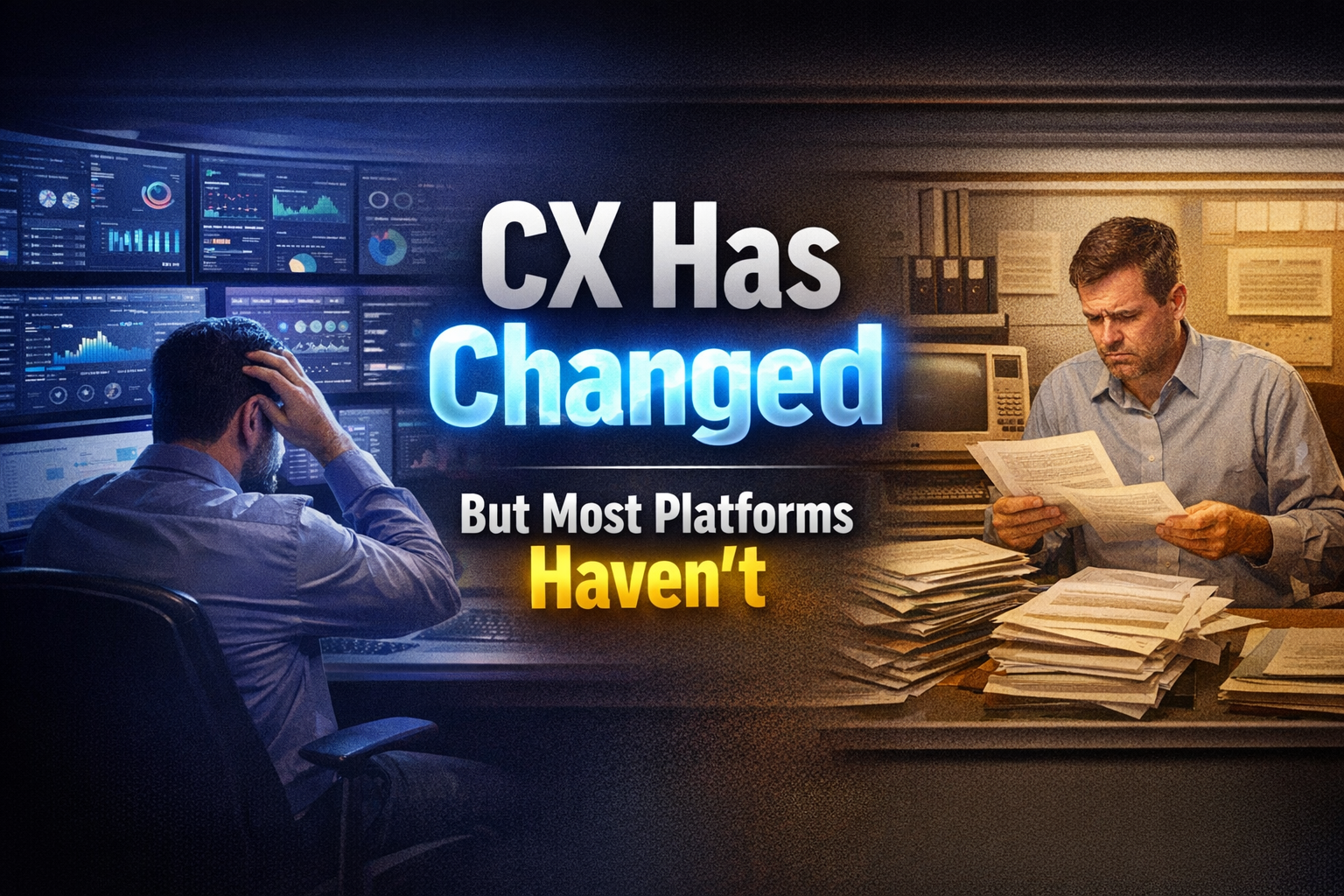
Before we go into each feature, let’s pause for a second and ask: What are you actually expecting from your CX platform today?
If the answer is still:
Then you’re solving the wrong problem. Because in 2026, CX is no longer about collecting more feedback. It’s about making faster, smarter decisions that directly impact outcomes. This is exactly why so many enterprises feel stuck. They’ve invested in CX tools, they’re collecting more data than ever, but the results don’t reflect that effort. And this isn’t just a tooling issue it’s a mindset gap.
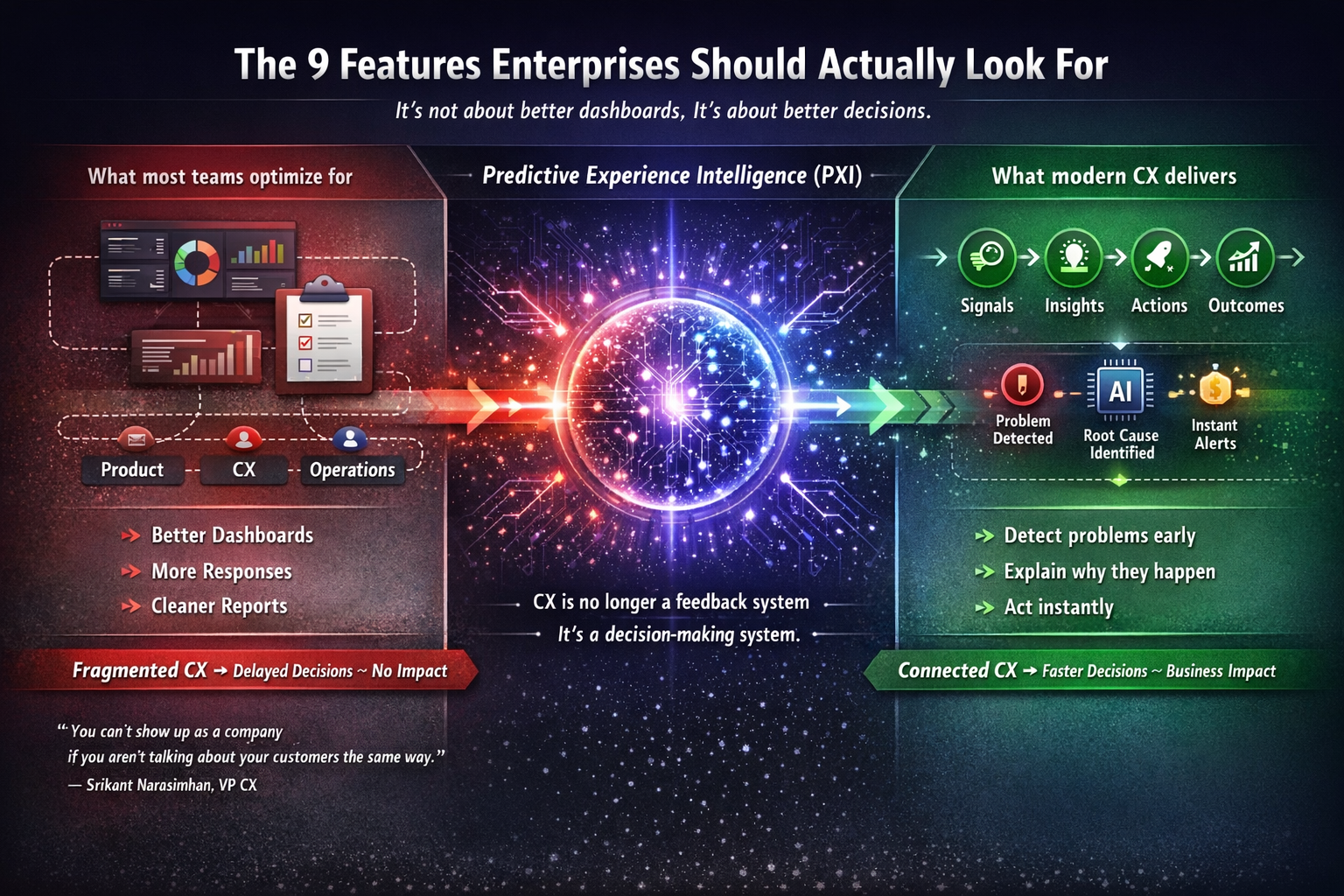
As Srikant Narasimhan, VP Enterprise CX at CVS Health, puts it:
“You can’t show up as a company if you aren’t talking about your customers the same way.”
This highlights something critical. Most organizations say they are customer-centric.
But internally, their systems are still fragmented:
No one is looking at the full journey in one place. And when that happens, decisions become disconnected from reality. That’s why modern CX platforms are no longer defined by features alone. They are defined by how well they connect signals, insights, and actions into one system.
Another perspective that reinforces this shift comes from recent CX leadership discussions at Enterprise Connect: “The future potential of AI is no longer a sufficient answer.”
In other words, enterprises are no longer impressed by tools that can generate insights.
They expect platforms that can:
This is where the definition of a “customer experience platform” has fundamentally changed. It’s no longer just a feedback system. It’s a decision-making system.
And that’s exactly what the next nine features represent.
They are not just capabilities to look for they are the building blocks of a CX system that can actually:
In the following sections, we’ll break down each feature in detail while also showing where traditional platforms like Zykrr fall short, and how modern systems like Numr approach them differently.
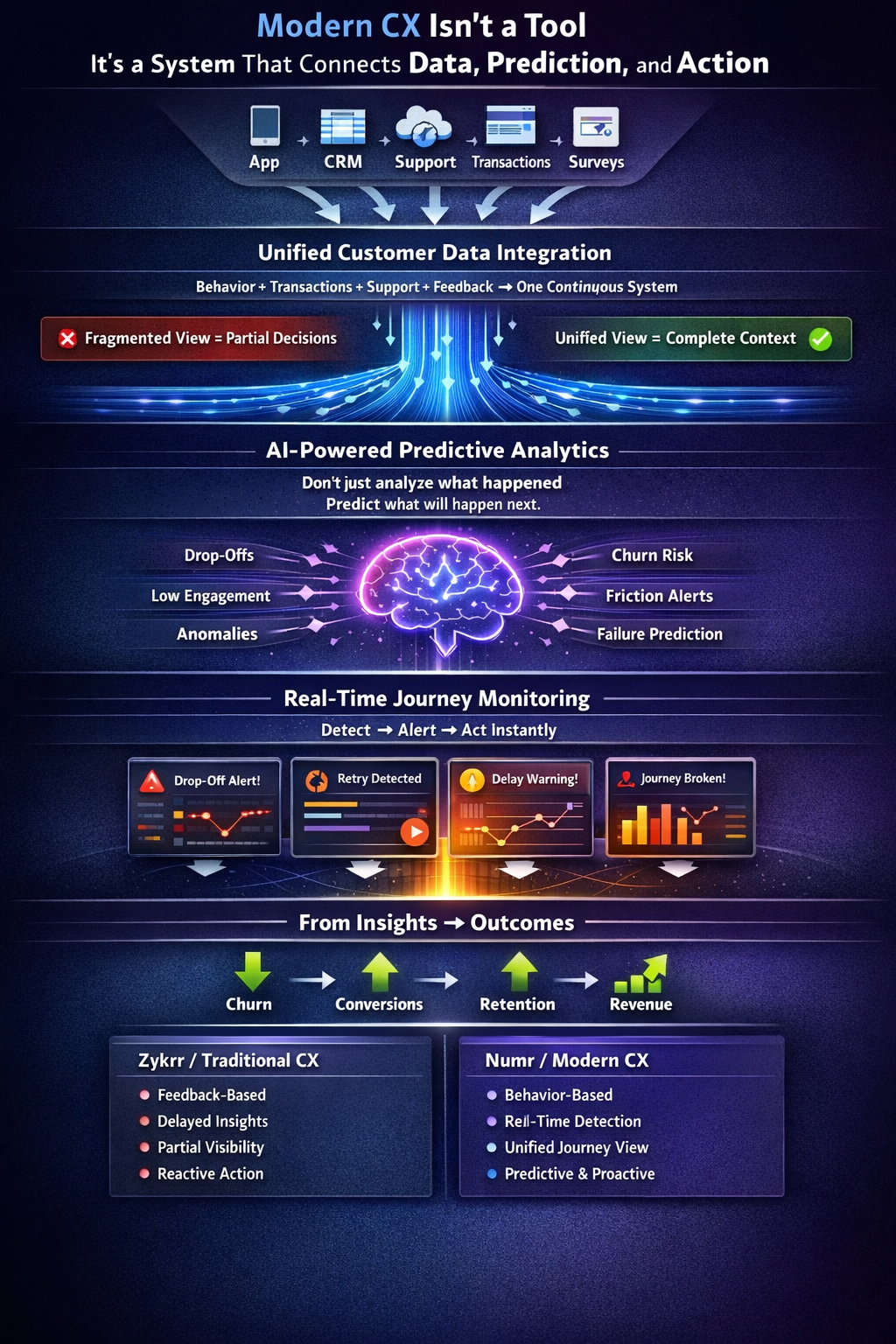
Let’s start with the foundation because if this part is broken, everything built on top of it will be unreliable. Most enterprises today believe they already have “integrated” customer data. You have CRM systems. You have app analytics. You have support logs. You have survey tools.
But here’s the real question: Are these systems actually connected or just co-existing? Because in most cases, they are still operating in silos. Your product team looks at usage data. Your CX team looks at surveys. Your support team looks at tickets.
Each team has a different version of the customer. And that creates a dangerous gap. You think you understand the journey but you’re only seeing fragments of it. This is exactly why many CX programs struggle to move beyond insights. When data is fragmented, decisions become incomplete. And when decisions are incomplete, actions are often ineffective.
This is also reflected in broader CX trends. A significant number of organizations are investing heavily in data integration and analytics, yet still struggle to connect insights to outcomes. The issue is not lack of data, it's lack of unified context. A modern customer experience platform must solve this at the core.
It needs to bring together:
Not as separate layers but as one continuous system.
Because only when you connect these signals can you answer real questions like:
And more importantly: What should we fix first to improve outcomes?
What this looks like in practice
Zykrr and traditional CX platforms primarily aggregate feedback and review data. They give you visibility into sentiment, but they don’t connect behavioral, operational, and transactional signals into a unified journey view. This means decisions are often based on partial insights. Numr, on the other hand, connects data across CRM, apps, call centers, and journey touchpoints into a single pipeline. Behavioral signals, feedback, and operational data are all tied together so instead of analyzing isolated inputs, you see the complete customer journey in context and act on it in real time.
This is the first and most critical feature of a modern CX platform. Because without unified data, everything else becomes guesswork.And in today’s environment, guesswork is exactly what enterprises are trying to eliminate.
Most CX platforms today are very good at telling you what already happened. They can show you trends. They can highlight declining scores. They can surface negative feedback.
But here’s the real question: How much of that actually helps you prevent the problem before it happens?
Because by the time a report shows a drop in satisfaction or a spike in complaints the damage is already done. Customers have already faced friction. Some have already disengaged. Some have already churned.
And this is exactly where traditional CX systems fall short. They are reactive by design. They analyze past data, mostly from surveys and feedback, and then rely on teams to interpret what it means. That may help with reporting but it doesn’t help with prevention. Modern CX platforms take a very different approach. Instead of looking backward, they focus on predicting what will happen next.
They use AI to analyze behavioral patterns across customer journeys:
These patterns are not random; they are early indicators of risk. And when you detect them early, you can act before the outcome becomes irreversible. This is what transforms CX from a reporting function into a decision system.
Because now you’re not just asking: What went wrong?
You’re asking: Who is about to churn and why?
And that’s a completely different level of control. This shift is also reflected in how enterprises are investing in CX today. A growing majority of organizations using AI in CX expect to increase their investment, not because they want more dashboards but because they need systems that can anticipate and act.
What this looks like in practice
Zykrr focuses on analyzing feedback and summarizing sentiment, which helps you understand past customer experiences. But it doesn’t predict what will happen next. Numr applies AI to behavioral signals across journeys, grouping customers into patterns, identifying early risk indicators, and forecasting outcomes like churn or drop-off. This allows teams to act proactively, not reactively, and prevent issues before they impact revenue.
This is the real power of predictive analytics in CX. It’s not about having smarter reports. It’s about having foresight. Because the moment you can predict customer behavior, you stop reacting to problems and start controlling outcomes.
Let’s be honest, customer experience doesn’t happen in dashboards. It happens in the moment. When a customer tries to log in and fails. When they abandon onboarding halfway. When they retry the same step multiple times. When they hesitate before completing a transaction. These are the moments where experience is either won or lost.
But here’s the problem with most CX platforms: They only tell you about these moments after they’ve already happened.
Through surveys. Through reports. Through weekly or monthly dashboards. By the time you see the issue, the customer has already experienced friction. And in many cases, they’ve already left.
This delay is one of the biggest reasons why CX programs fail to drive real outcomes. In fact, a large percentage of teams still take no action even after receiving CX data not because they don’t care, but because the data arrives too late to act effectively. Modern CX platforms are designed to eliminate this delay. Instead of waiting for feedback, they continuously monitor customer journeys in real time.
They track behavioral signals as they happen:
These signals are not just data points, they are live indicators of friction. And when you can see them as they happen, you can intervene immediately. This changes the role of CX entirely. You’re no longer reviewing what went wrong last week. You’re fixing what’s going wrong right now.
This is especially critical in industries like banking, insurance, and digital services, where even small delays or confusion can lead to immediate disengagement.
What this looks like in practice
Zykrr captures customer feedback after the experience through surveys, reviews, and post-interaction insights. This creates a time gap between problem and action. Numr continuously monitors live customer journeys across touchpoints apps, call centers, transactions, and interactions. As soon as friction signals appear (like retries, drop-offs, or delays), the system detects them instantly, giving teams the ability to respond in real time instead of after the experience has already failed.
Real-time journey monitoring is not just a feature. It’s a shift in how CX operates. Because when you can see the experience as it unfolds, you don’t just understand the journey. You control it.
Here’s where most CX platforms quietly fail and where the real difference begins. You already know when something goes wrong. Your dashboards show it. Your reports confirm it. Your surveys even explain it.
But let me ask you something: How often does that insight turn into immediate action?
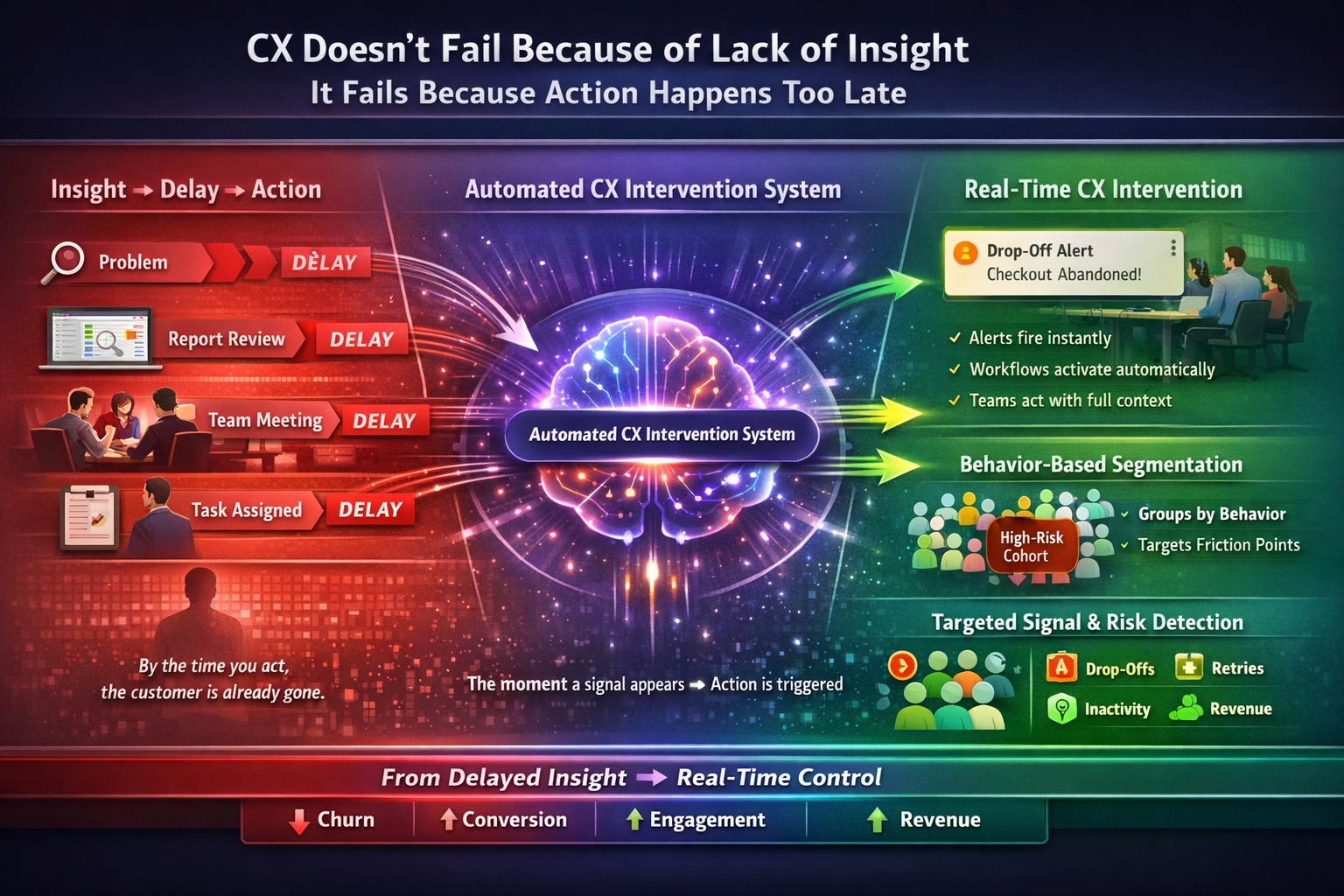
Because in most organizations, there’s a gap. A big one. You identify a problem and say customers are dropping off during onboarding. The data gets reviewed. A meeting is scheduled. Someone is assigned to investigate. And by the time anything actually happens the customer is gone. This is exactly why CX struggles to prove impact. Not because the insights are wrong but because action is delayed. And delay, in customer experience, is the same as loss.
This is also reflected in industry data where a significant portion of teams still take no action even after receiving CX insights. Not due to lack of intent, but because traditional systems are not designed to operationalise action. They stop at telling you what’s wrong. Modern CX platforms take a completely different approach. They don’t just identify problems, they trigger action automatically.
The moment a friction signal appears whether it’s a repeated failure, a stalled journey, or a high-risk customer segment the system responds instantly. Alerts are generated in real time. Workflows are activated. Tasks are assigned to the right teams with full context of the customer journey.
And this is the key shift. You’re no longer depending on someone to notice a dashboard. The system ensures that the right action happens, at the right moment, without delay.
Imagine a scenario where a customer is struggling during a critical step, maybe they’re retrying the same action multiple times or abandoning a process halfway. In a traditional setup, this would only be visible later through reports or feedback. But in a modern CX system, this behavior itself becomes a trigger.
An alert is raised immediately. A workflow assigns the issue to the right team. The team sees exactly what the customer experienced. And action happens while the customer is still in the journey. That’s the difference between reacting to churn and preventing it.
This is what transforms CX from a passive function into an active system that protects revenue in real time.
What this looks like in practice
Zykrr and traditional CX platforms surface insights through dashboards and feedback analysis, but the responsibility of taking action still lies with teams. This introduces delays, dependency, and often inaction. Numr eliminates this gap by automating CX intervention. As soon as a friction signal is detected, alerts fire instantly, workflows assign tasks, and teams are given full journey context to act immediately. There is no waiting for reports, no dependency on manual review action is built into the system itself, ensuring issues are resolved while the customer is still engaged.
This is the moment where CX stops being observational. And starts becoming operational. Because when insight and action happen together, you’re not just understanding customer experience, you're actively shaping it.
Let’s talk about something most CX teams think they’ve already solved segmentation.
You already group customers, right?
But here’s the real question: Do these segments actually help you fix customer experience problems?
Because in most cases, they don’t. Traditional segmentation is static. It tells you who your customers are but not what they’re doing or what they’re struggling with. And CX problems don’t come from demographics. They come from behavior.
For example, two customers might look identical on paper, same age, same location, same product but behave completely differently. One completes onboarding smoothly. The other drops off halfway. One uses your product regularly. The other signs up and never returns. If your segmentation can’t capture this difference, you’re missing the real story. This is why modern CX platforms move from static segmentation to dynamic, behavior-based cohorts powered by machine learning.
Instead of predefined groups, the system continuously learns from how customers interact across journeys:
These patterns are automatically grouped into cohorts without someone manually defining them. And this is where it gets powerful. Because now you’re not just segmenting customers. You’re identifying problem patterns at scale.
For example, imagine discovering a cohort where users explore a product but never convert not because of pricing, but because of a usability constraint that only affects a specific group. This kind of insight doesn’t come from surveys or static filters.
It comes from observing behavior and letting AI connect the dots. This approach also aligns with how CX is evolving globally.
With increasing investment in AI-driven CX, enterprises are shifting toward systems that can continuously learn and adapt rather than relying on fixed rules. Because customer behavior is not static. And your segmentation shouldn’t be either.
What this looks like in practice
Zykrr relies on traditional segmentation methods filters based on feedback, demographics, or predefined attributes. While this helps organize data, it doesn’t uncover real behavioral patterns or emerging risks.
Numr uses machine learning to dynamically create behavioral cohorts based on how customers actually interact across journeys. It automatically groups users experiencing similar friction, delays, or drop-offs linking these cohorts directly to outcomes like churn or conversion. This allows teams to focus on high-impact segments and take targeted action immediately.
This is the difference between organizing customers and actually understanding them. Because when you move to behavior-driven cohorts, you stop guessing which segments matter. The system shows you exactly where the problem is and who it’s affecting. And once you know that, fixing CX becomes far more precise.
Here’s something most CX teams underestimate: The majority of customer problems are silent.
Customers don’t always complain. They don’t always fill out surveys. They don’t always tell you what went wrong. They just stop. They stop logging in. They stop completing journeys. They stop using the product.
And eventually they leave. The problem with traditional CX systems is that they are built to capture what customers say, not what customers do. And in today’s environment, that’s a major limitation. Because by the time a customer gives feedback, the experience has already failed.
Modern CX platforms flip this completely. Instead of waiting for explicit input, they focus on behavioral signals, the subtle patterns that indicate something is going wrong before the customer ever says a word.
These signals can include:
Individually, these may seem like small data points. But together, they form a pattern. A pattern that tells you who is at risk. And more importantly: why they are at risk. This is what turns CX into a predictive system. Because now, instead of discovering churn after it happens, you can detect the signals leading up to it and intervene early.
This shift is critical, especially when you consider how large the perception gap has become in CX. A majority of companies believe they are improving experiences, yet only a small percentage of customers agree. One of the biggest reasons for this gap is that organizations rely too heavily on explicit feedback while missing the silent signals hidden in behavior.
What this looks like in practice
Zykrr captures explicit signals surveys, reviews, and customer feedback which means it only sees issues when customers choose to express them. This leaves a large blind spot where silent churn and hidden friction go undetected. Numr focuses on behavioral signal detection. It continuously tracks actions like retries, drop-offs, inactivity, and delays across journeys, identifying risk even when customers say nothing. These signals are surfaced in real time, allowing teams to intervene before disengagement turns into churn.
This is where CX becomes truly proactive. Because when you can detect risk without waiting for feedback, you’re no longer dependent on customer complaints. You’re identifying problems at their earliest stage and acting before they escalate. And in a world where most customers don’t tell you what went wrong, that capability is not just valuable it’s essential.
Let’s say your CX system tells you something is wrong. Drop-offs are increasing. Engagement is declining. Customers are not completing key journeys. That’s useful.
But here’s the real question:Do you actually know why it’s happening?
Because knowing what happened is not the same as knowing why it happened. And this is where most CX platforms fall short. They give you metrics. They give you scores. They give you dashboards.
But the interpretation?That’s still on you. Teams are left trying to connect the dots manually looking at reports, comparing data, running analyses, and often making assumptions.
And in a complex customer journey, assumptions are risky. This is one of the biggest reasons why CX programs struggle to drive real impact. Even when the data is available, the root cause remains unclear. And without clarity, actions become guesswork. Modern CX platforms approach this very differently. They don’t just surface issues, they explain them.
By combining behavioral data with contextual feedback, they automatically identify:
This is not just analysis, it's diagnosis. And that changes everything.
Because now, instead of asking: “What should we investigate?”
You’re asking: “How do we fix this specific problem?”
This shift is becoming increasingly important as CX leaders are pushed to prove real outcomes. As one CX leader insight highlighted during Enterprise Connect discussions: “The future potential of AI is no longer a sufficient answer.” In other words, it’s no longer enough to say we have data or we have insights. You need to show exactly what’s broken and how to fix it.
What this looks like in practice
Zykrr provides visibility into customer feedback and sentiment, but identifying root causes often requires manual analysis across multiple reports. Teams need to interpret the data themselves, which slows down decision-making. Numr combines behavioral signals with targeted, contextual feedback to automatically surface root causes. It shows not just where customers are dropping off, but the exact reasons behind it linked directly to specific customer groups and outcomes so teams can move from analysis to action without guesswork.
This is what separates surface-level CX from outcome-driven CX. Because when you truly understand why something is happening, you don’t just react, you fix the right problem, the right way, at the right time.
Let’s talk about something that quietly breaks most CX programs. You might have the best insights. You might even know exactly what needs to be fixed.
But here’s the real problem: Can your CX system actually do anything inside your business systems?
Because in most enterprises, CX tools sit on the side. They collect feedback. They generate reports. They show dashboards.
But your operations? They live somewhere else. In your CRM. In your ERP. In your call center systems. In your product and backend tools. And when these systems don’t talk to each other, CX becomes disconnected from execution. You know what’s wrong but you can’t fix it where it actually matters.
This is one of the biggest reasons why CX fails to move beyond insights. Because action doesn’t happen in dashboards. It happens inside your operational systems. Modern CX platforms are built with this reality in mind. They are not standalone tools.
They are deeply integrated systems that connect directly with your existing infrastructure.
This includes:
But integration here is not just about pulling data. It’s about enabling two-way interaction. The system doesn’t just read signals, it triggers actions inside these systems.
For example: If a customer is at risk, a task can be created in CRM instantly. If a journey breaks, a workflow can trigger a follow-up. If friction is detected, teams can act within their existing tools without switching systems. This is what makes CX operational. And this is also why enterprises are investing heavily in data integration and analytics because without it, personalization, automation, and predictive CX simply don’t work.
What this looks like in practice
Zykrr primarily focuses on aggregating feedback and presenting insights, with limited integration into core operational systems. This means CX insights often remain separate from execution, requiring manual coordination across teams. Numr is built as an API-first system that integrates directly with CRM, ERP, IVR, apps, and operational platforms. It doesn’t just bring data together it enables actions to be triggered within these systems in real time. This ensures that CX insights are not isolated, but embedded directly into how the business operates.
This is the difference between a CX tool and a CX system. A tool shows you the problem. A system helps you fix it inside your actual workflows. And in enterprise environments, that difference is everything.
Let’s be honest this is where most CX platforms struggle the most. You can have dashboards. You can have insights. You can have beautifully visualized reports.
But at the end of the day, leadership is asking one simple question: What is CX actually doing for the business?
Is it reducing churn?
Is it increasing conversions?
Is it improving revenue?
And this is where traditional CX models fall apart. They are built to measure experience but not to connect it to outcomes.
You might see:
But none of these directly answer: Did we actually move the business forward?
This is exactly why many CX leaders face internal challenges. Because while experience metrics look positive, the business impact remains unclear. And in today’s environment, that’s no longer acceptable.
As highlighted in CX industry discussions:
“CX has crossed a structural threshold; experience directly influences willingness to pay more, lifetime value, churn, and advocacy.”
This means CX is no longer a “soft metric.” It is directly tied to revenue. Modern CX platforms are built around this reality. They don’t stop at insights, they track what happens after action.
They connect: customer signals → actions taken → business outcomes in terms of ROI.
So instead of just identifying that customers are struggling, the system shows:
This creates a clear, measurable link between CX and business performance. And that changes how CX is perceived inside the organization.
It’s no longer: “a reporting function”
It becomes: a growth driver
What this looks like in practice
Zykrr focuses on feedback visibility, sentiment tracking, and reporting, which makes ROI indirect and difficult to quantify. Teams can see what customers feel, but not how actions impact business results. Numr directly links CX signals to outcomes by tracking what happens after intervention whether churn drops, conversions improve, or engagement increases. Every action is tied to measurable impact, allowing CX teams to clearly demonstrate business value instead of relying on proxy metrics.
This is the final shift in modern CX.
From: “Are customers happy?”
To: “Are we improving business outcomes because of CX?”
Because when you can answer that confidently, CX stops being a cost center and becomes a strategic advantage.
At this point, the shift becomes obvious. Enterprises are not replacing platforms like Zykrr because those tools are “bad.”
They’re replacing them because: They’ve outgrown what those platforms were built for.
Traditional CX platforms were designed for a different era when the goal was to collect feedback, measure, satisfaction, track experience scores. And for a long time, that was enough. But today, the expectations from CX have completely changed.
You’re no longer being asked: Did we run surveys? Did we improve NPS?
You’re being asked: Did we reduce churn? Did we improve conversions? Did we protect revenue?
And this is where the gap becomes impossible to ignore.
Because legacy CX tools including Zykrr are still built around:
They help you understand what customers say. But they don’t help you control what happens next. This is exactly why many enterprises find themselves stuck in a loop where they collect more data. They generate more insights. But outcomes don’t change at the same pace. And that’s frustrating especially when you know the problems exist, but the system isn’t built to fix them. At the same time, the industry itself is evolving rapidly.
Enterprises are investing more in:
Because they’ve realized something critical: CX is no longer about visibility. It’s about control.
And this is where modern platforms built on Predictive Experience Intelligence (PXI) come in. They are designed for a completely different objective not just to measure experience but to influence outcomes in real time.
They start with behavioral signals instead of surveys. They predict risk instead of reporting history. They trigger action instead of waiting for teams.
So instead of asking: “What happened to the customer?”
You’re asking: “What is about to happen and how do we fix it now?”
Numr is built around this new reality. It’s not designed as a feedback platform or a dashboard tool, it's designed as a system that detects issues, explains them, and triggers action before they impact revenue. By combining behavioral signals, contextual feedback, AI-driven clustering, and real-time workflows, Numr moves CX from observation to execution. Instead of relying on surveys and manual follow-ups, it continuously monitors journeys, identifies friction, predicts outcomes, and enables immediate intervention making CX a business-critical operating system rather than a reporting layer.
This is why enterprises are moving beyond traditional platforms. Not because they don’t work but because they don’t go far enough. And in 2026, “not enough” is exactly what CX leaders can’t afford.
Let’s step back for a moment. Because everything we’ve discussed about data, AI, journeys, automation, signals, ROI comes down to one fundamental shift: CX is no longer a survey program.
It is a system that runs how your business understands and acts on customers.
For years, enterprises approached customer experience as a measurement function. You collected feedback. You tracked NPS and CSAT. You built dashboards.
And then you tried to improve things based on what you saw. That model made sense when customer journeys were simpler and expectations were lower. But in today’s environment, that approach is too slow. Customers move across channels instantly. They expect seamless, fast, and intuitive experiences. And when something doesn’t work they don’t wait.
They leave. This is why the old model survey → dashboard → manual action is breaking down. It tells you what happened. But it doesn’t help you control what happens next. And that’s the gap modern CX needs to close.
Today, leading enterprises are moving toward a completely different model.
A system where:
This is what defines Predictive Experience Intelligence (PXI). And this is where CX becomes far more powerful. Because now, you’re not reacting to experience, you're actively shaping it.
Instead of waiting for customers to tell you something is wrong, you already know. Instead of reviewing reports after the fact, you act in the moment. Instead of hoping improvements work, you measure their impact directly.
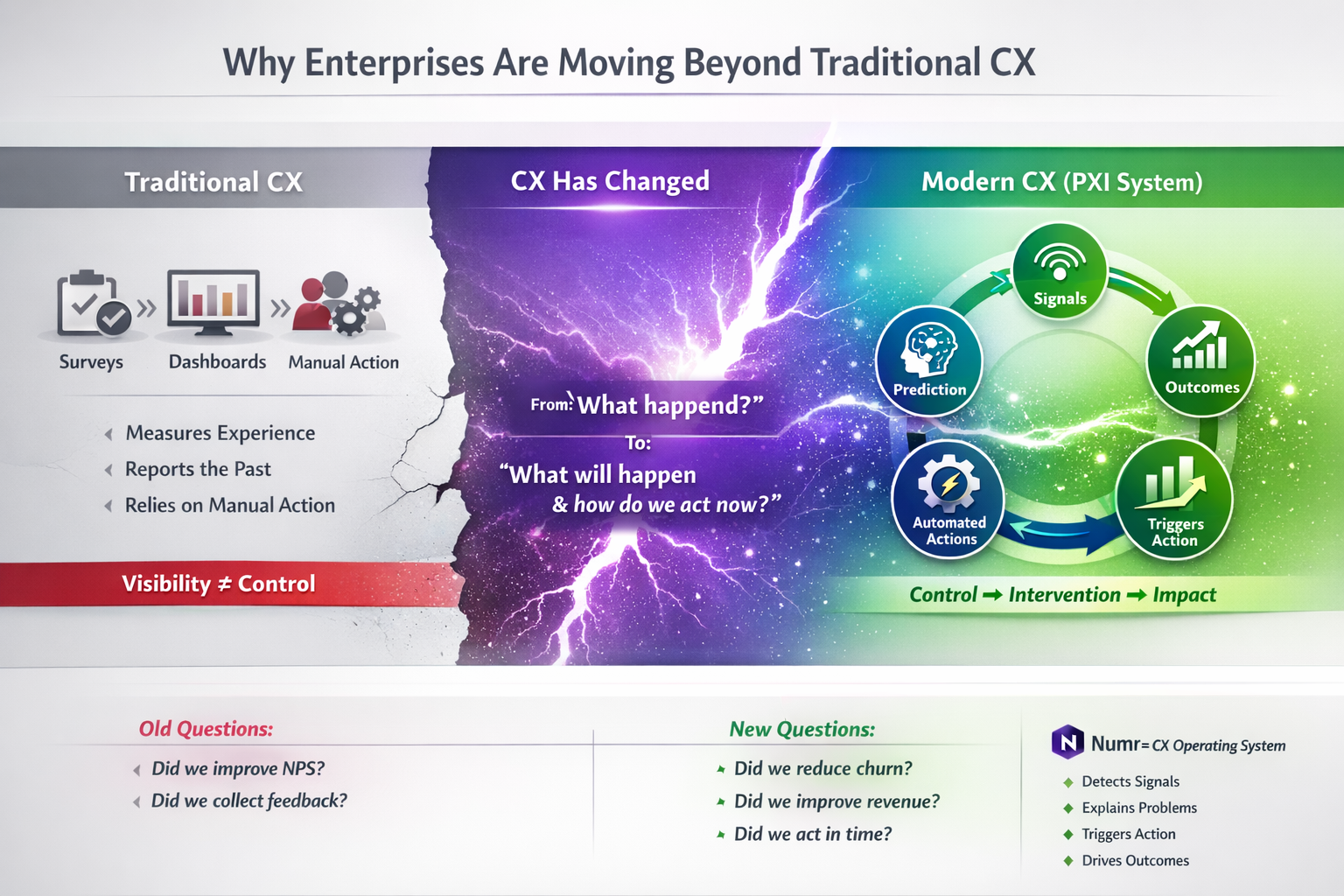
Numr is built as this exact system. It doesn’t operate as a traditional CX tool with surveys and dashboards at the center. It starts with behavioral signals across CRM, apps, call centers, and journeys, pulling everything into a unified pipeline. It then uses AI to group customers dynamically based on real behavior, identifies friction and root causes through contextual feedback, and triggers alerts and workflows in real time. Everything data, groups, reasons, and actions comes together in CXignals, giving teams a live view of what’s happening, why it’s happening, and what to do next. This is how CX moves from passive measurement to active execution directly tied to outcomes like churn reduction, conversion improvement, and revenue protection.
This is the future of customer experience. Not more dashboards. Not more surveys. A system that detects, decides, and acts. Because in the end, the goal is not to understand customer experience better. It’s to improve it before it breaks.
By now, the difference should be clear. Most CX platforms help you see what’s happening. Some help you understand it a little better. But very few help you actually change outcomes in real time.
And that’s exactly where Numr is positioned. Numr is not built as a survey tool. It’s not designed as a dashboard layer. It’s built as a full CX system, one that connects signals, explains problems, and triggers action before they impact revenue.
At its core, Numr follows a fundamentally different approach; it starts with behavior, not feedback. It focuses on prediction, not just reporting. It enables action, not just insight.
Instead of waiting for customers to respond to surveys, Numr continuously captures signals across:
All of this data flows into a unified pipeline, giving you a complete, real-time view of the customer journey. But visibility is just the first step.
Numr’s AI-powered platform then identifies patterns in this data grouping customers dynamically based on how they actually behave. It detects friction points, drop-offs, delays, and risk signals without needing predefined rules.
And when behavior alone isn’t enough, it adds contextual feedback asking the right customers the right questions at the right moment, without overwhelming everyone with surveys. This is where understanding becomes precise. You don’t just know that customers are dropping off.
You know which group, at which step, and for what exact reason. Then comes the most critical part.
As soon as a friction point or risk signal is identified:
There is no delay. No dependency on dashboards. Everything happens while the customer is still in the journey. And finally, all of this comes together in one place - the PXI™.
A control layer where you can see:
This is what makes Numr different. It’s not a platform that helps you track experience. It’s a system that helps you control it. And that’s the shift modern enterprises are moving toward.
From:
collecting feedback
analyzing reports
reacting to problems
To:
detecting signals
predicting outcomes
triggering action
In other words from measurement to execution and that’s exactly where Numr fits.
You’ve seen the gap. Most CX platforms help you measure experience.
But very few help you act on it when it matters most.
If your team is still relying on dashboards, surveys, and delayed reporting, you’re likely missing:
The shift is already happening. Enterprises are moving toward systems that don’t just show problems but fix them in real time. If you want to understand how this works in your context across your journeys, your data, and your customers
Schedule a CX strategy discussion
No long forms. No sales push. Just a walkthrough of how modern CX systems like Numr help you detect, predict, and act before revenue is impacted.
A customer experience platform is a system that collects, analyzes, and helps improve customer interactions across different touchpoints such as apps, websites, call centers, and support channels. Modern platforms go beyond measurement to enable real-time action.
In 2026, enterprises should look for features like unified data integration, predictive analytics, real-time journey monitoring, automated workflows, behavioral segmentation, signal detection, root cause analysis, enterprise integrations, and ROI tracking.
Predictive Experience Intelligence (PXI)™ is an advanced CX-focused system developed by NUMR CXM that uses behavioral signals and AI to predict risks within customer journeys and prevents worse business and financial outcomes such as churn or drop-offs by triggering actions before problems occur.
Traditional VoC tools focus on surveys and past feedback. PXI is a platform that focuses on real-time behavioral signals, predictive insights, and triggers automated actions, making it predictive and proactive rather than reactive.
Because they stop at insights. They rely on dashboards and manual follow-ups, which creates delays. By the time action is taken, the customer experience has already failed.
Real-time CX monitoring tracks customer journeys as they happen, detecting issues like drop-offs, retries, or delays instantly so teams can intervene before the experience breaks.
Customer journey analytics analyzes how customers move across touchpoints and identifies where friction, delays, or drop-offs occur in the experience.
AI helps identify patterns in behavior, predict risks like churn, group customers dynamically, and automate actions making CX faster, smarter, and more proactive.
Churn prediction uses behavioral and engagement data to identify customers who are likely to leave, allowing businesses to take action before they actually churn.
CX automation refers to triggering actions such as alerts, workflows, or customer communication automatically when specific signals or conditions are detected.
Without unified data, CX insights are fragmented. Integration ensures that behavioral, transactional, and feedback data are connected, giving a complete view of the customer journey.
Behavioral CX data refers to what customers actually do such as clicks, drop-offs, retries, and usage patterns rather than what they say in surveys.
Customer segmentation groups users based on shared characteristics. Modern CX platforms use behavior-based segmentation to identify patterns like friction, risk, or engagement levels.
14. How do companies measure CX ROI?
By linking CX improvements to business outcomes such as reduced churn, increased conversions, higher engagement, and improved customer lifetime value.
Root cause analysis identifies the exact reasons behind customer issues such as why users drop off or fail to complete journeys so teams can fix the real problem.
Customer experience directly impacts retention, conversion, and loyalty. Better experiences lead to higher engagement and long-term revenue growth.
Customer journey friction refers to any obstacle or difficulty that prevents users from completing actions smoothly such as confusing steps, delays, or poor usability.
By identifying early risk signals, understanding root causes, and taking proactive action such as improving journeys or resolving issues before customers leave.
CX analytics software helps businesses analyze customer behavior, feedback, and journey data to improve experiences and decision-making.
An enterprise CX platform is a scalable system designed to manage, analyze, and improve customer experience across large organizations, integrating multiple data sources and enabling action at scale.


.png)
.png)

.png)
.png)