
Survey research is one of the most widely used methods for collecting structured insights about human behavior, opinions, and experiences.
Organizations rely on surveys to understand:
Today, survey research has become increasingly digital. Industry research shows that online surveys now account for about 85% of quantitative survey research usage, making them the dominant method for collecting large-scale insights.
However, survey research is not a single technique. Instead, researchers rely on different survey research approaches depending on their objective.
Three methods are commonly used:
These methods are best understood as stages in a research process. Most research projects naturally move through a lifecycle: Discovery → Measurement → Prediction
Researchers first explore problems, then measure patterns, and finally apply analytics to predict future outcomes. As research specialists explain, exploratory research helps uncover unknown insights, descriptive research measures known patterns, and predictive research applies analytics to forecast behavior.
Understanding how these survey research methods differ and how they work together helps organizations design stronger studies and make more confident decisions based on survey data.
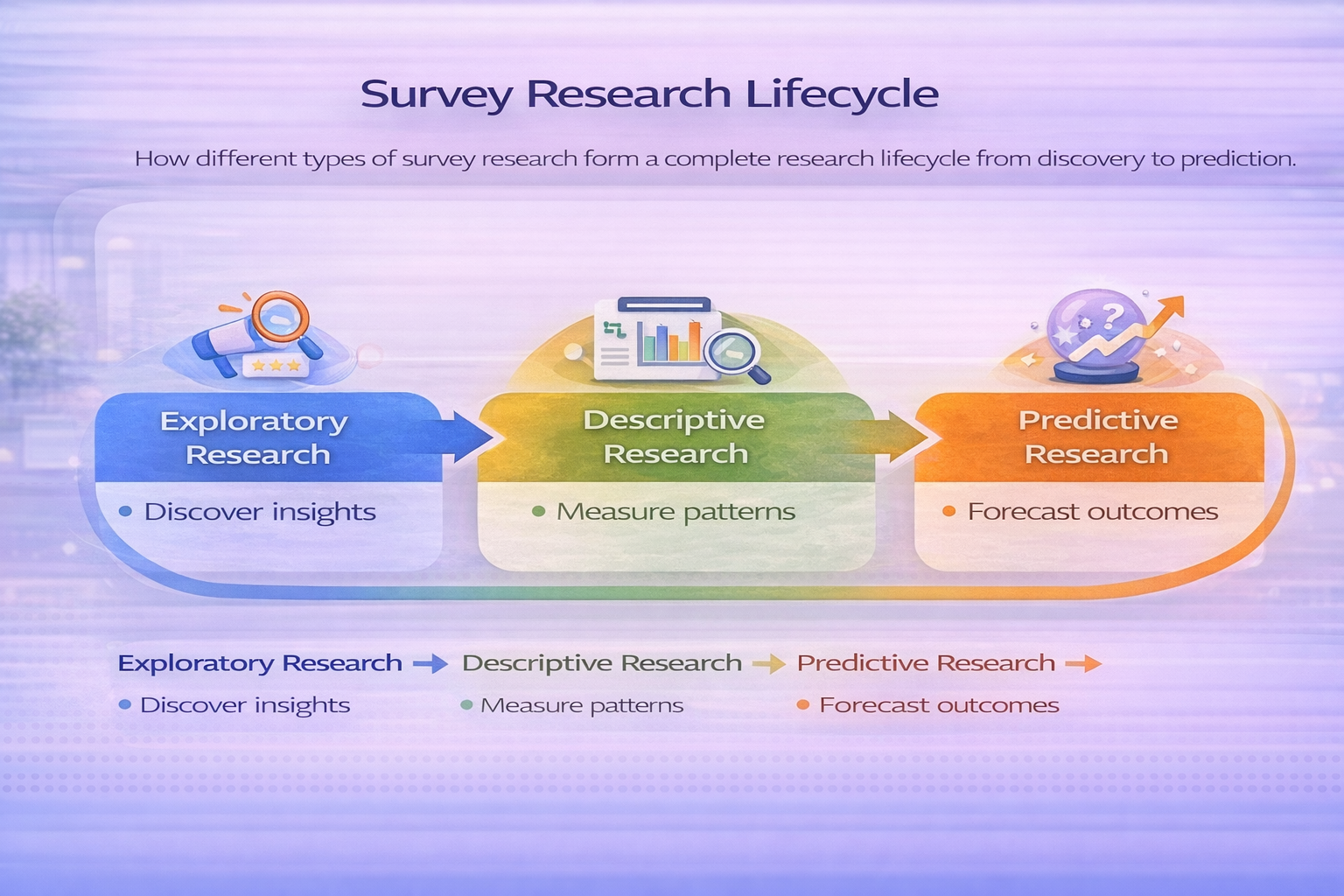
Survey research is not a single technique.
Instead, it represents a family of research methods designed to answer different types of questions about people, behavior, and experiences.
Researchers use surveys to understand things like:
Because research goals vary, different survey research approaches are used depending on the stage of analysis. For example, early research often focuses on discovering new insights, while later stages focus on measuring patterns or predicting outcomes.
Industry data highlights how important survey research has become. The global market research industry expanded significantly in recent years, growing from $102 billion to $140 billion between 2021 and 2024, reflecting the increasing demand for structured insights and data-driven decision-making.
As research practices evolve, three approaches consistently appear in modern research frameworks.
Each of these research types plays a different role in the research process.
For example:
Research experts often emphasize this progression when explaining survey methodologies. As analysts note: Exploratory research uncovers unknown insights, while descriptive research measures known patterns through structured data.
Understanding this progression is critical for researchers, analysts, and product teams. When these survey research approaches are used together, they create a complete research strategy that moves from discovery to measurement and eventually to prediction.
This is why modern research teams often combine these methods to generate deeper insights and support better decision-making.
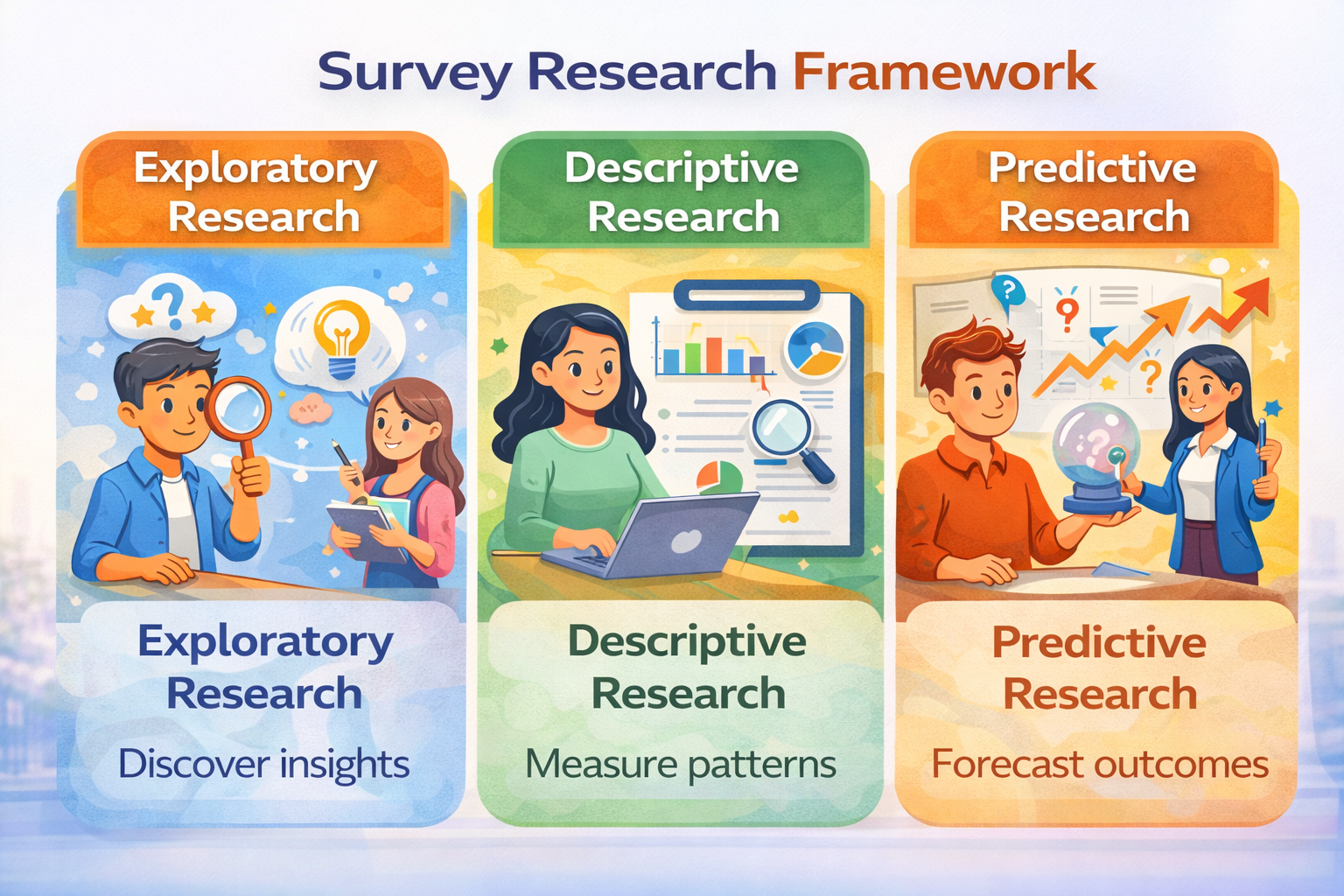
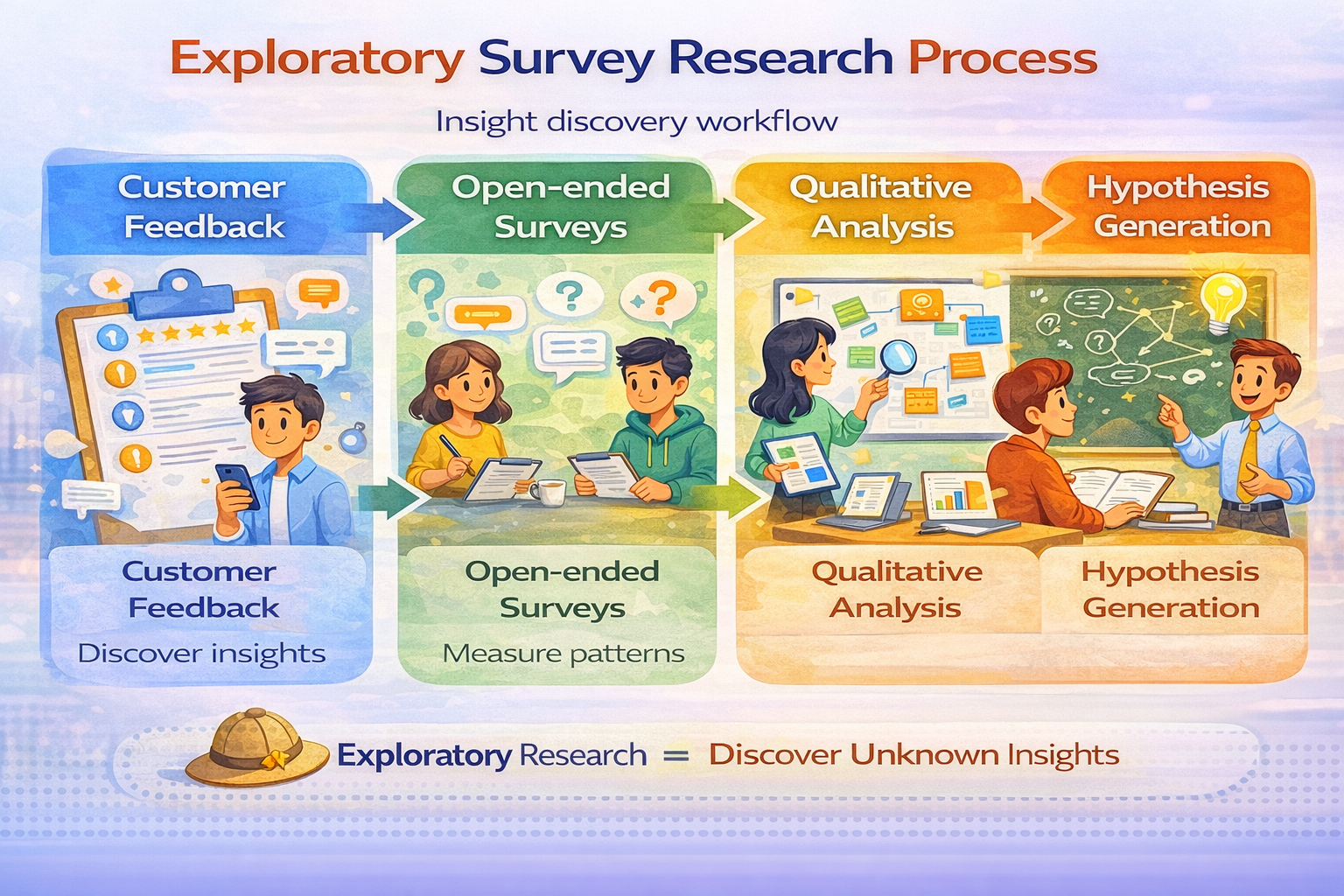
Exploratory survey research is typically used at the beginning of a research process, when organizations want to understand a problem that is not yet clearly defined.
Before measuring customer behavior or predicting future trends, researchers must first identify what questions need to be answered.
This is where exploratory research plays a critical role.
In simple terms, exploratory survey research helps researchers investigate questions like:
Rather than focusing on precise measurement, exploratory research focuses on discovery and insight generation.
To explain survey research clearly, it helps to start with the basic concept.
A survey is a structured way of asking questions to a group of people in order to collect opinions, feedback, or behavioral insights.
In research terms:
When researchers ask what is survey research, the answer is simple:
Survey research is the process of collecting structured feedback from individuals in order to analyze patterns, opinions, and behaviors. Exploratory surveys are designed specifically to discover insights that researchers may not yet fully understand.
As research specialists explain: Exploratory research uncovers unknown insights and identifies problems early in the research process. Because of this goal, exploratory surveys often use open-ended questions rather than structured response options.
For example, a typical exploratory survey example might ask:
These questions allow respondents to provide detailed feedback rather than limited selections.
Exploratory surveys are commonly used when organizations want to:
For example, a customer experience team might conduct an exploratory survey to understand why customers abandon a product shortly after signup. In CX research environments, exploratory surveys often help identify experience friction points across the customer journey.
These insights can then feed into broader CX and PXI-style experience intelligence frameworks, where qualitative insights help guide further analysis.
Exploratory research often combines multiple research techniques, including:
The shift toward digital research tools has significantly increased the reach of exploratory studies. Recent research shows that about 87% of qualitative research is now conducted online or remotely, reflecting the rapid adoption of digital research environments.
This digital transformation has made exploratory research easier to conduct at scale. Researchers can now collect qualitative insights from customers, employees, or users across different regions and demographics.
Many researchers ask: what should a survey look like when conducting exploratory research? Unlike structured surveys, exploratory surveys are typically shorter and more flexible.
A simple exploratory survey example might include questions such as:
Question 1
What challenges do you experience when using our product?
Question 2
What improvements would make the experience better?
Question 3
What features do you wish existed but currently do not?
These types of questions encourage respondents to share experiences and opinions in their own words.
Because exploratory research focuses on discovery, the goal is not statistical accuracy but insight generation.
When researchers ask what is the purpose of a survey, the answer often depends on the research stage.
In exploratory research, the purpose is to:
For example, exploratory surveys might reveal that customers struggle with a specific onboarding step. Researchers can then design a descriptive survey to measure how widespread that issue is.
This step-by-step process allows organizations to transform early insights into structured research strategies.
Exploratory survey research is especially important in modern customer experience analytics and PXI-style research environments. Before organizations can analyze behavioral data or predictive models, they must first understand what experiences customers are actually having.
Exploratory research helps uncover:
These insights often become the starting point for larger descriptive and predictive research projects.
In this way, exploratory survey research serves as the foundation of the research lifecycle.
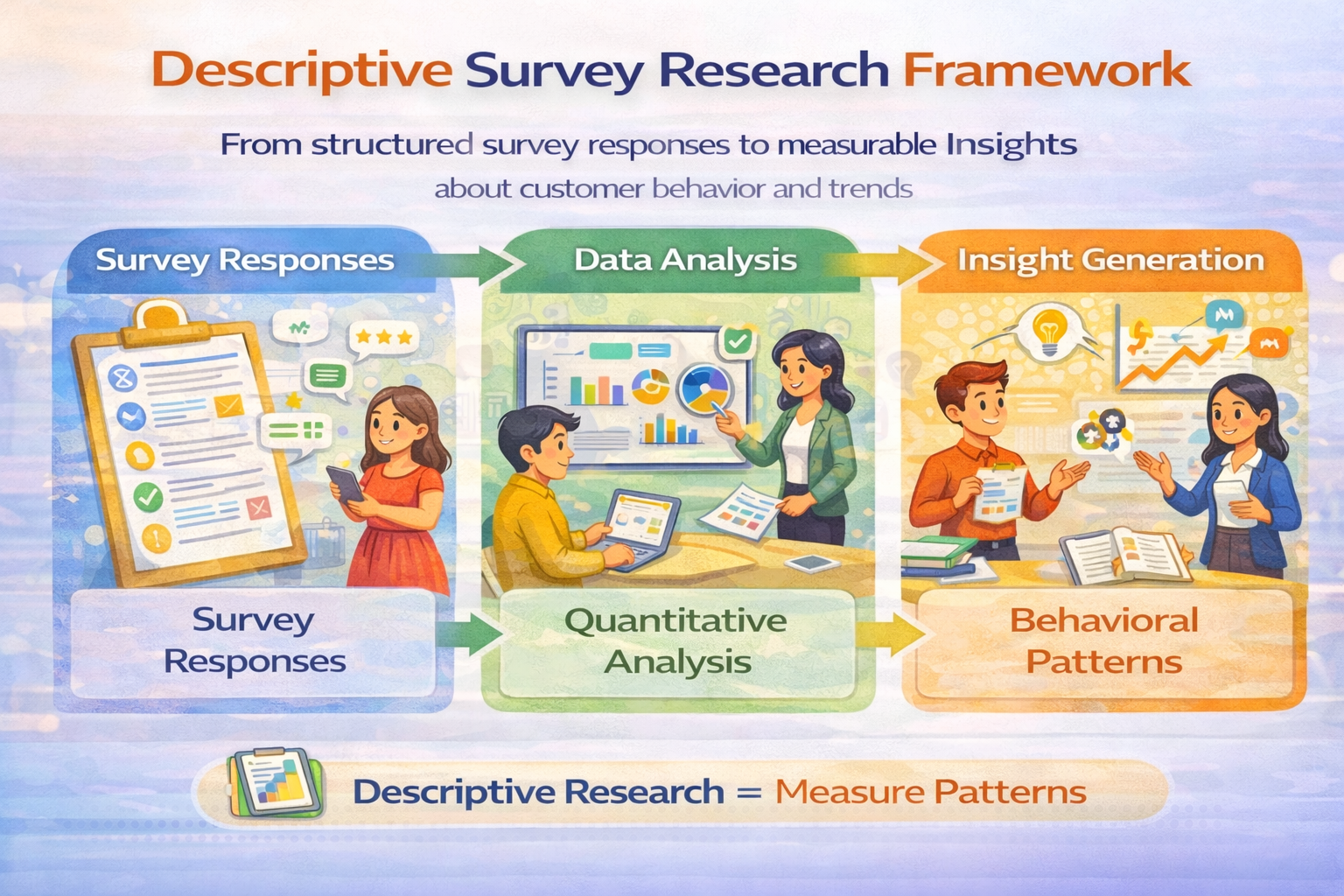
Once researchers identify the key questions through exploratory research, the next step is usually descriptive survey research. While exploratory surveys focus on discovery, descriptive research focuses on measurement.
In other words, descriptive surveys help researchers answer questions like:
This is why descriptive survey research is often considered the core of modern survey analytics. Organizations use it to quantify customer behavior, market trends, and user experiences.
Descriptive survey research measures patterns, opinions, and behaviors using structured surveys and quantitative data. Unlike exploratory surveys, descriptive research relies heavily on closed-ended questions that can be analyzed statistically.
Examples include:
Research experts summarize descriptive research clearly.
According to Starlight Research (Market Research Methodology Group):
“Descriptive research measures known patterns through structured surveys and quantitative datasets.”
Because of its ability to produce measurable insights, descriptive research is widely used in areas such as:
A common question researchers ask is: What do surveys look like when conducting descriptive research?
Unlike exploratory surveys, descriptive surveys follow a structured format.
A simple survey example might include questions such as:
Question 1
How satisfied are you with our service?
Question 2
How often do you use our product?
These types of questions allow researchers to analyze large datasets and identify patterns across respondents. This is why descriptive surveys are the most widely used type of survey research today.
Industry research shows that online surveys account for approximately 85% of quantitative survey usage among researchers. This insight was reported by Statista and Backlinko research studies analyzing global survey methodology adoption.
The primary purpose of descriptive survey research is to answer questions such as:
Research methodology experts often describe descriptive research as a snapshot of behavior or opinions at a specific moment in time.
According to LimeSurvey Research Insights Team (Survey Methodology Analysts):
“Descriptive research provides a snapshot of attitudes or behavior across a defined population.”
These insights are essential for understanding:
In customer experience research, descriptive surveys often form the foundation of CX analytics and PXI-style experience intelligence frameworks. They help organizations measure how customers interact with products, services, and digital experiences.
Modern customer experience research relies heavily on descriptive survey data.
Organizations frequently combine survey insights with behavioral analytics to understand customer journeys.
For example, descriptive surveys may measure:
These insights can then be combined with behavioral data to generate deeper experience intelligence insights. This approach is increasingly used in CX analytics platforms and PXI-style customer insight systems, where survey responses help explain customer behavior patterns. By measuring customer perceptions at scale, descriptive surveys allow organizations to make data-driven improvements to products, services, and customer journeys.
Descriptive survey research represents the measurement stage of the research lifecycle.
The process typically looks like this:
Because descriptive surveys generate structured datasets, they serve as the foundation for advanced analytics and predictive modeling. Without descriptive data, predictive insights would not be possible.
Once researchers have identified key variables and measured patterns through descriptive surveys, the next step is often predictive survey research. While exploratory research helps discover insights and descriptive research measures them, predictive research focuses on forecasting future outcomes.
Instead of asking:
Predictive research asks deeper questions such as:
This is why predictive survey research has become increasingly important in modern data-driven decision-making and CX analytics environments.
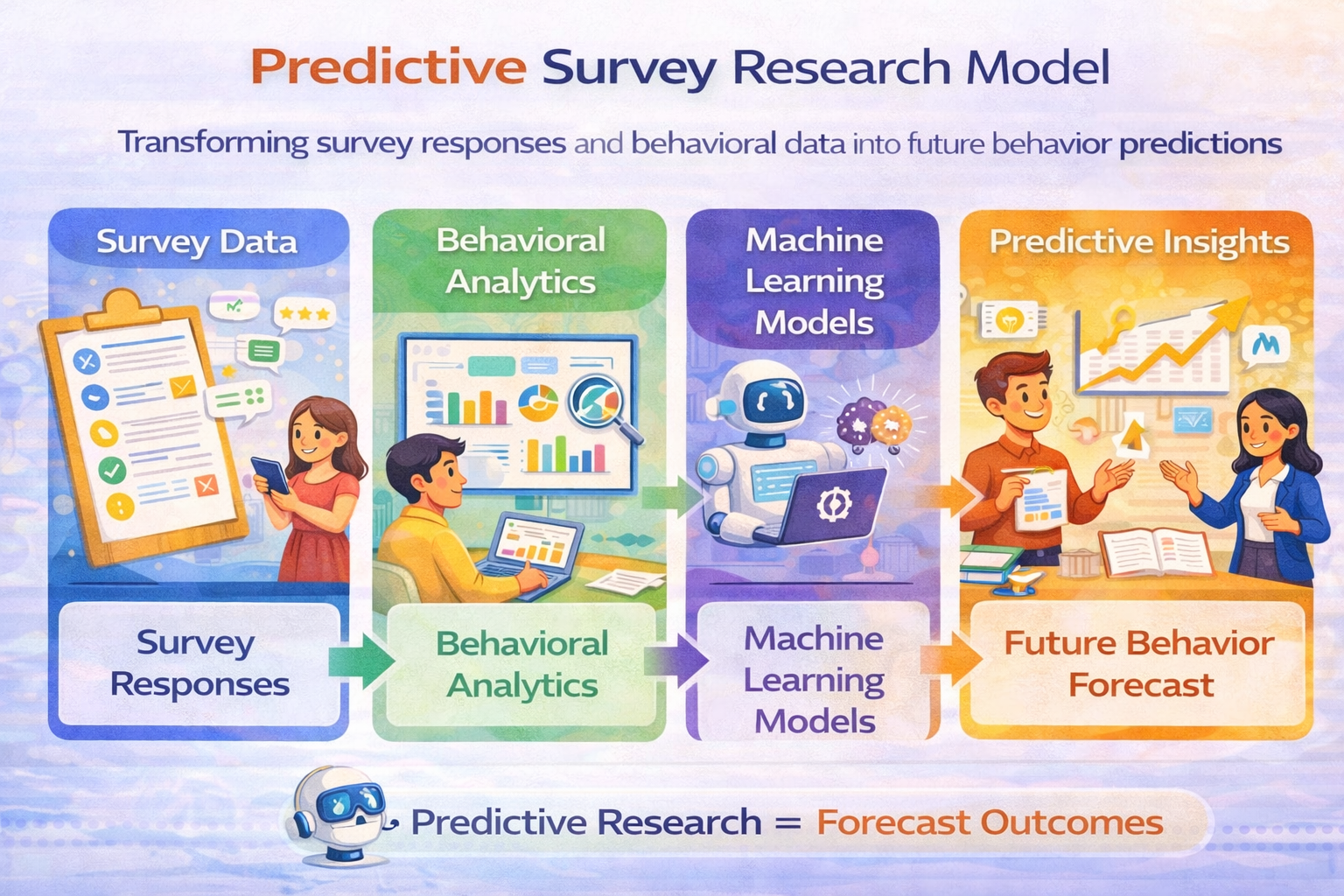
Predictive survey research uses survey data combined with advanced analytics to forecast future behaviors or outcomes. Researchers analyze patterns in survey responses and behavioral data to identify relationships between variables.
These insights help organizations predict future events such as:
Predictive surveys therefore go beyond simply measuring opinions. They help organizations understand what is likely to happen next based on current data.
Predictive research typically combines several types of data.
These include:
Using these datasets, researchers apply analytical techniques such as:
These techniques identify patterns and relationships within survey data. Once those relationships are discovered, predictive models can estimate future outcomes. For example, a predictive survey model might reveal that customers who report low satisfaction with onboarding are significantly more likely to stop using a product within the first month.
Predictive research is expanding rapidly because organizations now have access to larger datasets and more powerful analytics tools. Industry research shows that 47% of organizations now regularly use artificial intelligence in research workflows, while 69% experiment with synthetic data to improve predictive models.
These technologies allow researchers to combine survey insights with behavioral data and identify patterns that were previously difficult to detect.
Predictive research is therefore becoming a key component of:
Predictive survey research is particularly valuable in customer experience analytics. Organizations often collect survey responses to understand how customers feel about their experiences. However, when these responses are combined with behavioral data, they can also reveal which experiences predict future behavior.
For example, predictive survey analysis can help identify:
These insights are often used within PXI-style experience intelligence frameworks, where survey insights help organizations connect customer feedback with real behavioral outcomes. By forecasting future behavior, predictive survey research helps organizations move from reactive decision-making to proactive strategy.
Predictive survey research represents the final stage of the survey research lifecycle.
The complete research framework typically follows three steps:
When these research methods are combined, organizations can move from simple data collection to advanced research-driven decision-making.
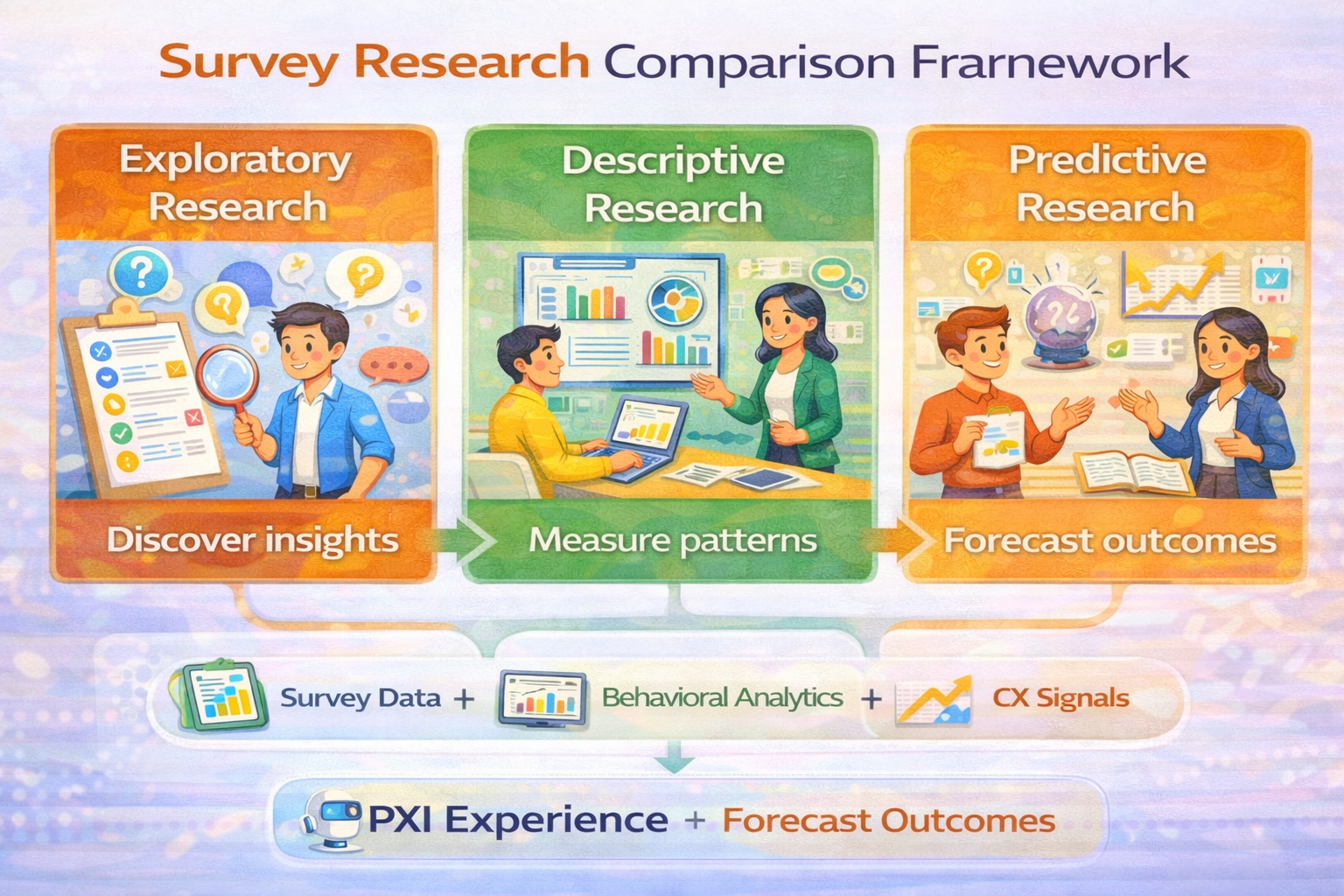
After understanding the three research methods individually, it becomes easier to see how they differ. Each survey research approach serves a distinct purpose within the research lifecycle. Exploratory surveys help researchers discover insights, descriptive surveys measure patterns, and predictive surveys forecast future outcomes.
Instead of competing with one another, these methods are designed to work together within a structured research framework. For organizations conducting customer research, product analytics, or customer experience (CX) analysis, combining these approaches allows teams to move from basic discovery to advanced decision-making.
The following table summarizes the differences between exploratory, descriptive, and predictive survey research.
Understanding these differences helps researchers choose the right method for the right research objective.
For example:
Modern research environments increasingly connect survey insights with customer experience analytics. Organizations today collect large amounts of customer feedback through surveys. However, the real value of a survey comes from how the insights are analyzed and applied. This is where modern CX and PXI-driven frameworks become important.
Survey responses can help organizations understand:
When survey insights are combined with behavioral analytics, teams can develop deeper experience intelligence insights. This approach allows organizations to move beyond simple survey reporting and begin building data-driven CX strategies.
Many modern customer experience platforms analyze surveys using a PXI (Product Experience Insights) framework.
This approach connects multiple layers of data, including:
When these signals are analyzed together, organizations gain a much clearer understanding of why customers behave the way they do.
For example, a PXI framework might connect:
This allows organizations to identify root causes behind customer experience issues, rather than simply measuring feedback.
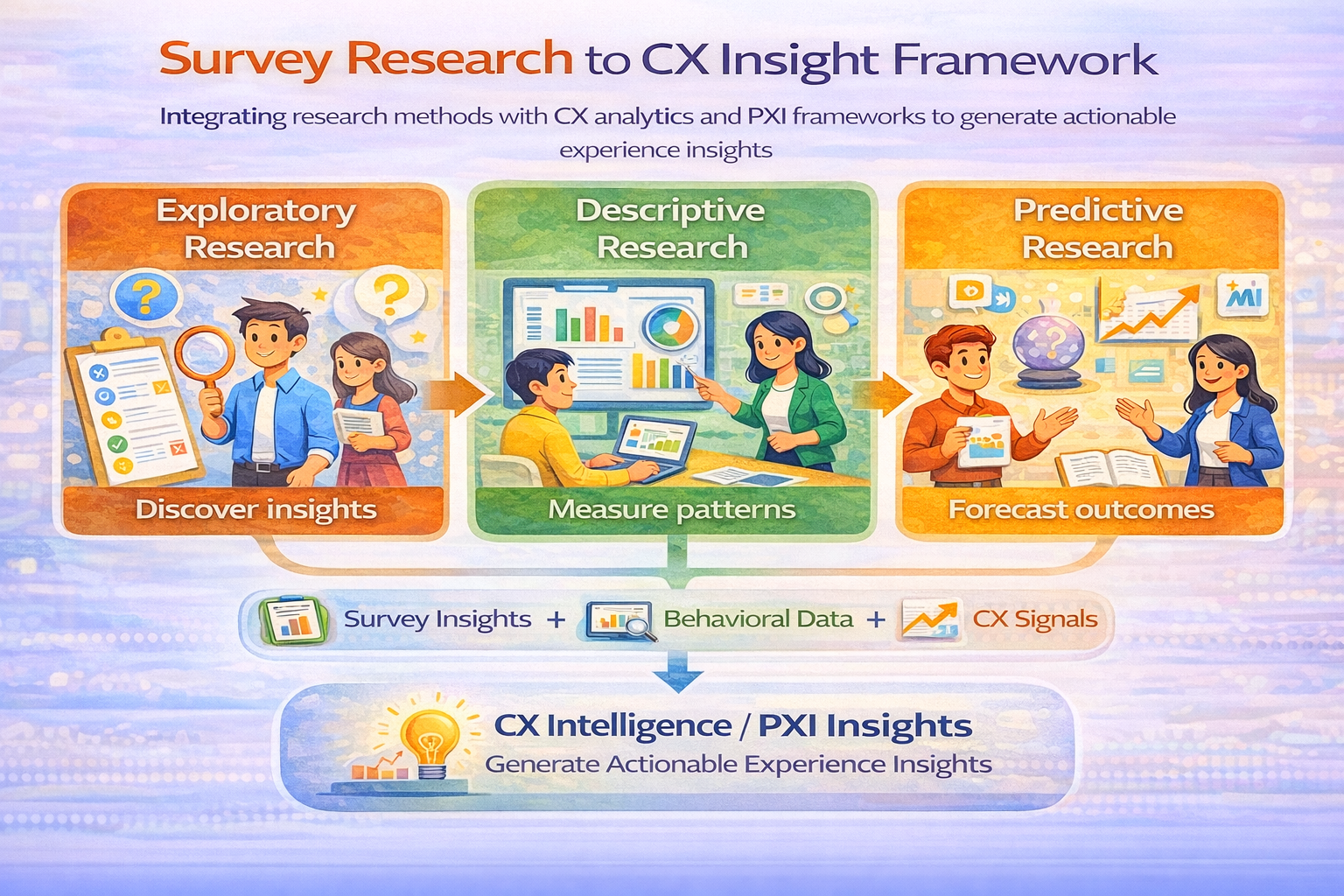
Research teams today are no longer focused only on collecting survey responses. Instead, they aim to transform survey data into actionable experience insights. This is why many organizations integrate survey research with CX analytics platforms and PXI-style experience intelligence systems, such as the frameworks used by Numr’s CX intelligence platform.
These systems help researchers:
By connecting exploratory insights, descriptive measurement, and predictive modeling, organizations can build a complete customer experience intelligence strategy.
In real-world research projects, exploratory, descriptive, and predictive survey research are rarely used in isolation.
Instead, they typically form a complete research workflow that helps organizations move from early discovery to advanced data-driven insights. This structured approach allows researchers to understand a problem, measure its scale, and eventually predict future outcomes.
For organizations focused on improving customer experience (CX), this research lifecycle is especially valuable. Survey research often provides the first signal of customer sentiment, while analytics platforms help transform those signals into deeper experience insights.
Most research strategies follow a progression that looks like this:
This approach helps researchers move from basic questions to actionable insights. For example, imagine a company conducting customer experience research.
The research process might look like this:
This progression allows organizations to move from understanding problems to preventing them.
Many people ask:
What is the purpose of a survey in modern analytics environments?
Even with advanced data analytics tools, surveys remain one of the most effective ways to capture human perception and experience. Behavioral data may show what customers do, but surveys reveal why they do it.
This is why surveys remain essential for:
A survey helps researchers collect insights that cannot always be observed through behavioral analytics alone. In other words, a survey connects human feedback with data-driven analysis.
Researchers often ask: What should a survey look like when studying customer experience?
Modern CX surveys are typically designed to be:
A simple example survey used in CX research might include questions like:
Question 1
How satisfied are you with your recent experience?
Question 2
What challenges did you experience during the process?
Question 3
What improvements would you like to see?
These questions allow organizations to collect feedback that can later be analyzed alongside behavioral analytics.
Survey data becomes significantly more powerful when it is combined with experience analytics and PXI-style frameworks.
Rather than analyzing survey responses alone, modern research teams often integrate survey insights with:
This combined approach helps organizations understand:
Platforms that support CX intelligence and PXI-driven research approaches, such as those developed by Numr, help researchers connect survey feedback with real customer behavior. This allows organizations to transform survey data into experience insights that guide strategic decision-making.
When exploratory, descriptive, and predictive research methods are combined with CX analytics, survey data becomes much more valuable.
Instead of simply reporting survey results, organizations can:
This approach transforms survey research from a simple feedback tool into a core component of modern experience intelligence systems. For organizations focused on improving customer journeys, this integration of survey research, CX analytics, and PXI insights provides a much clearer understanding of customer behavior.
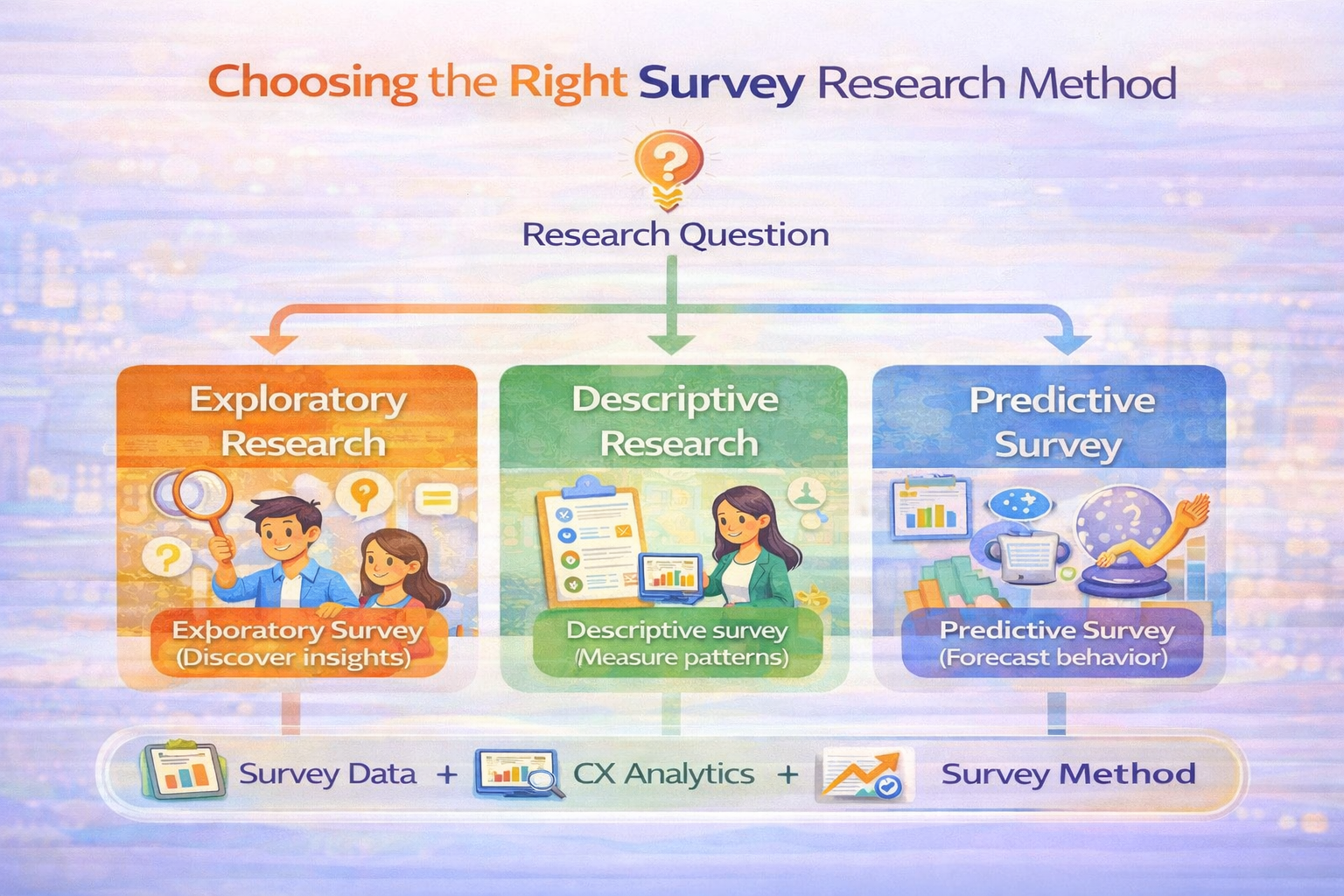
One of the most common questions researchers ask is:
Which type of survey research should we use?
The answer depends on the goal of your research. Exploratory, descriptive, and predictive survey research are designed for different purposes. Choosing the right approach ensures that your survey produces insights that are both useful and actionable.
If you start with the wrong method, even a well-designed survey may fail to deliver meaningful insights. Understanding what a survey is meant to achieve is therefore the first step in building an effective research strategy.
Every research project begins with a clear question.
Before designing a survey, you should ask yourself:
These questions help determine which survey method is appropriate.
For example:
In simple terms: Discovery → Measurement → Prediction.
Organizations often design surveys around specific objectives. Here is how the three survey research types align with common research goals.
This framework helps researchers design surveys that produce reliable and actionable insights.
Another common question researchers ask is: What do surveys look like for different research methods? Although the structure of a survey varies depending on the method, most surveys follow a similar format.
Exploratory surveys often include open-ended questions such as:
These questions help researchers discover new insights.
Descriptive surveys typically use structured questions.
Example survey question:
How satisfied are you with the service?
These responses allow researchers to measure patterns across large populations.
Predictive surveys often combine survey responses with behavioral data.
For example:
When these responses are analyzed alongside behavioral signals, researchers can build predictive models.
Regardless of the research method you choose, survey design quality directly affects the reliability of insights.
Effective surveys are:
Poorly designed surveys often lead to unreliable results.
For example, double-barreled questions such as:
"How satisfied are you with our pricing and product quality?" make it difficult for respondents to answer accurately. Good survey design ensures that researchers collect valid and meaningful data.
Modern research environments increasingly connect survey insights with customer experience analytics.
Instead of analyzing survey responses in isolation, organizations now integrate survey feedback with:
This combined approach allows researchers to understand:
Experience analytics frameworks such as PXI-driven CX intelligence systems help connect these signals. Platforms built around this approach such as those developed by Numr’s CX intelligence framework enable organizations to transform survey responses into deeper customer insights. This allows research teams to move beyond simple feedback collection and build data-driven experience strategies.
When survey research is properly designed and combined with experience analytics, it becomes a powerful decision-making tool.
Organizations can use surveys to:
In this way, survey research becomes more than a research technique.
It becomes a core component of modern customer experience intelligence.
Collecting survey responses is only the first step.
The real value of surveys comes from understanding what the feedback actually means and how it connects to real customer behavior.
When organizations analyze survey responses together with behavioral signals, they can identify patterns that explain why customers feel a certain way about products, services, or experiences.
Modern CX analytics and PXI insight frameworks help teams move beyond simple reporting by connecting survey responses with customer journey data, product usage patterns, and experience signals.
This allows organizations to identify:
If your team wants to understand how customer perception connects to real experiences, exploring modern survey analytics frameworks can be a powerful next step.
Explore how experience intelligence platforms help organizations transform survey feedback into CX insights.
A Likert-style rating scale is a survey response format used to measure opinions, attitudes, or perceptions.
Respondents typically select a response on a scale such as strongly disagree to strongly agree, allowing researchers to convert qualitative opinions into structured numerical data.
Likert scales are widely used because they make it easy to measure sentiment consistently across large groups of respondents.
They allow researchers to quantify feedback about customer experience, employee engagement, product usability, and service satisfaction.
A 5-point Likert scale is simpler and easier for respondents to complete, making it ideal for customer experience surveys.
A 7-point Likert scale provides more nuanced response options, which can help researchers capture subtle differences in sentiment.
Yes. Likert scale responses are often analyzed using:
These methods help researchers identify trends and patterns in survey responses.
Organizations use Likert scale surveys to measure customer sentiment at different points in the customer journey.
When survey insights are combined with behavioral analytics and experience intelligence frameworks, teams can identify friction points and improve the overall customer experience.
.png)

.png)
.svg)


