.png)
How Should Inner Loop and Outer Loop Work Together in Modern CX?
Inner loop and outer loop should operate as a connected system where each continuously feeds the other.
The inner loop captures real-time feedback, identifies individual risks, and resolves issues to protect customer relationships. The outer loop then aggregates those signals, identifies patterns, and eliminates the systemic causes behind them.
In a modern CX system, this relationship follows a structured execution flow: Signal → Insight → Root Cause → Alert → Action → Outcome
This ensures that feedback does not remain reactive. It becomes actionable and continuously improves customer experience.
This ensures that feedback does not remain reactive. It becomes predictive and actionable. The goal is not just to respond faster but to reduce the volume of issues that require response in the first place.
Most enterprises today have invested significantly in CX infrastructure. They run continuous NPS and CSAT programs, collect feedback across multiple touchpoints, and maintain dashboards that provide real-time visibility.
Despite this, outcomes often remain stagnant. Scores plateau, complaints repeat, and leadership struggles to connect CX efforts to measurable business impact.
The issue is not inactivity, it is misaligned action.
At an operational level, teams are actively responding to customers. Issues are acknowledged, tickets are resolved, and SLAs are met. From a process standpoint, the system appears to be working.
However, when looking at patterns over time, the same issues continue to resurface.
This indicates that while problems are being resolved at an individual level, they are not being eliminated at a systemic level.
Most CX organizations are structurally optimized for inner-loop execution. They prioritize responsiveness, resolution speed, and customer recovery.
But they underinvest in outer-loop capabilities such as:
As a result, CX becomes a reactive function rather than a proactive system.
As Bruce Temkin explains:
“If they don't fix the root causes of customer problems, they're just managing symptoms.”
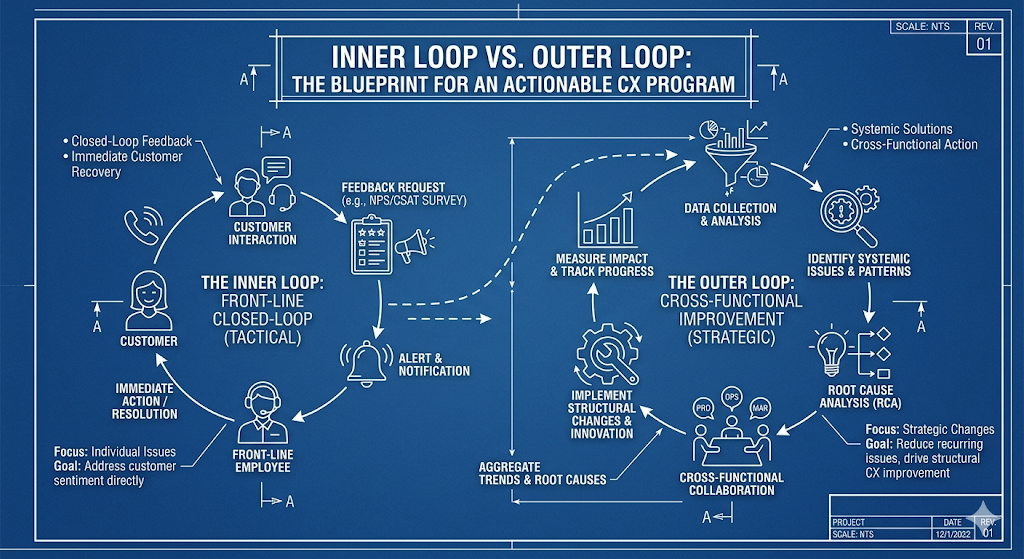
To build an actionable CX program, it is essential to clearly differentiate between these two loops.
The inner loop is focused on responding to individual customer feedback. It ensures that when a customer encounters a problem, the organization reacts quickly and resolves the issue.
This includes activities such as:
Inner-loop processes typically operate within hours to days and are managed by CX, support, or customer success teams.
The primary goal is to protect the relationship and prevent immediate churn.
The outer loop operates at a higher level. Instead of focusing on individual cases, it looks across large volumes of feedback to identify recurring issues.
These issues often point to systemic problems in:
Outer-loop initiatives involve cross-functional teams and typically take weeks to months to implement.
The goal is not recovery, it is prevention.
Inner loop ensures customers are saved.
Outer loop ensures problems are eliminated.
Most organizations believe they are performing well because they respond to feedback, track scores, and maintain structured workflows.
However, they fail to address the most important aspect of CX: eliminating recurring problems
A significant portion of customer feedback between 50–70% is linked to just 3–5 recurring issues
This concentration means that solving a small number of systemic problems can have a disproportionately large impact.
Instead of prioritizing these high-impact areas, teams often:
Only 30–40% of CX teams have strong executive alignment for outer-loop initiatives, making it difficult to drive cross-functional change
The inner loop continues to perform efficiently.
The outer loop remains underdeveloped.
Inner loop is the most mature component of most CX programs.
The process typically includes:
High-performing teams resolve approximately 90% of high-risk cases within 24–72 hours
Additionally, 85–90% of enterprises already have structured inner-loop systems in place, indicating strong adoption
Inner loop is highly effective at managing individual interactions. It ensures responsiveness and helps maintain customer relationships.
However, it does not address systemic issues. The same problems continue to generate new cases, leading to repetitive effort.
Outer loop is where organizations move from reactive recovery to proactive improvement.
Outer loop involves:
A single outer-loop fix can impact thousands of customers simultaneously. Instead of resolving issues repeatedly, it eliminates them at the source.
Outer-loop initiatives deliver 5–10× higher ROI compared to individual case resolution.
Rather than resolving hundreds of similar complaints individually, the outer loop identifies the underlying issue and fixes it once removing the need for repeated intervention.
This is where CX transitions from operational support to strategic growth.
Inner loop helps reduce immediate churn and improve short-term satisfaction. It plays a critical role in maintaining relationships.
However, its impact is limited and does not scale.
Outer loop improves entire customer journeys, reduces friction, and drives long-term growth.
Fixing systems generates exponentially more value than fixing individual cases.
High-performing CX programs do not treat inner loop and outer loop as separate workflows. Instead, they build a structured system where both loops are continuously connected, ensuring that every customer signal contributes to both immediate recovery and long-term improvement.
The foundation of any CX program is a strong inner loop. This means ensuring that customer feedback is captured in real time, ownership is clearly defined, and responses are delivered within strict SLAs.
When inner loop execution is strong, organizations can quickly resolve individual issues, protect at-risk customers, and maintain trust. However, the purpose of strengthening the inner loop is not just faster resolution, it is to generate high-quality signals that can be used for deeper analysis.
Once the inner loop is functioning effectively, the next step is to ensure that it continuously feeds the outer loop. Every interaction, complaint, or piece of feedback should be treated as a signal that contributes to pattern detection.
Instead of viewing feedback as isolated events, organizations must aggregate these signals to identify recurring issues. This shift transforms the inner loop from a reactive system into a source of strategic insight.
One of the most critical steps in this process is prioritization. Rather than attempting to fix every issue, high-performing teams focus only on the most impactful problems.
In practice, this means identifying and addressing 3–5 high-impact themes per quarter. These themes typically represent the majority of customer friction and offer the highest potential for improvement.
By narrowing focus, organizations can allocate resources more effectively and drive meaningful change.
Outer-loop initiatives cannot be executed by CX teams alone. They require collaboration across multiple functions, including product, operations, engineering, and customer experience.
These cross-functional teams, usually consisting of 5–12 members, work together to implement changes that address root causes. This ensures that solutions are not superficial fixes but structural improvements
that impacts the entire customer journey.
The final step is to measure the impact of these changes using clear business metrics. This includes tracking improvements in NPS, reductions in churn, and decreases in operational costs.
Measuring outcomes ensures accountability and helps organizations understand the true value of their CX initiatives. It also creates a feedback loop that informs future prioritization and decision-making.
When this system is executed correctly, it creates a continuous cycle where insights are translated into action, and actions drive measurable business results.
The exact flow is: Insight → Action → Outcome
The next stage of CX maturity is moving from reactive to predictive systems.
Instead of waiting for feedback, organizations detect early signals, predict risk, and act before problems escalate.
AI enables this shift by identifying 3–5× more themes compared to manual analysis, improving prioritization and speed
CX evolves from fixing problems after they occur to preventing them before they impact outcomes.
Most organizations measure CX success through operational metrics such as response time and ticket closure.
However, true maturity is defined by how effectively an organization eliminates problems.
Inner loop helps retain customers. Outer loop drives business growth.
As Jeanne Bliss explains:
“Customer experience improvement is about fixing the system, not just the symptoms.”
CX is not just a feedback system. It is a system of continuous improvement driven by action.
Most CX programs are built to respond. They capture feedback, trigger recovery workflows, and close tickets efficiently. But by the time a problem is resolved at the individual level, the same issue is already affecting hundreds of other customers.
That’s the gap.
If your current CX system is still focused on:
then you are optimizing for recovery not for prevention.
Customers don’t wait for resolution cycles.
They:
Every repeated issue is a system failure not a customer problem
Connect with us and see how PXI operates as a complete system across your customer journey. Experience how your CX can move from Signal → Risk → Reason → Alert → Action → ROI.
Book a demo to see how you can eliminate recurring issues, improve retention, and drive measurable growth.
Inner loop and outer loop represent two fundamentally different layers of customer experience execution.
The inner loop focuses on individual customers. It captures feedback, identifies at-risk users, and resolves issues quickly to protect relationships and prevent immediate churn. It is operational, fast, and case-based.
The outer loop, on the other hand, focuses on the system. It aggregates feedback across customers, identifies recurring patterns, and addresses the root causes behind those issues. It is strategic, cross-functional, and designed to prevent problems at scale.
The inner loop fixes the customer. Outer loop fixes the company.
Most CX programs fail because they over-invest in inner-loop activities and under-invest in outer-loop transformation.
They become highly efficient at responding to issues but do not eliminate the underlying causes. As a result, the same problems continue to occur, creating a cycle of repetitive effort without meaningful improvement. This leads to “activity without progress”
Outer-loop analysis is the process of identifying systemic issues across customer journeys by analyzing aggregated feedback.
It involves:
The goal is to eliminate root causes rather than repeatedly addressing symptoms.
Predictive Experience Intelligence (PXI) operates as a unified system that connects both loops into a continuous workflow.
It captures signals from customer interactions, predicts risk in real time, identifies root causes using AI, and triggers actions across teams before issues escalate.
This ensures that:
Focusing on the outer loop delivers long-term, scalable impact.
Key benefits include:
Since outer-loop fixes address root causes, they often deliver 5–10× higher ROI compared to individual issue resolution.
The most effective approach is to focus on high-impact, recurring themes.
Typically:
By prioritizing these top themes, organizations can maximize impact while avoiding fragmented efforts.
The goal is not to fix everything
It is to fix what matters most.
AI plays a critical role in scaling outer-loop analysis.
It enables organizations to:
This significantly reduces analysis time and improves decision-making speed.
Outer loop directly impacts revenue and efficiency.
By eliminating systemic issues, organizations:
For example, a 10-point improvement in NPS can lead to measurable revenue growth, while outer-loop fixes can improve customer engagement and loyalty at scale.
The biggest mistake is treating CX as a feedback and reporting function rather than an execution system.
Many organizations:
Insight without action does not improve experience.
Traditional CX systems:
Modern CX systems:
This transforms CX from measurement → execution system
.png)

.png)
.svg)


