.png)
Are You Sending Surveys at the Wrong Moment?
Most CX teams spend significant time improving survey design.
They refine question wording. They shorten questionnaires. They optimize subject lines. They test incentives. They improve mobile experiences.
Yet one of the most important drivers of survey performance often receives far less attention: Survey timing.
The reality is that customer feedback is highly dependent on context. A perfectly designed survey delivered at the wrong moment can produce lower response rates, weaker recall, and less reliable customer intelligence than a simpler survey delivered at the right stage of the journey.
This is why timing is not merely an operational consideration. It is a measurement decision.
According to recent CX measurement studies, transactional NPS surveys sent within two hours of a customer interaction generated approximately 32% more completions than surveys sent later. Researchers also found that organizations often achieve 2× to 10× higher response rates when surveys are embedded inside product experiences instead of relying solely on email distribution.
These findings highlight an important reality.
The question is not: "When should we send a survey?"
The better question is: "When is the customer most capable of providing accurate feedback?"
That distinction fundamentally changes how organizations approach customer experience measurement.
As Amitayu Basu, CEO of NUMR Inc., explains:
"More responses are not always better. I would rather have fewer thoughtful responses than a large dataset full of lazy answers."
This philosophy aligns closely with a broader trend identified across the CX industry. Research summarized in the timing study notes that 2025 marked a significant shift, with many CX leaders moving away from response-rate obsession and toward response quality, signal accuracy, and insight utilization.
In other words, the conversation is no longer about collecting the largest possible dataset. It is about collecting the most useful one.
Many organizations treat survey timing as a tactical distribution decision.
In reality, timing directly influences three critical dimensions of CX measurement:
The relationship between these factors is often underestimated. A poorly timed survey may still generate responses. The problem is that those responses may no longer reflect what customers actually experienced.
Customers are more likely to participate when an experience remains fresh and personally relevant. As time passes, motivation to respond naturally declines.
Research from CXIndex found that surveying customers shortly after interactions can significantly improve participation rates compared with delayed outreach. Similarly, SurveyMonkey and Delighted benchmarking studies consistently recommend collecting transactional feedback as close to the interaction as practical because engagement decreases as recognition fades.
This explains why high-performing Voice of Customer programs increasingly use event-triggered surveys rather than fixed survey schedules. The closer the survey sits to the experience, the stronger the participation signal tends to be.
Participation alone does not guarantee quality. Customers must also remember what happened. This introduces one of the most overlooked concepts in CX measurement:
Every customer interaction has a period during which memories remain detailed, emotionally accurate, and cognitively available. Outside that window, feedback quality deteriorates.
According to CustomerGauge's NPS research, timing directly affects emotional recall because surveys sent too late risk losing important context, while surveys sent too early may miss critical parts of the experience altogether.
Consider a product delivery experience. If you survey immediately after delivery, the customer may not have used the product. If you wait three weeks, they may struggle to remember the delivery experience itself.
Neither timing produces optimal insight. The strongest customer feedback programs identify the Recall Window and collect feedback inside it.
This is where timing becomes strategically important. Poor timing does not simply reduce participation. It reduces signal quality. And poor signals lead to poor decisions.
According to Gartner's Voice of Customer guidance, organizations generate better customer intelligence when measurement programs are designed around customer context rather than reporting convenience. High-quality customer signals are created when feedback reflects actual experiences rather than reconstructed memories or incomplete outcomes.
From a CX Dashboard perspective, this distinction is critical. A dashboard metric answers a business question. A widget answers a decision question.
If survey timing introduces inaccurate signals, every dashboard, widget, insight, and recommendation built on top of that data becomes less reliable.
That is why timing should never be viewed as an email scheduling exercise. It is a customer intelligence design decision.

One of the biggest mistakes organizations make is focusing on calendar benchmarks before understanding customer journeys.
Yes, industry research shows that Tuesday through Thursday mornings often perform well for email survey engagement, with several studies identifying 9 AM–11 AM and 10 AM–2 PM as strong response windows.
However, those benchmarks are secondary. Customer context matters more than calendar optimization.
A transactional survey sent immediately after a meaningful support interaction on a Monday afternoon will almost always outperform a survey sent on Tuesday morning after the customer has emotionally moved on. The strongest CX programs therefore design timing around journey moments rather than send schedules.
Feedback should be requested when:
This principle forms the foundation of modern CX measurement. Journey first. Timing second. Calendar third.
That sequence consistently produces stronger customer signals, higher-quality feedback, and more confident business decisions
Transactional surveys are designed to measure a specific customer interaction rather than the overall customer relationship.
These surveys typically capture feedback immediately after important journey events such as:
The primary objective is to understand how customers experienced a particular touchpoint while the details remain clear in their memory. From a CXM perspective, transactional surveys are not simply feedback tools.
They are journey measurement tools. Their purpose is to identify friction, effort, satisfaction, and resolution quality at the exact moment an experience occurs. This is why timing becomes critical.
The further feedback collection moves away from the interaction, the greater the risk that customers forget important details or reinterpret the experience through later events. That statement reflects one of the most important principles in customer experience measurement:
The value of feedback depends on when it is collected.
Support experiences are highly dependent on memory, effort, and emotional context.
Customers can usually recall:
However, that clarity fades quickly.
Research cited in the timing study recommends surveying customers immediately after chat completion or within 24 hours of ticket closure to maximize recall accuracy and participation. Checker's analysis of hundreds of CX programs similarly identified approximately 24 hours after resolution as an effective measurement window.
The objective is to capture the customer's perception while the interaction remains cognitively available. Waiting a week often reduces both participation and response quality.
Product delivery surveys require a different approach. Unlike support interactions, customers need time to experience the outcome before providing meaningful feedback.
Surveying immediately after delivery often creates incomplete responses because customers have not yet:
Research from Checker's analysis of more than 500 CX programs found that B2C post-purchase surveys frequently perform best when delivered approximately two to three days after product delivery rather than immediately. Staffino similarly recommends collecting delivery feedback one to two days after service completion or delivery.
The principle remains consistent: Feedback should arrive after customers have experienced the outcome but before memory begins to fade.
Events create another unique timing challenge. Attendees need enough time to reflect on the experience, but not so much time that details disappear.
Industry research consistently recommends collecting event feedback within 24–48 hours after attendance. This timing helps organizations capture:
while the experience remains memorable.
One of the most common mistakes in customer experience measurement is treating relationship surveys the same way as transactional surveys. They serve fundamentally different purposes.
Transactional surveys answer: "How did this specific interaction perform?"
Relationship surveys answer: "How does the customer feel about the relationship overall?"
Because the objectives differ, timing strategies must also differ.
Relationship surveys measure:
These metrics should not fluctuate based on a single support interaction or isolated event. Instead, they should capture a broader view of the customer relationship.
Research from Staffino recommends running relational NPS (rNPS) programs at predefined intervals such as quarterly or biannual cadences rather than after every customer interaction.

Quarterly surveys are useful when organizations need visibility into:
This cadence works particularly well in subscription businesses and high-frequency engagement environments.
Organizations with longer customer lifecycles often benefit from biannual measurement.
Examples include:
Because customer relationships evolve more slowly, quarterly surveying may generate unnecessary noise and survey fatigue. Research consistently recommends structured intervals for relationship measurement rather than event-driven triggers.
One of the most important concepts in CX measurement rarely appears in discussions about survey response rates. That concept is the Recall Window.
The Recall Window refers to the period during which customers can accurately remember and evaluate an experience.
Every interaction has one. The challenge is identifying it. According to CustomerGauge research, timing directly affects emotional recall. Surveys sent too early may miss key experience outcomes, while surveys sent too late risk losing critical context altogether.
This creates two common measurement failures.
Customers may not yet understand the outcome being evaluated.
Examples include:
In these situations, feedback reflects assumptions rather than experiences.
Delayed surveys create a different problem. Customers forget details. Context disappears. Emotions soften. Memories become reconstructed rather than recalled.
This weakens both response quality and decision confidence. The strongest Voice of Customer programs therefore identify the Recall Window for each journey stage and align measurement accordingly.
Although journey timing should always come first, channel timing still plays an important role in survey performance. Different channels create different participation patterns.
Research consistently shows that response behavior varies significantly across email, SMS, and in-app experiences.
The most effective CX programs therefore optimize both:
rather than focusing exclusively on one dimension.
Customer journey timing determines when feedback should be collected. Channel timing determines how feedback should be delivered. Both influence response rates, completion rates, and response quality.
A perfectly timed survey can still underperform if it is delivered through the wrong channel or at an inconvenient moment.
This is why mature CX programs optimize timing at two levels:
Research summarized in the survey timing benchmark document shows that different channels generate very different participation patterns because customers engage with each channel differently. Email, SMS, and in-app surveys each have unique strengths, limitations, and timing requirements.
As Samudra Gupta, CTO of NUMR Inc., explains:
"Response quality can be engineered through survey length, device experience, validation rules, fraud checks, and better question design."
Timing is part of that engineering process. The goal is not simply to reach customers. The goal is to reach them when participation feels natural rather than disruptive.
Email remains one of the most widely used survey distribution channels because it scales easily and supports richer questionnaires.
However, email also faces significant competition for attention. Customers receive dozens or even hundreds of messages each day. This makes timing particularly important.
The most commonly cited windows include:
These periods often align with higher email open rates and stronger participation levels. However, CX teams should remember that calendar optimization is secondary to customer journey timing.
A support survey sent immediately after ticket resolution on a Monday afternoon will often outperform a perfectly scheduled Tuesday-morning survey sent days after the experience occurred. Journey context remains the primary driver.
SMS surveys are particularly effective for short transactional feedback programs. Because text messages typically achieve higher visibility than email, they often generate stronger participation rates.
Research highlighted in the timing document recommends avoiding early-morning outreach and instead targeting periods when customers are more likely to engage voluntarily.
This timing helps organizations avoid interruptions while still reaching customers during active hours.
SMS works especially well for:
The shorter the survey, the more effective SMS tends to become.
In-app surveys represent one of the most powerful developments in modern Voice of Customer programs. Unlike email and SMS surveys, in-app surveys can be triggered directly by customer behavior.
This creates a significant advantage. Feedback is collected while customers are actively experiencing the product.
Research cited in the timing benchmark study found that organizations often achieve response rates between 2× and 10× higher when surveys are embedded within product experiences compared with traditional email approaches.
Examples of effective triggers include:
Rather than asking customers to remember an experience later, in-app surveys capture reactions in real time. This often improves both participation and recall quality.
Most discussions about survey timing focus on response rates. Far fewer discuss timing bias. Yet timing bias can be even more dangerous. Why?
Because it affects data quality rather than participation volume.
Timing bias occurs when survey timing influences who responds, how they respond, or what they remember. The result is a distorted customer signal.
Research referenced in the timing study found that surveys distributed immediately after negative experiences generated response rates up to three times higher than surveys distributed following positive experiences.
This finding has important implications. If survey timing disproportionately attracts dissatisfied customers, organizations may mistakenly conclude that customer sentiment is worse than reality. The feedback itself is genuine. The sample becomes skewed.
Timing bias can influence multiple areas of CX decision-making.
Customers experiencing frustration often feel more motivated to provide feedback. If surveys are triggered primarily during moments of friction, negative sentiment becomes amplified.
Leadership teams may allocate resources toward highly visible issues while overlooking broader customer needs.
Changes in survey timing can create shifts in survey results that have nothing to do with actual customer experience performance.
When survey timing introduces bias, confidence in CX dashboards and Voice of Customer programs decreases.
This is why survey governance should evaluate not only response rates but also response composition. The objective is to understand whether feedback accurately reflects customer reality.
Another critical timing challenge is survey fatigue. Customers increasingly receive feedback requests after almost every interaction.
After purchases. After support conversations. After deliveries. After onboarding. After renewals. After website visits. Eventually customers stop responding.
According to Microsoft's Global State of Customer Service research, 72% of customers want companies to value their time more effectively, including reducing unnecessary effort associated with customer service interactions and feedback requests.
Excessive surveying creates three problems:
The result is often more data collection and less customer intelligence.
Survey activity should be coordinated across departments rather than managed independently. Without governance, customers may receive multiple survey requests from different teams.
Organizations should define limits for how often individual customers can be surveyed. This prevents overexposure.
Relationship surveys and transactional surveys serve different purposes. Running them simultaneously often creates an unnecessary survey burden.
Research consistently recommends maintaining structured intervals for relationship surveys rather than triggering them continuously.
One of the biggest mistakes organizations make is asking: "What is the best day to send a survey?"
The better question is: "What customer journey moment should trigger feedback?"
This shift moves survey design from calendar management to customer experience management.
This framework aligns timing with customer context rather than arbitrary schedules. That alignment improves participation, recall, and insight quality simultaneously.
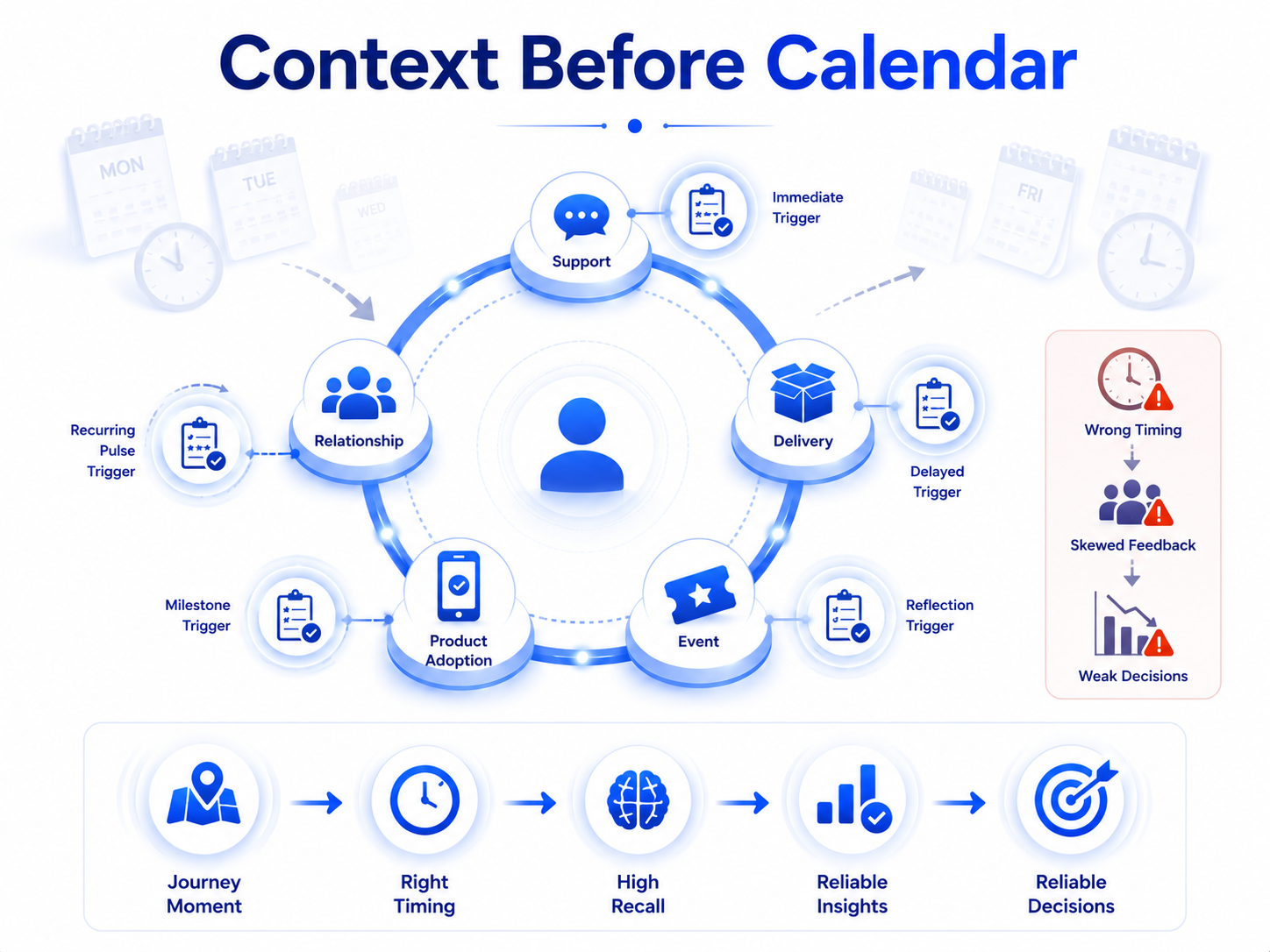
Many survey timing guides focus heavily on calendar optimization.
Tuesday. Wednesday. 10 AM. 11 AM.
Those recommendations are useful. But they are not the primary driver of customer intelligence quality. NUMR approaches survey timing differently.
The most important question is not: "When should we send the survey?"
The most important question is: "When can the customer provide the most accurate signal?"
When survey timing aligns with meaningful journey moments, organizations gain:
Because timing is not simply a survey setting. It is part of the measurement methodology. The objective is not maximizing survey volume. The objective is maximizing insight quality.
Survey timing directly affects response rates, recall accuracy, response quality, and decision confidence. Transactional surveys should be tied closely to customer interactions.
Relationship surveys should follow structured measurement cadences. Channel timing should support customer convenience rather than internal schedules. Most importantly, survey timing should align with the customer journey.
Research across CustomerGauge, SurveyMonkey, Delighted, Staffino, and other CX benchmarking studies consistently shows that customers provide more accurate and useful feedback when surveys are delivered during the right recall window and at the right stage of the journey.
The best time to send a CX survey is not necessarily Tuesday at 10 AM. The best time is when customers can still accurately remember the experience you want to measure.
Organizations that align timing with meaningful customer moments collect better signals, reduce survey fatigue, improve insight quality, and make better customer experience decisions. Because better timing ultimately leads to better customer intelligence.
Survey timing has a direct impact on response rates, completion rates, recall accuracy, and the quality of customer intelligence that reaches decision-makers. But timing alone is not enough.
Leading CX organizations combine journey-based survey triggers, Voice of Customer analytics, customer journey measurement, response quality monitoring, and survey governance to ensure feedback is collected at the right moment and used effectively.
With NUMR, teams can:
Book a Demo to see how NUMR helps organizations capture better customer signals, improve survey effectiveness, and make more confident customer experience decisions.
There is no universal best time for every survey.
The most effective survey timing depends on the customer journey stage and the type of feedback being collected. Transactional surveys generally perform best when sent shortly after the interaction being measured, while relationship surveys are usually distributed on a structured quarterly or biannual cadence.
Research consistently shows that journey-based timing produces more reliable feedback than relying solely on calendar-based recommendations.
Survey timing influences how relevant an experience feels to the customer.
When surveys arrive while an interaction is still fresh, customers are more likely to participate because they can easily recall what happened and understand why their feedback matters.
As time passes, participation motivation often decreases and recall quality begins to deteriorate. This is why survey timing affects both response rates and feedback quality.
Most transactional surveys should be delivered as close to the customer interaction as practical.
Common examples include:
The objective is to collect feedback while the experience remains fresh and memorable.
Relationship surveys should measure long-term customer sentiment rather than individual interactions.
Most CX programs use:
Industry best practices generally discourage sending relationship surveys after every interaction because this increases volatility and contributes to survey fatigue.
The Recall Window is the period during which customers can accurately remember and evaluate an experience.
Every interaction has a different Recall Window. If a survey arrives too early, customers may not have experienced the outcome being measured. If it arrives too late, details, emotions, and context may fade.
Collecting feedback within the Recall Window improves response quality, recall accuracy, and decision confidence.
In many situations, yes.
Research cited in multiple CX benchmarking studies shows that in-app surveys can generate significantly higher response rates because feedback is requested within the product experience itself.
Customers do not need to leave the application, open an email, or remember an earlier interaction.
This reduces effort and often improves participation. However, effectiveness still depends on customer context, survey design, and trigger strategy.
Timing bias occurs when survey timing influences who responds or how customers respond.
For example, surveys sent immediately after negative experiences may attract more dissatisfied respondents than surveys sent during neutral or positive moments.
This can create a distorted view of customer sentiment and lead organizations to prioritize issues based on an unrepresentative sample.
Effective survey governance helps reduce timing bias by ensuring measurement remains balanced and representative.
Absolutely. Poor timing can influence:
If customers cannot accurately remember the experience being measured, metrics such as NPS, CSAT, and CES may no longer reflect reality. This is why timing should be considered a measurement methodology decision rather than a simple distribution decision.

.png)
.svg)


