.png)
How Does Root Cause Analysis Help You Stop Revenue Leaks?
If your revenue looks stable but growth feels slower than expected you may not have a growth problem. You may have a leak problem. RCA helps you do exactly that.
Instead of reacting to individual failures like a failed payment or a churned customer you begin to understand the underlying system failures causing those outcomes across your entire customer base.
In a modern CX system, this follows a structured flow: Signal → Risk → Reason → Alert → Action → ROI
This is how CX becomes a revenue protection system. Not just a support function.
One of the biggest challenges you face is that revenue leakage doesn’t look dramatic. You won’t see a single dashboard showing a massive drop and clearly telling you what went wrong.
Instead, leakage accumulates quietly over time.
Revenue leaks happen through small, repeated frictions such as:
Each of these may seem minor in isolation. But together, they create a measurable financial impact.
Across industries, revenue leakage typically accounts for 1–5% of EBITDA, which is significant at scale. In usage-based or subscription models, 10–20% of billable usage is often missed, delayed, or incorrectly captured
This means you are not just losing potential revenue you are losing revenue you have already earned.
The reason this goes unnoticed is simple. Revenue leaks are not events. They are patterns. And patterns don’t show up clearly in traditional dashboards.
They require deeper analysis, cross-functional visibility, and system-level thinking.
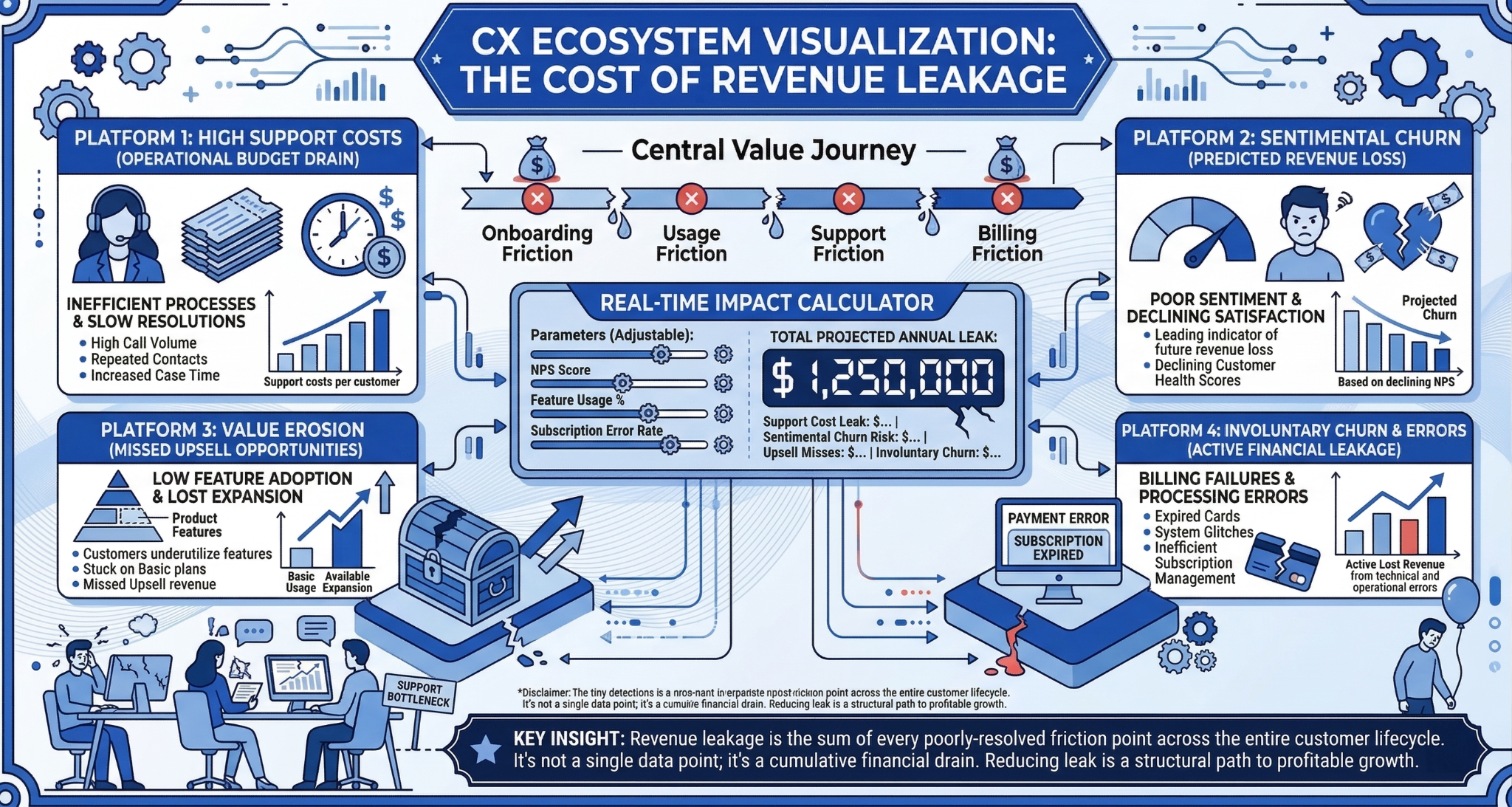
Most teams still think of CX as a support or satisfaction function. But in reality, your CX system directly impacts revenue.
A revenue leak is any instance where earned or potential revenue is lost due to experience failures.
You might be losing revenue through:
What makes this more critical is that these issues are often interconnected.
Friction in one part of the journey creates hesitation, delays, or frustration, which eventually translate into:
Your metrics can show you what leaked.
Only RCA can show you why it leaked.
Revenue leaks rarely appear as large, obvious failures. Instead, they show up as small frictions in your customer journey.
These frictions include:
Individually, they may not seem critical. But at scale, they create significant loss.
In many digital businesses, up to 40% of online payments fail on the first attempt, leading to approximately 14% revenue loss if not recovered properly
This is not a one-time issue. It is a recurring pattern.
If you fix one failed transaction, you solve one instance.
If you fix the underlying system issue, you recover revenue across thousands of transactions.
Some of the biggest leaks happen before churn becomes visible.
For example:
These are not always tracked clearly but they directly impact growth.
This is where RCA becomes critical. It changes how you approach problems.
Without RCA, you focus on fixing individual issues. With RCA, you focus on fixing the system causing those issues.
Let’s say you notice high checkout abandonment.
A surface-level fix might focus on improving UX or sending reminders.
But RCA goes deeper:
The problem is not the checkout.
The problem is infrastructure.
You move from fixing transactions to fixing systems. And that’s where scalable revenue recovery happens.
As Peter Drucker once observed:
“What gets measured gets managed but what gets understood gets improved.”
RCA is what turns measurement into understanding.
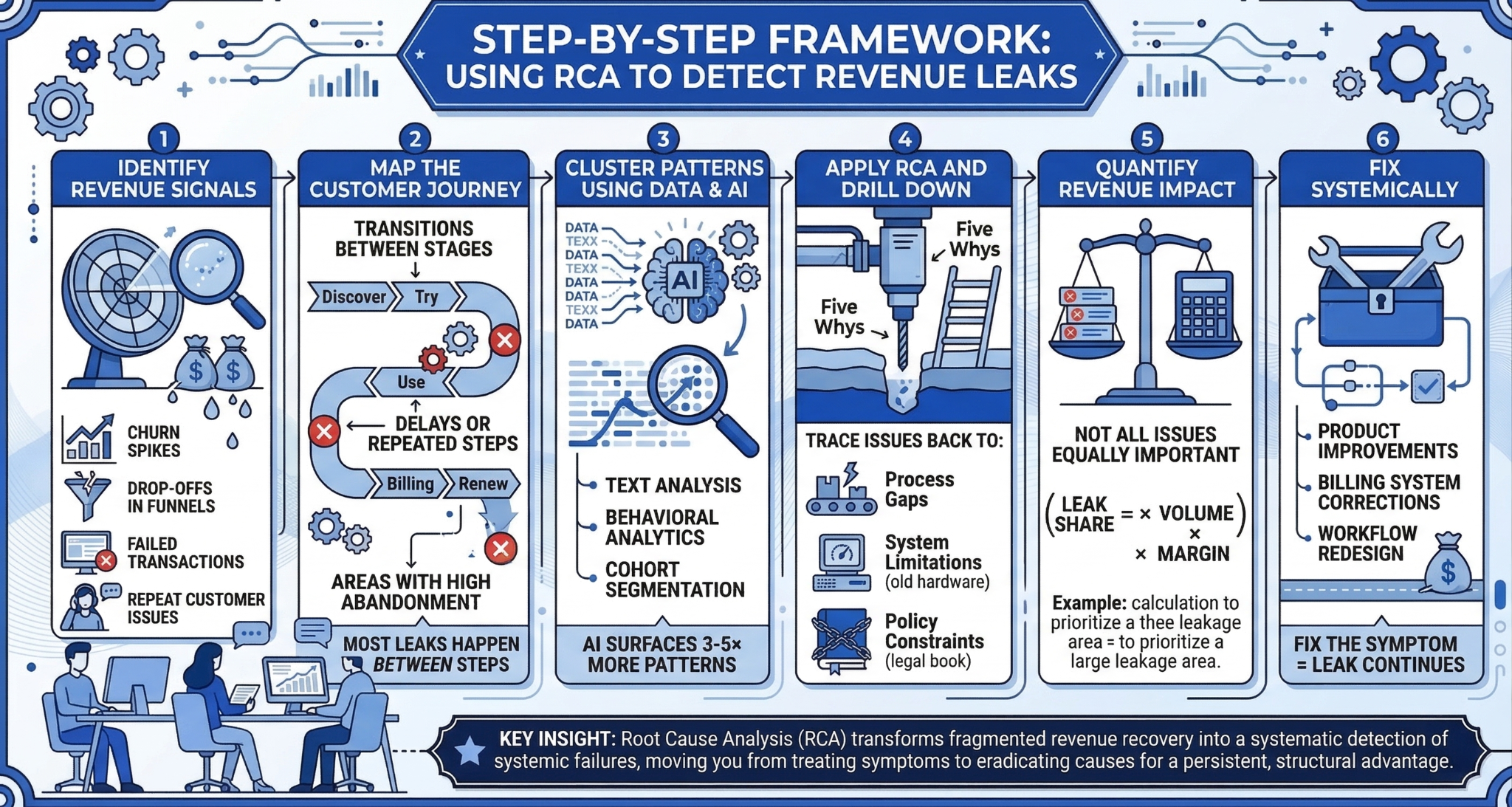
To make RCA actionable, you need a structured approach.
Start by identifying where revenue risk exists.
Look for signals such as:
These signals indicate where revenue may be leaking.
Next, analyze where friction occurs within the journey.
Focus on:
Most leaks happen not within a step but between steps.
At this stage, you need to move from individual events to patterns.
Use:
AI can surface 3–5× more patterns compared to manual analysis, making it easier to detect hidden issues.
Once patterns are identified, apply RCA techniques to uncover root causes.
Trace issues back to:
This is where you move from symptoms to causes.
Not all issues are equally important.
You need to calculate impact using: (leak share × volume × margin)
This helps you prioritize high-value fixes.
Finally, implement fixes that address the root cause.
This could involve:
If you only fix the symptom, the revenue leak continues.
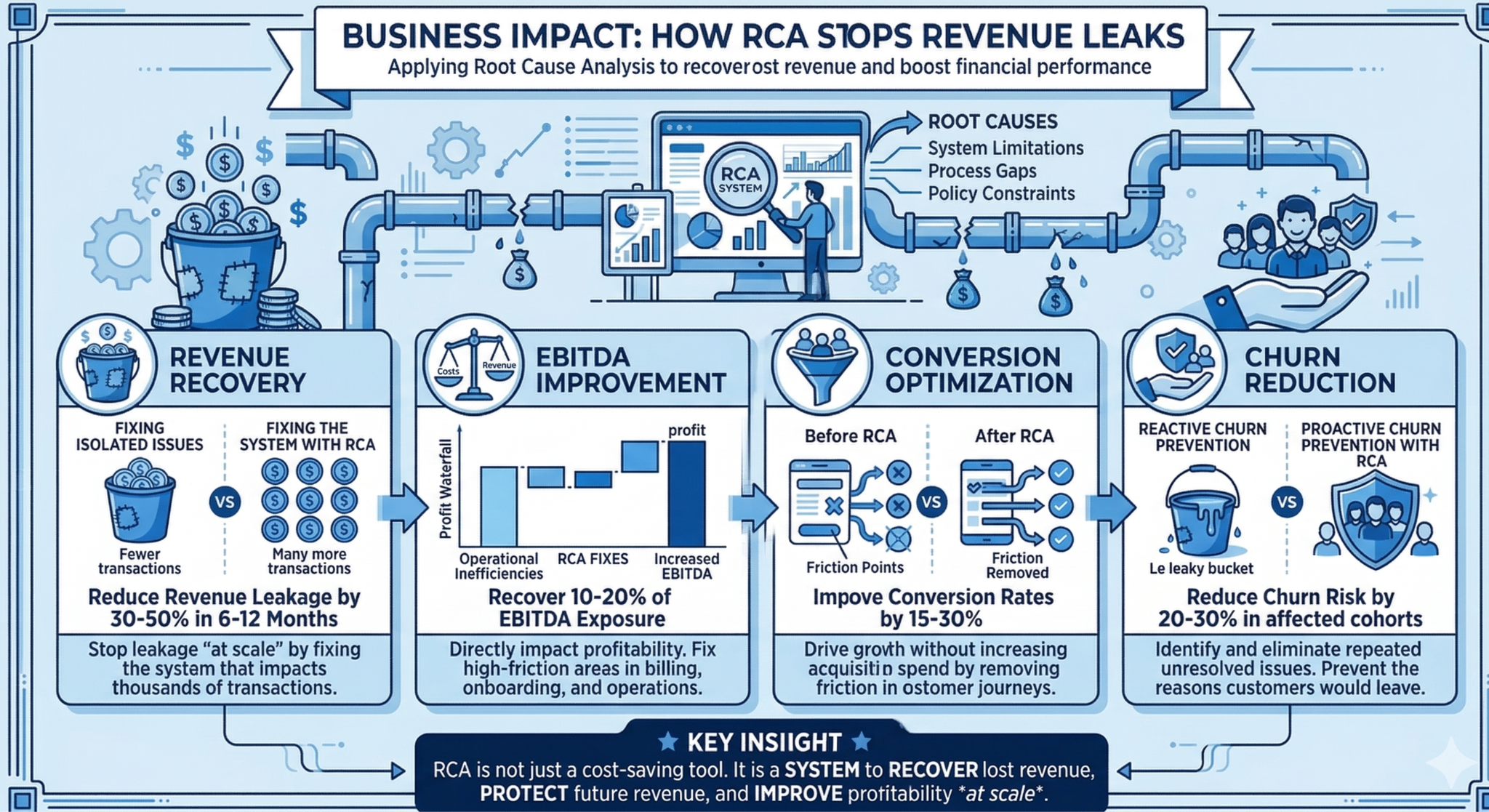
Root Cause Analysis is not just about improving customer experience. When you apply it correctly, it directly impacts your financial performance by identifying and fixing the hidden points where revenue is being lost.
When you start identifying and fixing root causes instead of isolated issues, you stop revenue from leaking at scale.
Organizations that apply RCA effectively can reduce revenue leakage by 30–50% within 6–12 months. This happens because you are no longer fixing one transaction or one customer issue, you are fixing the system that impacts thousands of transactions.
Revenue leaks don’t just affect top-line growth. They directly impact profitability. By identifying and fixing high-friction areas, you can recover 10–20% of EBITDA exposure, especially in environments where inefficiencies are deeply embedded in billing, onboarding, or operational workflows.
This makes RCA not just an experience initiative but a financial one.
A large portion of lost revenue comes from friction in conversion journeys. When you remove these friction points through RCA whether it’s checkout issues, payment failures, or confusing flows you can improve conversion rates by 15–30%.
This growth comes without increasing acquisition spend, making it one of the most efficient ways to drive revenue.
Customer churn is often the result of repeated unresolved issues rather than a single bad experience.
RCA helps you identify these recurring friction points and eliminate them, which can reduce churn risk by 20–30% in affected cohorts.
Instead of reacting after customers leave, you prevent the reasons they would leave in the first place.
RCA is not just a cost-saving tool. It is a system that helps you recover lost revenue, protect future revenue, and improve profitability at scale.
Not all parts of your journey contribute equally to revenue loss.
In many cases, 30–40% of churn cohorts are driven by just 3–5 root causes. This means you don’t need to fix everything.
You need to fix what matters most.
Traditional CX focuses on experience metrics.
But modern CX connects directly to revenue.
Around 40% of CX teams now collaborate directly with finance to map CX issues to revenue impact
This is how CX becomes measurable in financial terms.
AI makes RCA faster and more scalable.
You move from delayed reporting to real-time detection.
You identify issues faster, fix them sooner, and reduce revenue loss.
Most companies focus heavily on growth. They invest in acquisition, expansion, and scaling.
But they ignore where revenue is leaking.
Revenue loss is rarely sudden. It is cumulative. It builds over time through repeated friction and unresolved issues.
RCA connects:
So you can see not just what is happening but why.
Growth comes from acquisition.
Profit comes from eliminating leaks.
Right now, your business is likely tracking revenue, growth, and performance metrics very closely. But the real question is: Do you know where your revenue is quietly leaking?
Because most revenue loss doesn’t come from big failures. It comes from small, repeated experience gaps, failed payments, onboarding friction, unresolved issues, and silent churn.
If you’re only looking at top-line growth, you’re missing what’s happening underneath.
If you want to grow sustainably, you need to stop treating CX as a support function and start treating it as a revenue system.
With Predictive Experience Intelligence (PXI), you can:
This is how you move from reacting to problems → to preventing revenue loss at scale.
You don’t need more data. You need clarity on what’s causing revenue to leak. Every failed experience is not just a CX issue
It’s a financial loss in disguise
See how PXI operates as a system that connects experience signals directly to financial outcomes.
Experience how your CX can move from Signal → Risk → Reason → Alert → Action → ROI
Book a demo to identify hidden revenue leaks, prioritize high-impact fixes, and recover lost revenue faster
Revenue leakage in CX refers to the loss of earned or potential revenue due to gaps or failures in the customer journey.
This can include:
In simple terms, revenue leakage happens when your system fails to capture or retain revenue that should have been generated.
Root Cause Analysis helps you identify the underlying reasons behind revenue loss instead of just addressing surface-level issues.
For example, instead of fixing individual failed payments, RCA helps you understand why those failures are happening such as system limitations, process gaps, or integration issues.
By fixing these root causes, you eliminate revenue leakage at scale rather than resolving isolated incidents.
Revenue leakage is typically caused by recurring friction in key parts of the customer journey, such as:
In many cases, a small number of root causes drive a large portion of revenue loss.
Revenue leakage can be significant, often ranging between 1–5% of EBITDA depending on the industry and business model.
In subscription or usage-based businesses, up to 10–20% of billable usage may go unbilled or delayed, leading to direct revenue loss.
This makes identifying and fixing leaks a critical business priority.
To identify revenue leaks, you need to look beyond traditional metrics and focus on patterns across the customer journey.
Key indicators include:
Revenue leaks are not isolated events; they are patterns that require analysis and correlation.
To effectively detect and manage revenue leakage, you should track:
These metrics help you connect customer experience issues directly to financial impact.
AI helps you scale Root Cause Analysis by processing large volumes of data quickly and accurately.
It enables:
This reduces time-to-detection and helps you act before revenue loss escalates.
Revenue growth focuses on increasing new revenue through acquisition, upselling, or expansion.
Revenue recovery focuses on identifying and reclaiming revenue that is already being lost due to inefficiencies or experience gaps.
Growth adds revenue.
Recovery protects and restores it.
Both are essential but recovery is often overlooked.
Fixing revenue leakage is not just a CX responsibility. It requires cross-functional collaboration between:
Organizations that align CX with finance are better able to measure and prioritize high-impact fixes.
The biggest mistake is treating revenue leakage as isolated operational issues instead of systemic problems.
Many organizations:
Without RCA, leaks continue even after fixes.
Modern CX systems go beyond feedback collection and reporting.
They:
This transforms CX from a support function into a revenue protection system
.png)

.png)
.svg)


