.png)
How Do You Turn Customer Complaints into Business Growth?
Every complaint you receive is not one problem, it represents dozens you haven’t seen yet.
If you want to turn complaints into growth, you need to stop treating them as isolated issues and start treating them as signals. Each complaint carries insight about what is broken in your journey, process, or product. When you connect those signals and act on them systematically, you don’t just resolve problems, you prevent them.
In a modern CX system, this works through a structured loop: Signal → Risk → Reason → Alert → Action → ROI
This is the difference between reacting to customers and learning from them.
If you look at how most organizations handle complaints today, they are treated as operational disruptions.
They come in as tickets, get assigned to support teams, resolved, and closed as quickly as possible. From a process perspective, that feels efficient.
But from a system perspective, nothing actually changes.
When you treat complaints only as issues to resolve, you miss their real value. Because complaints are not just problems.
They are signals. They tell you where your customer journey is breaking, where your processes are failing, and where your product is not meeting expectations.
Every complaint you receive can point to:
The majority of dissatisfied customers never tell you what’s wrong.
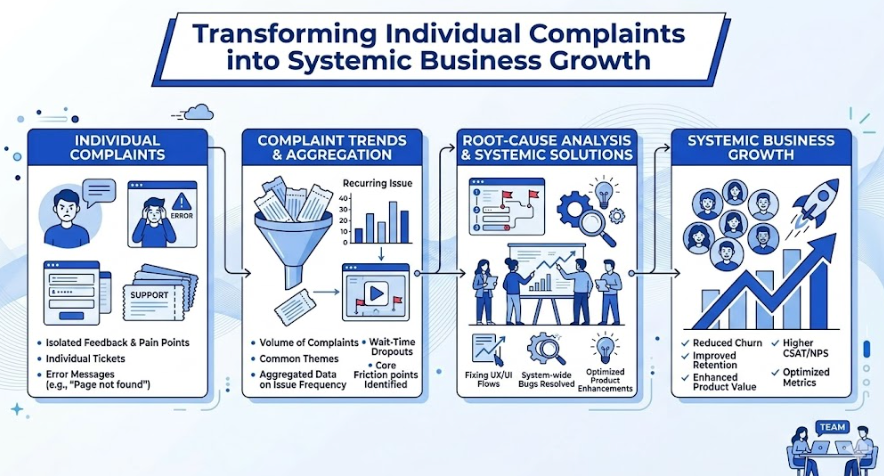
Every complaint you see is just a sample.
Behind it, there are dozens of customers experiencing the same issue silently.
Complaints are not the problem. They are the visibility you have
Many CX teams believe closing the loop simply means responding to the customer.
But that’s only half the system.
Modern CX operates through two interconnected loops.
The inner loop focuses on resolving individual complaints.
It includes:
This operates within hours to days and is critical for retention.
Outer Loop: Fixing the Business
The outer loop operates at a systemic level.
It involves:
This takes longer weeks to months but creates long-term impact.
Inner loop protects relationships. The outer loop drives growth.
Closing the loop is not about response.
It is about transformation.
If you change how you look at complaints, you unlock a completely different level of value.
They see complaints as:
They see:
Customers who have a great experience:
Customers who complain and receive a strong resolution often become more loyal than those who never had an issue.
Complaints are not cost centers
They are growth triggers
As Jeanne Bliss explains:
“Customers don’t expect you to be perfect. They expect you to fix what’s broken and remember it.”
That second part remembering and improving is what most companies miss.

The inner loop is where trust is recovered.
You need to capture complaints across all channels:
The more complete your signal capture, the better your response.
Speed is critical.
Responding within 24–48 hours can significantly increase retention, often delivering around 12% improvement in customer retention rates
Generic responses don’t rebuild trust.
Customers expect:
Make sure the issue is actually resolved.
Confirm satisfaction.
Rebuild confidence.
With strong follow-up and resolution:
15–20% of detractors can become promoters
You can retain up to 80% of at-risk customers when complaints are handled properly
Speed and ownership drive trust recovery.
Most organizations stop at the inner loop.
They resolve tickets and close complaints efficiently.
But the same issues keep coming back.
Because the system itself hasn’t changed.
Fixing customers does not fix the business.
This is where CX becomes a growth driver.
You need to bring together complaints across:
Most complaints cluster into just 3–5 key themes per quarter.
In fact, 60–70% of complaints are driven by systemic issues
You identify:
Not all issues are equal.
You prioritize based on:
You fix:
You track:
One systemic fix can impact thousands of customers.
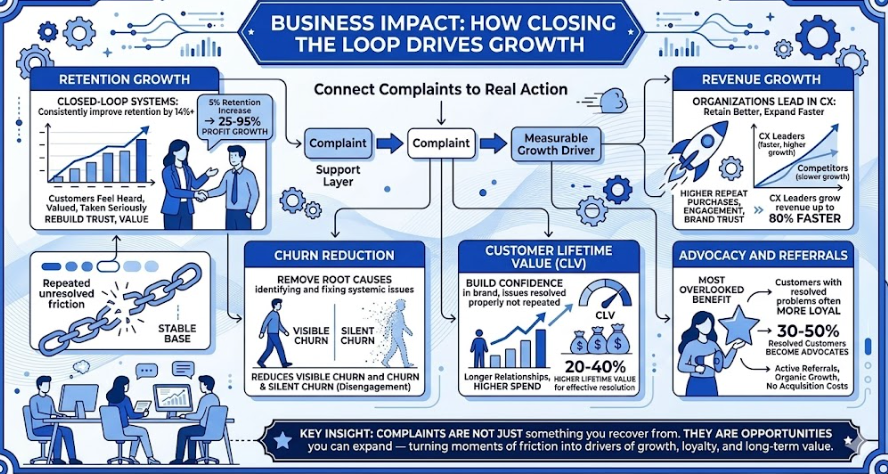
When you start connecting customer complaints to real action, your CX function stops being a support layer and becomes a measurable growth driver. Instead of just resolving issues, you begin influencing retention, revenue, and long-term customer value in a structured way.
When you close the loop effectively, you are not just responding to customers, you are rebuilding trust.
Closed-loop systems consistently improve retention by 14% or more because customers feel heard, valued, and taken seriously. Over time, even a small improvement in retention creates a compounding effect.
In fact, a 5% increase in retention can drive 25–95% profit growth, depending on the business model and industry dynamics. This is why retention is often one of the highest ROI levers in CX.
Customer experience has a direct impact on how fast your business grows.
Organizations that lead in CX don’t just retain customers better they also expand faster. They see higher repeat purchases, better engagement, and stronger brand trust.
As a result, CX leaders can grow revenue up to 80% faster than competitors, simply by reducing friction and improving customer journeys.
Churn is rarely caused by a single bad experience. It is usually the result of repeated, unresolved friction.
When you use closed-loop systems to identify and fix systemic issues, you remove the root causes that drive customers away.
This reduces both visible churn and silent churn, where customers disengage without explicitly complaining, giving you a more stable and predictable customer base.
When customers see that their issues are resolved properly and not repeated they build confidence in your brand.
This leads to stronger engagement, longer relationships, and higher spend over time.
As a result, customers whose problems are resolved effectively tend to have 20–40% higher lifetime value, making every resolved complaint a long-term revenue opportunity.
One of the most overlooked benefits of resolving complaints well is advocacy.
Customers who have a problem and see it resolved effectively often become more loyal than those who never faced an issue at all.
Around 30–50% of resolved customers become advocates, meaning they actively recommend your brand, contribute to referrals, and support organic growth without additional acquisition costs.
Complaints are not just something you recover from.
They are opportunities you can expand turning moments of friction into drivers of growth, loyalty, and long-term value.
Despite the benefits, most organizations struggle to implement this system.
Only 40–50% of CX teams have formal closed-loop systems
There is no connection between feedback and action.
High-performing teams follow a structured system.
Outcome: complaint → insight → action → growth
CX is evolving rapidly.
What’s Changing
You are moving from reacting to complaints → to preventing them.
Complaints will become optional not necessary.
You can look at complaints in two ways.
Complaints are problems to fix.
Complaints are opportunities to improve.
Your CX maturity is not defined by how fast you respond.
It’s defined by how effectively you eliminate problems at scale.
Right now, your team is likely focused on resolving complaints as quickly as possible. Tickets get closed, customers get responses, and operations move forward.
But if the same complaints keep coming back, you’re not improving your CX, you're maintaining it.
And that’s where growth gets limited.
If you want real impact, you need to shift how you use complaints.
With Predictive Experience Intelligence (PXI), you can turn every complaint into a signal that drives system-level improvement.
You can:
This is how complaints stop being operational noise and start becoming strategic inputs.
Your customers don’t expect perfection. They expect improvement.
And if they see the same issue twice, they assume nothing has changed. Every repeated complaint is a missed opportunity to grow.
See how PXI operates as a system that connects complaints directly to business outcomes. Experience how your CX can move from Signal → Risk → Reason → Alert → Action → ROI
Book a demo to turn complaints into insights, insights into action, and action into measurable growth
Closing the loop in CX means not only responding to customer complaints but also using those complaints to improve the overall system.
It includes two key components:
True closed-loop CX ensures that the same issue does not happen again.
Customer complaints provide direct insight into what is not working in your customer journey.
They highlight friction points, process gaps, and product issues that may not be visible through metrics alone.
Since most unhappy customers do not complain, each complaint represents a much larger group of customers experiencing the same issue.
Complaints are early signals of churn, revenue loss, and improvement opportunities.
Closing the loop reduces churn by addressing both immediate and systemic issues.
At the individual level, quick and effective resolution helps retain at-risk customers. At the system level, fixing root causes prevents the same issues from affecting other customers.
This dual approach reduces both visible churn and silent churn, where customers leave without providing feedback.
What is the difference between inner loop and outer loop in CX?
The inner loop focuses on resolving individual customer issues quickly and effectively.
The outer loop focuses on analyzing patterns across multiple complaints and fixing systemic problems.
Both loops are necessary for a complete CX system.
To turn complaints into actionable insights, companies need to:
The goal is to move from individual feedback to scalable improvements.
A well-implemented closed-loop CX system delivers measurable business outcomes, including:
It also improves operational efficiency by reducing repeated issues and support load.
Speed is critical in complaint handling.
Responding within 24–48 hours significantly increases the chances of retaining at-risk customers and rebuilding trust.
However, speed alone is not enough. The response must also be personalized, empathetic, and solution-focused.
Fast + meaningful response drives the best outcomes.
RCA is a key part of the outer loop.
It helps identify why complaints are occurring repeatedly by analyzing underlying system issues.
Without RCA, companies only fix symptoms. With RCA, they eliminate root causes and prevent future problems. RCA turns complaints into long-term improvements.
AI helps scale and accelerate complaint analysis.
It enables companies to:
This allows teams to act faster and more accurately, improving both inner-loop and outer-loop performance.
The biggest mistake is treating complaints as isolated issues rather than systemic signals.
Many companies focus only on resolving individual tickets without analyzing patterns or fixing root causes. This leads to repeated problems, higher costs, and missed growth opportunities.
Modern CX systems connect feedback directly to action and outcomes.
They:
This transforms CX from a support function into a growth engine.
.png)

.png)
.svg)


